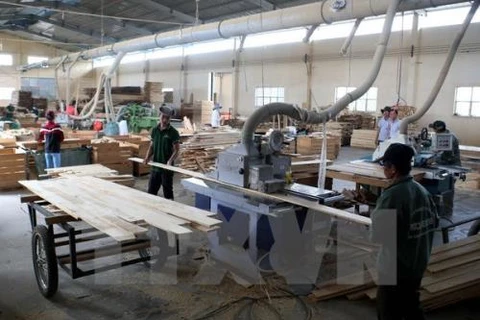
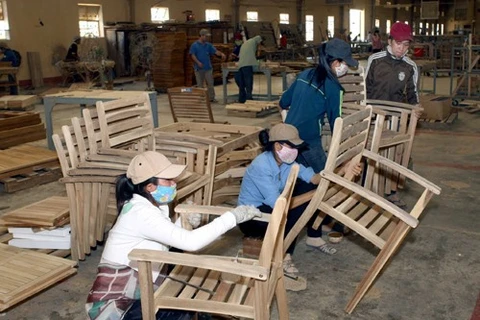
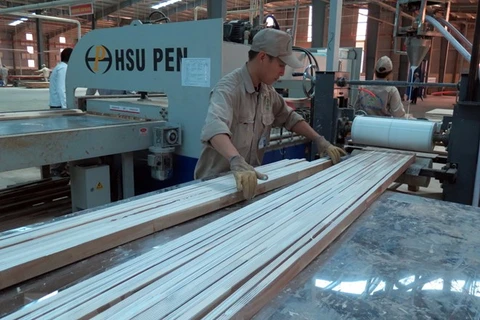
Producing wooden furniture for export (Photo: VNA)
 Hanoi (VNA) – A conference seeking solutions to boost rapid and sustainable growth of the wood and forestry processing and export industries will be held in Ho Chi Minh City on August 8.
Over the past years, the wood processing and export industries have expanded significantly, making Vietnam the fifth largest wood exporter in the world, the second in Asia and the biggest in Southeast Asia.
In the 2013-2017 period, wood exports grew 10.6 percent per year with average revenue of 6.6 billion USD per year, becoming a major product in agro-forestry-fisheries group. Exports of wooden products and processed wood expanded 11 percent per year with average revenue of 4.7 billion USD per year.
According to the Vietnam Administration of Forestry under the Ministry of Agriculture and Rural Development, in the first seven months of 2018, forestry products’ export value increased 14 percent year on year to 5.025 billion USD, 56 percent of the yearly target and 22.6 percent of total export revenue of the agricultural sector.
Trade surplus of wood and wooden products in the period hit 3.52 billion USD. Wood imports in the first seven months hit 1.24 billion USD, up 0.4 percent year on year.
At the same time, export markets of Vietnamese forestry products have changed significantly. Instead of shipping the products to Asian countries such as China’s Taiwan, Singapore and the Republic of Korea for export on to a third country, Vietnam now directly exports products to 120 countries and territories. The US, China, Japan and the Republic of Korea combined consumed 78.5 percent of products.
Growth was also seen in the Malaysian, French and Australian markets.
Recently, Vietnam has exported machinery for wood processing rather than importing it as three years ago. At the same time, the wood and wooden furniture sector of Vietnam has improved in terms of quality and quantity.
Experts forecast that the domestic wood market will continue to rise for the rest of the year due to consumers’ habit, while orders are often finished at the end of the year, bringing bright prospects for the industry for the whole year.
The US’s application of high taxes on Chinese wooden products is also an opportunity for Vietnamese firms.
In the upcoming conference, representative of more than 500 wood processing enterprises, State agencies as well as domestic and international organisations will work together to find solutions to problems and plan for the development of the sector.
At the event, the Ministry of Industry and Trade will put forth measures to boost wood processing and export sector, with a focus on expanding markets and increasing trade promotion to take advantage of free trade agreements. The ministry will suggest solutions to ensure materials for the industry.
Particularly, amidst stricter regulations of importing countries on the legacy of wood origin, the ministry will continue tightening the management over imported wood, ensuring the implementation of Vietnam’s international commitments.
Measures to foster links between businesses and forest planters in major material regions for more stable material supply will also be discussed.
Meanwhile, the ministry will give recommendations to enterprises on activities to cooperate with each other to form production chains, strengthen the application of advanced technology to reduce cost, optimise advantages from free trade agreements with major markets and seek new promising ones.-VNA
VNA