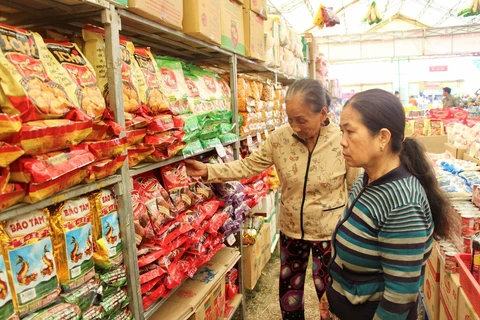
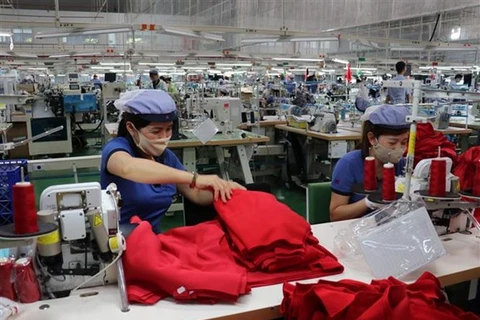
More than 56,200 enterprises were forced to stop operation in the first six months, up 10 percent year-on-year.(Photo tuoitre.vn)
 Hanoi (VNS/VNA) - The COVID-19 pandemic is not only a big test for enterprise resilience but also an opportunity for businesses to re-evaluate their long-term strategy and urgency of sustainable development.
Industry insiders and experts shared their opinions at a dialogue with the press on the topic “Sustainable business development, lessons learned from the COVID-19 pandemic”, held by the Vietnam Business Council for Sustainable Development (VBCSD) on July 15 in Hanoi.
Experts said the pandemic has revealed the shortcomings in governance of Vietnamese enterprises, including risk management, crisis management and adaptation. This is considered one of the main reasons for the collapse of many local enterprises since the outbreak of the disease.
According to data from the General Statistics Office (GSO), more than 56,200 enterprises were forced to stop operation in the first six months, up 10 percent year-on-year, of which the number of companies registering to temporarily cease operations rose 38.2 percent.
Pham Hoang Hai, head of VBCSD’s Secretariat, said applying corporate sustainability index (CSI) will help businesses improve competitiveness, increase resilience and quickly recover in all scenarios.
“The set of corporate sustainability index has equipped enterprises with a tool to be able to cope with the economic impacts,” Hai said.
He highlighted the correlation between the implementation of the sustainable governance practices, information transparency and social and environmental responsibility with the business results of enterprises.
“Corporate sustainability practitioners always achieve better business results and higher labour productivity.”
Pham Thi Thanh Xuan, representative of the Vietnam Leather, Footwear and Handbag Association, said this index is an effective tool to help companies detect weaknesses and shortcomings during operation, thereby contributing to promoting sustainable development.
The COVID-19 pandemic had far-reaching effects on Vietnam's economy, including the leather industry, Xuan said, adding in the first six months, the industry’s exports dropped remarkably, especially by 3.6 percent in May alone. Enterprises have had to reduce labour and employment.
"The association has been closely accompanying enterprises to overcome difficulties and limit impacts on workers' jobs," she said.
Representative of Nestle Vietnam Co. Ltd., Le Thi Hoai Thuong said the COVID-19 pandemic had a profound impact on the production and development of the business and the SCI is a measure which helps Nestle know what the company needed to do to overcome difficulties.
“At the beginning of the pandemic, based on internal assessments, the company immediately devised a strategy to help overcome the storm. That campaign gives priority to the health of our employees,” she said.
Bui Thi Thu Trang, representative of Deloitte Vietnam, said many businesses do not have adequate understanding about corporate governance when they care more about how to ensure the growth and revenue for businesses.
To achieve good governance, companies must ensure three factors including capital management, crisis management and risk management, but domestic enterprises have yet to pay adequate attention to the two latter elements.
In the current context, especially after the COVID-19 pandemic, Trang suggested businesses proactively digitalise their operations, as this not only helps improve the governance efficiency but also cushion businesses from external shocks.
Nguyen Quang Vinh, Secretary General of the Vietnam Chamber of Commerce and Industry (VCCI), highlighted that applying the sustainability index will help Vietnamese businesses attract investors more effectively, especially as the country is deeply integrating into the world economy.
According to the UN Global Compact Progress Report 2019, businesses are increasingly committed to greater transparency in disclosing information about sustainable development activities.
From 2000 to date, nearly 65,000 sustainability reports have been delivered. Currently, more than 30 countries have adopted a mandatory sustainability reporting law.
According to Hai, the CSI Index has been updated with many new points to suit the requirements from the important free trade agreements that Vietnam has recently signed, as well as important changes in labour and environmental management policies, especially the 17 sustainable development goals specified in the national action plan for the implementation of the 2030 Agenda for Sustainable Development./.
VNA