Countries commit to working together to stabilise oil prices

The 12 th Ministerial-level International Energy Forum (IEF) concluded in Cancun, Mexico, on March 31 after adopting a joint declaration committing member countries to step up dialogue and cooperation in order to stabilise the world energy market.
The 12 th Ministerial-level International Energy Forum (IEF) concluded inCancun, Mexico, on March 31 after adopting a joint declaration committing membercountries to step up dialogue and cooperation in order to stabilise the worldenergy market.

The joint declaration highlighted the need for compilingan IEF Charter, maintaining the principle of neutrality, holding open and franktalks and not to encroach upon the operations of either the International EnergyAgency (IEA) or the Organisation of Petroleum Exporting Countries (OPEC).

The IEF delegates discussed ways of researching and using alternativeenergies to stabilise the oil price and protect the environment.

Speaking at a joint press conference, the Mexican Minister of EnergyGeorgina Kessel Martinez called upon all countries to pay more attention totransparency and the necessary liquidity of the energy market, which willstrongly affect future investment flows in every country in the world.

According to OPEC’s General Secretary Abdullah Al-Badri, speculating andthe irresponsible behaviour by several oil consuming countries in announcingdata on their national oil reserves are two of the reasons which have led tofluctuating oil prices.

He also supported the IEF’s proposal toestablish a joint oil database system by collecting the annual data of theworld’s 30 largest oil producers and consumers.

Established 20 yearsago, the IEF, which is the world’s largest gathering of energy ministers is heldevery two years and includes OPEC and IEA member’s countries and newly emergingeconomies such as Brazil , China and India .

This year’s conferenceattracted more than 300 delegates from 66 member countries and representativesfrom 16 international organisations and 38 of the world’s leading groups./.
See more

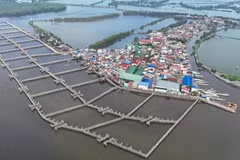
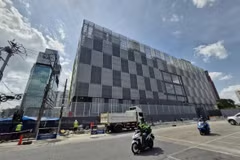
ST Telemedia Global Data Centres (Thailand), an affiliate of Singapore Telecom, is developing three data cehtres in Thailand including this facility on Rama IX Road in Bangkok. (Photo: bangkokpost)

Thailand tightens regulations on data centres

The new rules focus on controlling investment scale, electricity and water consumption, environmental impacts, and preventing investors from reserving resource quotas beyond their actual needs.

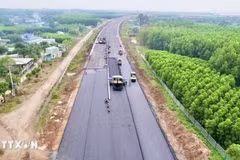
A road is under construction in Dong Nai city, Vietnam. (Photo: VNA)

ADB: Southeast Asia needs 7.1 trillion USD in infrastructure investment by 2040

ADB estimates that the region will need an average of 476 billion USD in infrastructure investment annually during 2026–2040, equivalent to 8.7% of GDP. However, at current investment levels, government budget resources would cover only around 45% of this demand, leaving an annual financing gap of 264 billion USD.

Kyodo News publishes an article titled “Sculptures by Japanese, Vietnamese artists on display in Yokohama,” (Screenshot photo)

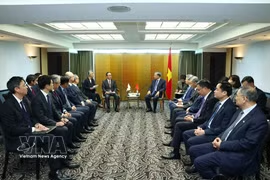
Japanese media widely cover top Vietnamese leader ’s visit

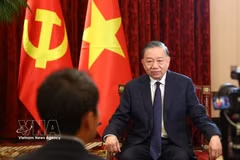
Japanese media have continued extensive coverage of General Secretary of the Communist Party of Vietnam (CPV) Central Committee and President To Lam’s activities in Japan, highlighting his meetings with representatives of leading financial institutions at the Tokyo Stock Exchange, witnessing of cooperation agreement signing and participation in cultural exchanges.

Thailand pushes for establishment of ASEAN emergency public health centre

Thailand pushes for establishment of ASEAN emergency public health centre

The draft agreement stipulates that ACPHEED will comprise three specialised centres based in three ASEAN member states. Vietnam will oversee the centre for prevention and preparedness; Indonesia will host the centre for detection and risk assessment; and Thailand will be responsible for the centre for response and risk communication.

Indonesia designates 31 mln ha of waters as conservation areas

Indonesia designates 31 mln ha of waters as conservation areas

Head of the Convention and Marine Resource Balance working team at the ministry’s Directorate of Ecosystem Conservation Ahmad Sofiullah said this week that it is a strategic effort to ensure the sustainability of Indonesia’s marine ecosystems.

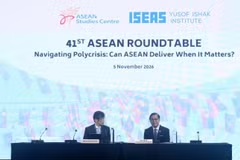
Thai Deputy Prime Minister and Minister of Foreign Affairs Sihasak Phuangketkeow (R) takes part in the Q&A session at the 41st ASEAN Roundtable. (Photo: VNA)

Thailand calls on ASEAN to proactively address polycrisis

Thai Deputy Prime Minister and Minister of Foreign Affairs Sihasak Phuangketkeow noted that no single member state could tackle challenges ranging from major-power competition and economic fragmentation to climate change and energy and food security on its own. Regional cooperation is therefore a strategic imperative, enabling ASEAN not only to overcome crises but also to sustain its development momentum.

Palm oil and palm oil-based products are among Indonesia’s promising export commodities. (Photo: VNA)

Indonesia to launch commodity export monitoring platform next year

DSI will draw on data from customs authorities, trade activities and the financial system, alongside contracts and documents uploaded by exporting companies. The platform will monitor the volume, quality, prices and destination markets of various commodities, as well as transactions between related parties.