Credit institutions expect improved business performance in Q2

Nearly 60 percent of credit institutions forecast their business performance results to improve in Q2 after estimating those in Q1 to be not as good as expected, the latest survey by the State Bank of Vietnam (SBV) showed.
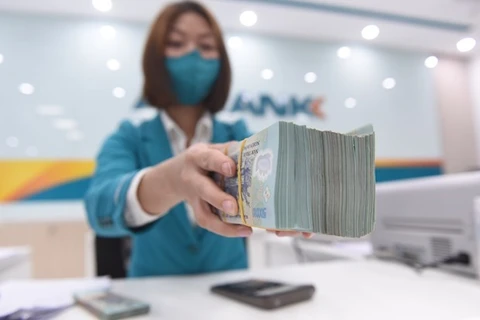
Credit institutions expect improved business performance in Q2 ảnh 1A customer makes a deposit at a Vietcombank's office. (Photo: VNA)
Hanoi (VNA) - Nearly 60 percent of credit institutions forecast theirbusiness performance results to improve in Q2 after estimating those in Q1 tobe not as good as expected, the latest survey by the State Bank of Vietnam(SBV) showed.

According to the SBV survey on business trends of credit institutions in thesecond quarter of 2022 released late last week, many credit institutions saidthat though their business performances in Q1 grew, they did not meetexpectations due to the impact of the Tet (Lunar New Year) Holiday. They expectperformance to be better in Q2.

Under the latest survey, credit institutions revised their expectations forprofit growth in 2022 compared to the previous survey.

Accordingly, nearly 90 percent of credit institutions forecast a positivegrowth in pre-tax profit in 2022 compared to 2021, down 5 percentage pointsfrom the previous survey.

A further 6 percent of credit institutions forecast a decline in their profitsthis year, while 5 percent expect their profits to be unchanged.

Credit institutions estimated the bad debt in the banking system inched down inQ1, and they expect the indicator to continually decline in the upcomingquarters.

After estimating a 2.6 percent rise in capital mobilisation in Q1, creditinstitutions expect the banking industry to gain an average deposit growth of3.6 percent in Q2 and 11.4 percent for the whole year. Compared to the previoussurvey period, this year's expected deposit growth decreased by 0.7 percentagepoints.

Credit institutions estimated the credit of the banking system rose by 5.3 percentin Q1, much higher than the growth rate of 2.95 percent in the same period in2021.

They expect the indicator to increase by 4.8 percent in Q2 and reach 14.1 percentfor the whole year, unchanged from the previous survey.

Credit institutions said the banking system's liquidity in Q1 remained strongbut was not as abundant as in Q4 2021 due to the high capital demand forpayments during the Lunar New Year.

Credit institutions expect liquidity to improve in Q2 2022 and the whole year,compared to 2021.

Credit institutions forecast both deposit and lending interest rates wouldremain unchanged or inch up by only 0.03-0.06 percentage points in April-June,and 0.13-0.18 percentage points for the whole year. The increase will mainlycome from deposit interest rates.

Credit growth in Q1 2022 hits high level

Credit growth of credit institutions was quite positive at 5.04 percent at theend of the first quarter of this year, much higher than the 2.16 percent risein the same period last year, SBV Deputy Governor Dao Minh Tu said at theGovernment’s regular press conference in March.

According to Tu, the surge showed the economy has positive signs and the dailylife, production and business of people and firms have also returned to normalthanks to the Government's effective measures against the pandemic.

''The increase is very high compared to previous years. At the end of the year,we will consider to adjust the credit growth to ensure it meets targets ofmacro-monetary policies and inflation control," Tu said.

According to Tu, the credit growth target in 2022 that the SBV set at thebeginning of this year was 14 percent. However, the target can be adjusted upor down at the end of the year, depending on the actual situation.

Regarding bad debts, Tu reported after five years of implementing Resolution42/2017/QH14, the bad debt settlement of credit institutions has achievedpositive results. Accordingly, from August 15, 2017 to November 30, 2021, 380trillion VND of bad debt was recovered according to Resolution 42. On average,some 5.66 trillion VND of bad debt was handled each month during theapplication of Resolution 42, against about 2.14 trillion VND previously.

However, the outbreak of the COVID-19 pandemic has negatively affected thecredit quality of the credit institution system. Bad debts have been increasingsince 2020 and reached more than 2 percent by the end of November 2021. Manyhave warned bad debt will continue to rise again due to the pandemic’s impacts.

Meanwhile, Resolution 42 on piloting the bad debt settlement of creditinstitutions will expire this year. The SBV, therefore, has proposed tolegislate the policies specified in Resolution 42 into a new law to continuallyenable the banking industry to settle bad debts of credit institutions. Theissuance of a new law on bad debt handling will help credit institutionsmaintain and accelerate the handling of bad debts to avoid potential risks forthe economy according to Tu./.
VNA

See more

A company in Da Nang operates a customer relationship management system supported by AI chatbots. (Photo: VNA)

AI drives rise of sleepless enterprises in Vietnam

The concept of a sleepless enterprise does not necessarily mean making employees stay on the job all the time. Instead, it's about building intelligent systems that can respond to customers, process transactions, monitor operations, analyse data and flag risks continuously.

Head of the Vietnam Trade Office in Australia Tran Thi Thanh My (Photo: VNA)

Vietnam, Australia eye 20 bln USD trade target

The head of the Vietnam Trade Office in Australia hoped that the visit by Party General Secretary and State President To Lam will mark a new milestone, opening the door for firms on both sides to forge stronger links and launch concrete cooperation agendas, helping hit that 20 billion USD trade goal sooner rather than later.

Phu Quoc pepper products, granted three stars under the OCOP programme in An Giang province, are displayed at an exhibition of outstanding OCOP products from the Mekong Delta. (Photo: VNA)

Phu Quoc leverages OCOP programme to take local specialities global

Better known as one of Vietnam’s premier island destinations, Phu Quoc is leveraging its “One Commune, One Product” (OCOP) programme to transform traditional specialities into internationally recognised products, integrating local agriculture, food processing and tourism to promote sustainable economic growth.

Production at an FDI enterprise in Tay Ninh province. (Photo: VNA)

FTA Index 2025 to be unveiled later this month

The index is designed to provide valuable information not only for State management agencies but also as an important reference for businesses, foreign investors, and industry associations in planning investment and business activities in Vietnam.

Air Premia, a carrier of the Republic of Korea, will resume flights between Incheon and Ho Chi Minh City from November 5. (Photo: The Courtesy of Air Premia)

Air Premia to resume Incheon–Ho Chi Minh City route from November

Flights will depart Incheon International Airport at 6:40 pm (RoK time) and arrive at Tan Son Nhat International Airport in Ho Chi Minh City at 11 pm (Vietnam time). Return flights will leave Ho Chi Minh City at 12:30 am on Mondays, Tuesdays, Thursdays, Fridays and Sundays, landing in Incheon at 7:40 am.

Production at Viet Hai High-Tech Structure Production Company Limited in Vung Ang Economic Zone. Ha Tinh province aims to develop Vung Ang Economic Zone into a regional centre for industry, energy, seaports and logistics (Photo: VNA)

Revised master plan of Vung Ang EZ approved

The adjustment aims to create a more rational development framework to maximise the zone’s potential and advantages while providing a legal foundation for construction management and ensuring sustainable development.

Illustrative image (Photo: VNA)

Vietnam looks to domestic market to sustain wood industry growth

Vietnam’s wood sector has long been a top foreign-currency earner. Exports of wood and wooden products neared 17.3 billion USD in 2025, reaching more than 160 countries and territories and clearing the high bars set by the US, the European Union and Japan.

Delegates at the event (Photo: VNA)

Vietnam remains key market for Polish food producers

The campaign promotes selected European Union agricultural and food products, including fresh, chilled and frozen beef and pork, fresh apples, apple juice and dried apples, targeting consumers, importers, distributors, retailers and the hospitality sector.

Wei Xiaoli, a representative of Shandong Jindafeng Machinery Co., Ltd., in an interview granted to the Vietnam News Agency. (Photo: VNA)

Chinese firms see strong potential for agricultural mechanisation cooperation with Vietnam

Business representatives said mechanisation not only helps reduce reliance on manual labour but also improves production efficiency, shortens planting and harvesting times, reduces post-harvest losses and enhances the quality of agricultural products. For rice-producing countries like Vietnam, they noted, accelerating mechanisation is an inevitable trend to strengthen the competitiveness of the agricultural sector.

Community-led fisheries groups have become frontline defenders of coastal fisheries. (Photo: VNA)

Community-led fisheries groups strengthen IUU fight in Ha Tinh

With a long coastline and abundant inshore fishing grounds, Ha Tinh has long identified the marine economy as a key growth driver. However, growing fishing pressure and destructive practices have posed major management challenges. Community-led self-management initiatives are now providing an effective solution.

At the VIFC-HCMC (Photo: VNA)

700 bln USD for net zero: Vietnam bets on VIFC

Assoc. Prof. Dr. Nguyen Huu Huan, Vice Chairman of the Executive Board of VIFC-HCMC, said the VIFC will focus on building market infrastructure needed to bridge the gap between big investment pledges and bankable projects.