Customs sector focuses on CPTPP implementation

Vietnam’s customs sector will help businesses carry out procedures while implementing the Comprehensive and Progressive Agreement for Trans-Pacific Partnership (CPTPP), said Deputy General Director of the General Department of Vietnam Customs Nguyen Duong Thai.
Customs sector focuses on CPTPP implementation ảnh 1Customs officials in the northern city of Hai Phong (Photo: VNA)

Hanoi (VNA) - Vietnam’s customs sector willhelp businesses carry out procedures while implementingthe Comprehensive and Progressive Agreement for Trans-Pacific Partnership(CPTPP), said Deputy General Director of the General Department of VietnamCustoms Nguyen Duong Thai.

Speaking at a workshop in Ho Chi Minh City on May 28, Thaisaid the customs sector would reform administrative procedures, modernisecustoms, improve the business environment and enhance national competitiveness.

Thai said the Ministry of Finance had recently submitted tothe Government a draft decree on preferential export tariffs and specialpreferential import tariffs under the CPTPP agreement for 2019-2022.

The General Department of Vietnam Customs is also finalisingamendments and supplements to Circular 38/2018/TT-BTC on inspection andidentification of goods origin, which is expected to be completed in June andwill be submitted to the Ministry of Finance for approval, he added.

Thai said there are some notable issues brought by the deal,including the fact CPTPP members committed to eliminating 97 percent to100 percent of tariff lines for goods imported from Vietnam.

In contrast, Vietnam also pledged to eliminate tariffs on86.5 percent of tariff lines on imported goods from member countries withinthree years, but still maintains tariff quotas on some items such as sugar,eggs, salt and used cars, Thai said.

He said the CPTPP inherited its advanced rules of origin andorigin procedure from the Trans-Pacific Partnership, encouraging theintegration of member countries and aiming to form a complete supply chain.

Meanwhile, Thai said the procedure for certification oforigin would be simplified, as the deal allows the origin of goods to becertified by manufacturers, exporter or importers.

Traditionally, the certificate of origin must be issued bythe competent authority of the exporting country or the manufacturing country, Thaisaid.

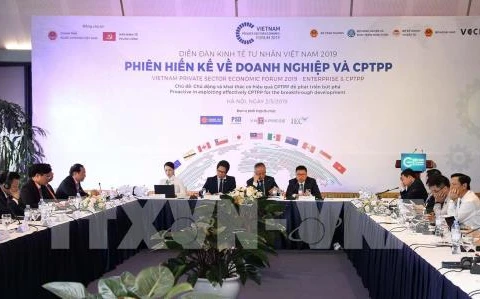
At the workshop, experts discussed tax policies and customsprocedures as well as rules of origin of goods in the CPTPP.

Director of the Ministry of Finance’s InternationalCooperation Department Vu Nhu Thang said that when Vietnam joins the CPTPP, itsexports to the member countries would enjoy import tax incentives.

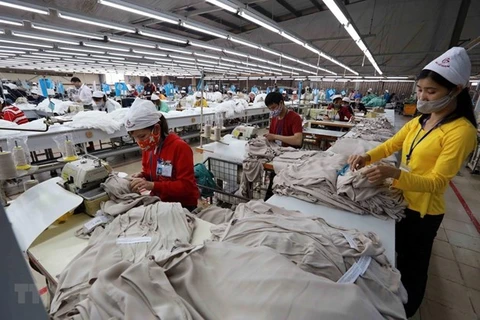
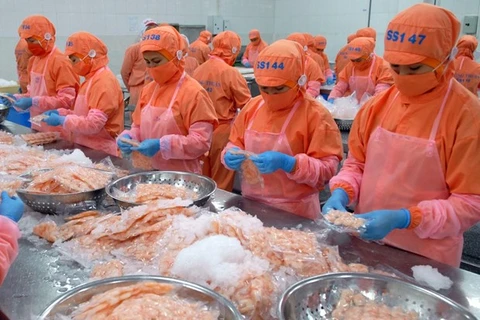
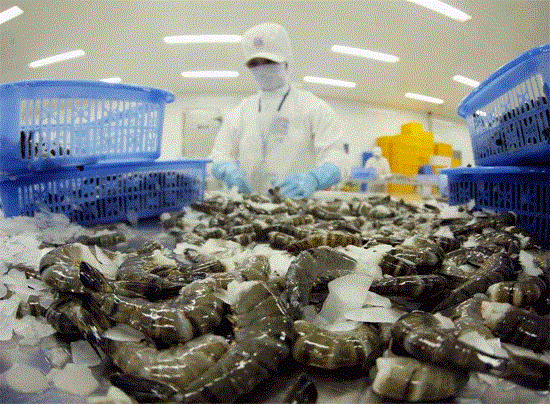
This is a good condition for Vietnamese enterprises toaccess new markets, especially its advantageous products such as seafood,textiles, footwear and agricultural products, Thang said, adding that however,opportunities also come with challenges as businesses have to compete withgoods of importing countries in Vietnam.

Tran Van Cong, Deputy Director of the Ministry ofAgriculture and Rural Development’s Agro Processing and Market DevelopmentAuthority, said Vietnam needed to step up the building of a national standardand regulation system, trademarks and national brands.

Authorities need to have a plan for the cuts of import andexport taxes of members in the CPTPP for Vietnamese goods so that enterprisescould have timely response plans, Cong said.

The CPTPP agreement gathers 11 member countries, namelyAustralia, Brunei, Canada, Chile, Japan, Malaysia, Mexico, New Zealand, Peru,Singapore and Vietnam.

The deal took effect from December 30, 2018, while Vietnamratified the agreement on January 14, 2019.

Under the trade pact, Vietnam’s GDP is expected to increaseby 1.32 percent annually, while export turnover may increase 4.04 percent andimport turnover by 3.8 percent.-VNA
VNA
See more

Ben Thanh Market in Ho Chi Minh City attracts a large numbers of domestic and international visitor.( Photo: VNA)

Vietnam targets 50 million international visitors by 2030

The Ministry of Culture, Sports and Tourism has outlined three scenarios for 2027–2030. Under the high-growth scenario, international arrivals would rise 15–18 percent annually to reach 45–50 million, while domestic tourism would reach around 160 million trips. Total tourism revenue is projected at 80–90 billion USD.

Factories and production facilities in the Chu Lai Open Economic Zone, Da Nang city, are equipped with modern production lines. (Photo: VNA)

Ready-built factories gain from new manufacturing FDI wave

Ready-built factories attracted 73% of new manufacturing FDI in northern Vietnam over the past two quarters, as foreign investment continued to surge at the region's industrial hubs during the first eight months of 2026. The trend points to growing demand for premises that can be put into operation quickly.

Vietnamese durian industry pivots from volume to value

Vietnamese durian industry pivots from volume to value

Durian has morphed from a high-value crop into a strategic Vietnamese export. But as output climbs and importing markets tighten rules on quality, food safety and traceability, the industry must pivot from volume growth to sustainable value chains, better quality and diversified markets.

A display area for Mid-Autumn Festival cakes at a supermarket (Photo: VNA)

Mid-Autumn Festival cake market heats up at affordable end

Industry insiders say competition is no longer just about the cake itself. Product quality, packaging, brand reputation, delivery services and personalisation are increasingly shaping consumer choices in a market crowded with both domestic and foreign players.

Minister of Foreign Affairs Le Hoai Trung (Photo published by VNA)

Vietnam, India set 25 billion USD trade goal

Vietnam and India agreed to make better use of complementary strengths, ease market access difficulties and facilitate business activities toward achieving the 25 billion USD bilateral trade target.

Delegates at the meeting between Vietnamese businesses operating in Cambodia and the Council for the Development of Cambodia (CDC) on September 14. (Photo: VNA)

Vietnamese businesses seek to expand investment in Cambodia

Vietnam currently has 223 investment projects in Cambodia with total registered capital of nearly 3.4 billion USD. Vietnamese companies operate in agriculture, particularly large-scale farming, finance and banking, telecommunications, aviation, processing, trade and services.

Children visit President Ho Chi Minh's hometown and learn about his childhood. (Photo: VNA)

Vietnam's tourism sector faces labour shortage

A 2026 survey by Hoteljob.vn found that nearly 90% of tourism businesses planned to recruit. In Ho Chi Minh City alone, 89.7% of businesses were hiring, while 71.8% said recruitment was difficult or very difficult. The biggest shortages were among frontline workers, particularly in housekeeping, engineering, food service, front-office operations, and kitchens.

Octopus processing for export at Huy Nam Company in An Giang province. (Photo: VNA)

New opportunities for Vietnam’s seafood exports

The Vietnam-EFTA Free Trade Agreement brings together two groups of highly complementary economies. EFTA members Switzerland, Norway, Iceland and Liechtenstein have strengths in technology, innovation, finance, clean energy and sustainable development, while Vietnam is one of Asia’s most dynamic economies and is emerging as a major regional manufacturing, trade and investment hub.