Deep processing needed to raise value of coffee: experts

To increase the value of coffee beans and gain higher economic profits, Vietnam should focus investment in the deep processing industry and in technical production solutions, said experts at an international seminar on sustainable development for the Vietnamese coffee sector.
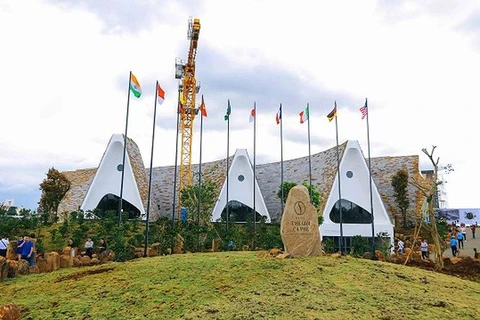
Deep processing needed to raise value of coffee: experts ảnh 1An overview of the international seminar on sustainable development for the Vietnamese coffee sector (Source: VNA)

Dak Nong (VNA) – To increase the value of coffee beans and gainhigher economic profits, Vietnam should focus investment in the deep processingindustry and in technical production solutions, said experts at aninternational seminar on sustainable development for the Vietnamese coffeesector.

Theevent was held on December 10 in Gia Nghia town in the Central Highlandsprovince of Dak Nong, as part of the second Vietnam Coffee Day Festival,which is underway in the locality from December 9-12.

ViceChairman of the provincial People’s Committee Truong Thanh Tung stated that theevent offers a chance for experts, scientists, managers, entrepreneurs, andfarmers to discuss measures to best develop Vietnamese coffee, from production,harvest and preservation to processing and consumption.

Participantsstressed that Vietnam ranks second in the world in terms of coffee productionand export (only behind Brazil), with the output of around 1.7 million tonnes ayear. However, the country’s export value remains low and competitiveness isweak, as it mainly exports coffee beans.

Accordingto the Agro Processing and Market Development Authority under the Ministry ofAgriculture and Rural Development, in recent years, there has been a shift fromreducing the proportion of coffee beans for export to increasing the proportionof processing and exporting instant and ground roasted coffee.

ActingDirector of the authority Nguyen Quoc Toan emphasised the need for Vietnam toraise the proportion of instant and ground roasted coffee from over 10 percentat present to 25 percent by 2020.

Attentionshould be paid to attracting investment in building ground roasted coffeeprocessing plants with the capacity of at least 5,000 tonnes per year, andinstant coffee ones with the capacity of at least 3,000 tonnes per year, Toansaid.

Healso suggested synchronously implementing solutions related to science-technology,dissemination, and market development.

Atthe seminar, many delegates underlined the importance of expanding the domesticmarket.

Deputyhead of the Vietnam Coffee-Cocoa Association Do Ha Nam said that around 200,000tonnes of coffee beans are consumed domestically each year, equal to 11.7percent of total output.

Vietnamis striving for 30 percent of coffee consumed in the domestic market by 2030.It has also set the target of raising export turnover to 6 billion USD over theyear and remaining the world’s second largest producer and exporter of coffeebeans.–VNA
VNA

See more

Viettel launches the Unitel Logistics brand in Laos. (Photo: VNA)

Vietnamese firms expand global footprint

The Government recently approved the “Go Global” programme for 2026-2030, which identifies the private sector as a key driving force in Vietnam’s international expansion process. It aims to help Vietnamese private enterprises strengthen their overseas presence in a comprehensive, effective and sustainable manner through international investment, business activities and deeper integration into regional and global supply and value chains.

Vietnam and Cambodia are seeking to strengthen supply chain connectivity and promote sustainable border trade at a trade promotion conference in Vietnam's Mekong Delta province of Dong Thap on May 15. (Photo: https://thoibaonganhang.vn/)

Vietnam, Cambodia eye stronger border trade, supply chain connectivity

Vietnam–Cambodia trade ties have grown rapidly in recent years, becoming one of the major pillars of economic cooperation in the Mekong sub-region. The two countries share a 1,137-km border and an increasingly developed network of international and secondary border gates, facilitating cross-border trade, logistics and investment.

Illustrative image. (Photo: VNA)

Three proposals to connect overseas Vietnamese resources with private economy at home

There are currently many Vietnamese IT specialists working in technology corporations, banks, start-ups and innovation ecosystems across Canada. With appropriate mechanisms in place, this workforce could become a technology bridge, helping Vietnamese enterprises access management expertise, technical solutions, international standards and partnership networks in North America.

The Nguyen Van Linh–Nguyen Huu Tho intersection fully opens both underpasses to traffic, helping ease congestion in the area. (Photo: VNA)

Ho Chi Minh City pushes for full public investment disbursement

Ho Chi Minh City was allocated a record 147.599 trillion VND (5.6 billion USD) in public investment capital for 2026, up 22.6% from last year and accounting for nearly 14.6% of the nation’s total public investment budget. However, disbursement by the end of April remained below the national average.

Visitors explore Quang Tri province’s OCOP products (Photo: VNA)

Quang Tri links OCOP products with tourism to expand farm produce markets

The central province currently has 160 OCOP products developed by cooperatives, cooperative groups and businesses, including two five-star and 31 four-star products. These locally distinctive products are gradually becoming "ambassadors" showcasing Quang Tri’s culture and identity to domestic and international visitors.

Work starts on Hanoi’s Red River Landscape Boulevard Axis project on December 19, 2025. (Photo: VNA)

Hanoi approves nearly 28-bln-USD Red River landscape boulevard project

Covering more than 11,400 hectares and requiring an estimated 736.96 trillion VND (nearly 28 billion USD), the project is expected to reshape urban development along both banks of the Red River over the coming decades while improving transport connectivity and public spaces in the capital.

Deputy Prime Minister Nguyen Van Thang and delegates perform the ground-breaking ceremony for the Northwest Dien Bien Phu New Urban Area, Resort and Sports Complex project. (Photo: VNA)

Vingroup launches largest-ever urban development project in Dien Bien

Under the master plan, the project will span more than 228.5ha and accommodate around 12,000 residents. It is designed under a “city within a city” model integrating residential areas, commercial and service facilities, resorts, schools, healthcare services, public spaces and sports infrastructure.

Deputy Prime Minister Nguyen Van Thang and delegates press the button to launch construction of the Dien Bien Phu cultural-historical tourism and cable car complex project in Dien Bien province on May 10, 2026. (Photo: VNA)

Dien Bien Phu cultural-historical tourism, cable car complex project launched

The project aims to effectively tap the area’s natural landscapes, geographical advantages and distinctive historical value, while creating a high-quality tourism product with strong competitiveness. It is also intended to preserve, honour and promote the value of the Dien Bien Phu Victory special national historical relic site.

Politburo member Nguyen Duy Ngoc (third, right), who is Standing Deputy Head of the Central Steering Committee for Science-Technology Development, Innovation and Digital Transformation, holds a working session with the Colombo Port City Management Board. (Photo: VNA)

Vietnam studies Colombo smart port city model

Ngoc praised Sri Lanka’s orientations in developing seaport infrastructure, digital infrastructure, digital economy and international service centres, describing them as valuable references for Vietnam in developing strategic infrastructure, innovation centres, smart urban areas and digital economy ecosystems.