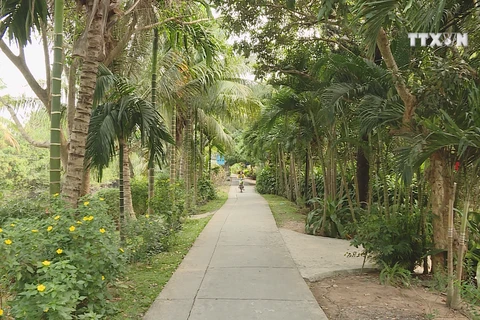
Dich Diep follows the common style of a traditional Vietnamese village in the northern delta that is characterised by temples, pagodas, wells, rivers and banyan trees. (Photo: VietnamPlus)
 Hanoi (VNA) - Dich Diep, an ancient village in Truc Chinh commune, Truc Ninh district, the Red River Delta province of Nam Dinh, is a mirror of the traditional culture of Vietnam.
Dich Diep village was formed at around the beginning of the 11th century under the reign of King Ly Thai To (1010-1028) with the name Dich Diep Trang. Local residents share the pride as the village has kept its name over the past 1,000 years.
Beauty of northern rural area
Dich Diep follows the common style of a traditional Vietnamese village in the northern delta that is characterised by temples, pagodas, wells, rivers and banyan trees.
According to the elderly in the village, the village takes the shape of a boat with its bow being the southern gate and its stern being the western gate. They said visitors to the village will easily get lost as local roads are like a bagua map. Entering the village entrance, visitors will find an ancient and nostalgic world opening up for them, a quiet and peaceful land that is not like bustling towns.
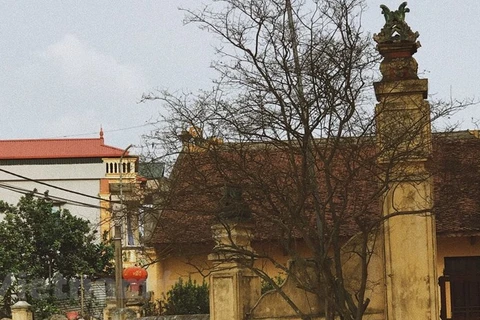
There had been several gates in Dich Diep, which led to other villages. However, only the southern gate, built in 1864, has been maintained.
Since ancient times, a village gate has served as more than just an entrance or exit. Many villages have more than one gates, each facing different directions. Originally, the gates could be made of spiked bamboo to prevent wild beasts from entering. Later, they became part of the general defence against any intruders.
In the flourishing middle Le Dynasty, village gates were built stronger, longer lasting, and more beautifully with materials such as bricks, stones, laterite, and lime mixed with salt and honey or cane sugar. Above each gate there is usually a relief of the village name or slogan which shows the villagers’ aspirations.
 The southern gate of Dich Diep village was built in 1864. (Photo: VietnamPlus)
 Village roads are lined with o ro (acanthaceae) and cuc tan (pluchea indica) plants on both sides, which were often seen in villages in northern Vietnam in the past. Under ancient trees are tile-roofed houses built by wood , with parabolic shape gates.
Vu Thi Cuc and her sister – Vu Thi Quy own one of the oldest houses in Dich Diep.
“Our house was built more than 100 years ago, using ironwood, with a tile roof, three rooms and doors facing the yard and the garden,” Cuc said. “Column patterns as well as desks and chairs are almost intact.”
 One of the oldest houses in Dich Diep village. The 100-year house is owned by Vu Thi Cuc and her sister Vu Thi Quy. (Phto: VietnamPlus)
 Local elderly said villagers in Dich Diep Trang initially engaged in farming and then weaving for their living. In 1947, they made “ao tran thu” (a cotton- padded waistcoat) for soldiers and a silk shirt for President Ho Chi Minh and received applause from the President. Weaving has been passed down from generation to generation in the village.
The village pagoda is named “Co lieu linh tu”. Nobody knows exactly when the pagoda was built. However, its bell has been proven to be made under the reign of King Gia Long in 1818.
800-year-old Bodhi tree
The about 800-year-old Bodhi tree in Dich Diep was recognised as a national heritage tree on April 17.
It is believed that under a Bodhi tree, Siddhārtha Gautama achieved enlightenment (bodhi) after meditating under it for 49 days, hence the name, which literally means the ‘tree of awakening’.
In Vietnam, this type of tree is also known as the Bo Tree. Given its close association with the attainment of Buddhahood, this kind of tree has great symbolic significance and according to legend is the centre of the world and the spot at which all Buddhas’ past and future gain enlightenment. This kind of tree can be found in many Vietnamese villages.
 The 800-year-old Bodhi tree in Dich Diep (Photo: VietnamPlus)
 Local old people believe that the Bodhi tree is a symbol of longevity, strength and good characteristics of villagers./.