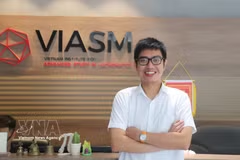
Digital communication technology helps media agencies better perform tasks: VNA General Director

Digital communication technology has become an effective tool for media agencies to provide mainstream news sources in the cyberspace, according to Journalist Vu Viet Trang, General Director of the Vietnam News Agency (VNA).
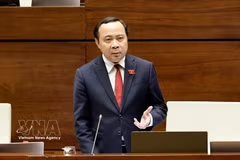
Digital communication technology helps media agencies better perform tasks: VNA General Director ảnh 1General Director of the Vietnam News Agency Vu Viet Trang (Photo: VNA)

Hanoi (VNA) – Digital communication technology has become an effective tool for media agencies to provide mainstream news sources in the cyberspace, according to Journalist Vu Viet Trang, General Director of the Vietnam News Agency (VNA).

Trang has given some comments on communication trends in the digital era and highlighted orientations for the VNA to sustain its stature as a mainstream media agency in the cyberspace.

Mainstream news suppliers in cyberspace

She noted that the number of social network users in Vietnam currently stands at around 73.6 million, 95% of which use Facebook. Meanwhile, the monthly active users of Zalo, a social media platform of Vietnam, reached 74.7 million in February this year, higher than the 67.8 million users of Messenger of Facebook-owner Meta.

Trang said via social networks, press agencies can quickly learn of erroneous or ill-intentioned information so as to provide corrections. Press outlets’ mass presence in the cyberspace has encouraged internet users to help spread and turn their official news into the mainstream information flow.

In the flow of strong digital transformation, most of the press agencies have been shifting to a multimedia model, she pointed out, noting that social networks are a channel for press agencies to advertise their “brands” and information products and then attract the public to their traditional and typical news items.

Digital communication technology helps media agencies better perform tasks: VNA General Director ảnh 2There are about 73.6 million social network users in Vietnam at present. (Source: network.vn)

NA and the strategy for building digital platforms

The General Director said the VNA’s source news departments and press - publication units have been strongly reforming both news contents and formats.

They have launched new types of information such as infographic, longform (which combines text, photo, video, and diagram in a product), megastory (which combines audio, video, photo, and data shown by using digital technology), and timeline (information shown in timeline). They are also actively popularising information about Vietnam in multiple languages such as Vietnamese, Chinese, Russian, English, French, and Spanish on social media apps while diversifying ways for spreading external information, helping fulfill the VNA’s role as the key press agency for foreign service of Vietnam. 

The VNA currently owns 14 verified Facebook fanpages tasked with disseminating official information and the country’s achievements in national reform and development. Foreign-language fanpages have also proved effective in performing communication tasks, according to Trang.

She said the VNA is utilising digital platforms as an effective channel for distributing multimedia and multilingual news to users around the world.

As the national e-newspaper for foreign service, VietnamPlus is stepping up access to users on digital platforms. Aside from its Facebook fanpages, it has also set up accounts on other popular platforms such as Zalo, TikTok, MyClip, Twitter, and YouTube.

The VNA’s official news shared on social networks by VietnamPlus has greatly helped to fight against ill-intentioned and fake news, she said.

Digital communication technology helps media agencies better perform tasks: VNA General Director ảnh 3Some newspapers for foreign service of the VNA. (Source: VNA)

The official added other external information outlets of the VNA like Vietnam Pictorial, Viet Nam News, and VNews have also been strongly capitalising on the internet to spread news to readers, especially Vietnamese and foreign people worldwide.

Trang stressed that mainstream media agencies are always the places where readers seek verified and precise information, so they need to uphold their advantages and goals in order to become mainstream news sources in the cyberspace as well.

Apart from providing precise information, press agencies also have to cover policy implementation and report on objective opinions and assessments by authorities, experts, and effected groups so that the public can gain an overarching view of issues, she went on.

As social networks are not copies of press agencies, prudence is necessary and information must be precise when publishing news on those platforms, thereby helping optimise social media advantages like interactions, comments, and shares to perform political tasks in an effective manner, the VNA leader added./.

VNA

See more

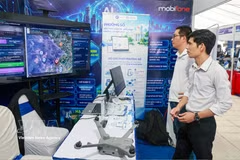
Vietnamese Deputy Minister of Science and Technology Tran Trung Tinh speaks at the event. (Photo: Published by VNA)

Vietnam, RoK seek to expand cooperation in AI and semiconductor sectors

Vietnamese Deputy Minister of Science and Technology Tran Trung Tinh stressed that the Politburo's Resolution No. 57-NQ/TW identifies science and technology, innovation and digital transformation as leading breakthroughs and key drivers of rapid and sustainable development. Semiconductors and artificial intelligence (AI) are among the strategic technologies prioritised for development.

Representatives of Cambodia’s Ministry of Education, Youth and Sport (MoEYS), the Agence Universitaire de la Francophonie (AUF) and Viettel Cambodia (Metfone) sign a tripartite agreement to strengthen cooperation and accelerate digital transformation in Cambodia’s higher education sector. (Photo: khmertimeskh.com)

Vietnamese company joins Cambodia’s digital transformation efforts

The agreement establishes a cooperation framework to modernise higher education through digital governance, digital learning, artificial intelligence (AI) applications, and capacity building through training and knowledge sharing. It also aims to expand internship, employment and scholarship opportunities for students.

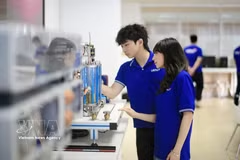
USTH students access modern equipment (Photo: VNA)

Vietnam’s AI ambition runs into talent wall

AI is becoming a foundational technology, cutting across industrial production, healthcare, education, finance, governance and public service delivery. But turning technological potential into practical value requires a workforce able to study, master and apply AI to Vietnam’s real-world problems.

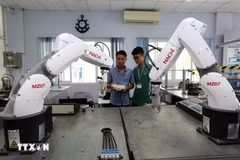
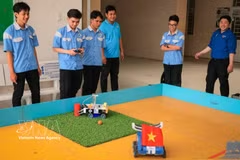
Trainees practise programming and operating robots at the Ho Chi Minh City High-Tech Park Training Centre. (Photo: VNA)

Vietnam, Malaysia hold potential for cooperation in robotics industry

Businesses from both countries should lead joint research and field-testing projects in areas such as electronic component inspection, warehouse transport, agricultural monitoring and medical logistics, said Samirul Ariff Othman, a policy, economic and business analyst at Global Asia Consulting and visiting lecturer at Universiti Teknologi PETRONAS.

Illustrative image (Photo: SGGP)

Ericsson establishes R&D capability in Vietnam

This initiative builds on Ericsson’s growing software engineering and testing capabilities in the country, and will further strengthen Vietnam’s contribution to Ericsson’s global technology development.

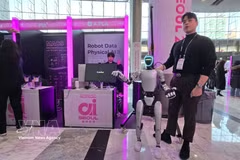
An AI-powered robot at the 2026 Seoul AI Conference. (Photo: VNA)

RoK’s AI robotics drive opens cooperation opportunities with Vietnam

Dao Tuan Hung, President of the Business Association of Vietnamese in Korea (BAVIK), said Vietnam should adopt a practical approach by prioritising specialised robots, including autonomous mobile robots (AMR/AGV), collaborative robots and machine vision systems, in sectors such as agro-fishery processing, textiles and garments, electronics and logistics.

Russian survey vessel Akademik M.A. Lavrentyev (Photo: VNA)

Russian survey vessel docks in Hai Phong

This is the third joint marine scientific survey in Vietnamese waters, running from November 4 - December 12, and one of the opening field activities under the Vietnam–Russia roadmap for marine scientific research cooperation for 2026-2035.

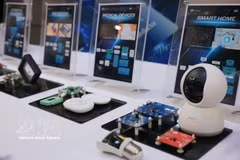
Smart products, chips and semiconductor materials are displayed at the launch ceremony of the national semiconductor chip prototyping support centre in Hanoi on June 26, 2026. (Photo: VNA)

Vietnam-Japan semiconductor cooperation paves the way for high-tech investment

The two countries are implementing five semiconductor research projects involving leading universities, with funding agreements signed in July. The projects cover three-dimensional integrated circuits, advanced semiconductor materials, secure artificial intelligence (AI) chips and power electronic components.

An exhibition space at the “Da Nang Semiconductors and High-Tech 2026” conference, organised by the Da Nang People’s Committee. (Illustrative photo: VNA)

Mobilising international resources to drive Vietnam’s technology development

Vietnam previously focused mainly on attracting overseas experts and intellectuals to work in the country over the long term, but this approach encountered certain difficulties. Cooperation methods are now shifting towards greater flexibility, allowing experts to take part in conferences and scientific seminars, contribute to addressing major national challenges, or participate in short-term training and research programmes.

Assoc. Prof. Dr. Dinh Ngoc Thach, lecturer and researcher in automatic control theory and robotics at the French National Conservatory of Arts and Crafts (Cnam) (Photo: VNA)

Core technologies key to sustainable robotics development in Vietnam: expert

Vietnam should select suitable robotic platforms and gradually build capacity in core technologies, including sensing, environmental perception, positioning, state estimation, AI, control and system integration. This will help develop technologies applicable across multiple sectors while avoiding fragmented investment and dependence on a single product category.

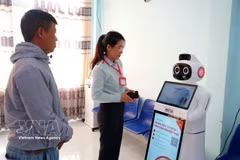
AI robots have become effective assistants in providing administrative services and reducing the workload of officials in Lam Dong province (Photo: VNA)

AI robots help streamline administrative procedures

Operating around the clock, AI robots provide information on administrative procedures, required documents, processing times, fees and relevant regulations, complementing assistance from civil servants.