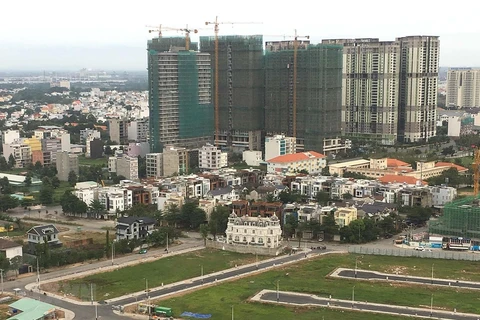
Vietnam's property market will not lack capital for development next year, experts have said (Photo: VNA)
 Hanoi (VNS/VNA) - Vietnam's real estate market will not be short of capital next year but will still face many challenges from policies and administrative procedures, experts said at the annual Vietnam Real Estate Forum.
Can Van Luc, chief economist of the Bank for Investment and Development of Vietnam (BIDV), told the forum in Hanoi on December 19 that real estate capital with 60 percent from banks and 40 percent from other sources will be maintained next year.
On November 15, the State Bank of Vietnam issued Circular 22 effective from January 1, 2020 to tighten credit in the real estate sector, which will aid the market, according to Luc.
“The property market is healthy in the long-term and this circular will encourage loans for building, buying and repairing houses,” Luc said.
In 2019, bank loans for real estate activities, such as buying, repairing and building houses, exceeded 300 trillion VND (12.93 billion USD), up 15 percent year on year. Meanwhile, capital from other sources, including bonds, remittance and foreign direct investment (FDI), reached about 240 trillion VND (10.34 billion USD), he said.
"Thus, financial resources for real estate are still relatively large, the local real estate market doesn't have to worry about lacking capital," Luc said.
This economist said there are five main sources of capital flowing into the real estate market, including banking loans, private capital, FDI capital, corporate bonds and other resources like cash of the people, gold and remittances.
In the first 10 months of 2019, loans for construction rose by 8.5 percent year on year to 8 trillion VND (344.7 million USD), 5.5 percent for trading of property and 19.6 percent for house buying and home repair. This year, the Government has consolidated loans for trading real estate, and buying and repairing houses into real estate loans so the figure increased by 14.5 percent.
Regarding private capital, in the first 11 months, there were 16,000 construction enterprises were established, up 2 percent, and 7,300 newly-established real estate trading enterprises saw their capital rise by 27.5 percent. Meanwhile, FDI from newly-registered projects and increases of existing capital reached 4.8 billion USD.
The total value of enterprises’ corporate bonds issued in the 11 months was 237 trillion VND (10.21 billion USD), up 6 percent year on year, including 71 trillion VND (3.06 billion USD) from real estate enterprises. This is an impressive figure and an important capital resource.
Vietnam allows businesses to set up trust funds to supply more investment for the property market, which is a potential channel in the future, Luc said.
Fintech could also be a channel to attract capital for real estate in the future, said Luc.
"Currently, the global economy is recovering while global trade will recover next year, making foreign capital flow strongly into Vietnam. The capital is expected to continue the strong growth in Vietnam next year," economic expert Le Xuan Nghia said.
"Bank credit is also important for the stable development of the real estate market due to the large proportion of capital banks supply. In the past year, the stable commercial banking system has contributed greatly to the stability of the real estate market," Nghia said.
“The capital for the property market should be centralised in a bank, because banks manage risks well. The good management of risks will bring benefits for developers of property projects and property investors,” he said.
Besides that, domestic investment has flowed into infrastructure development, and Government investment in infrastructure is set to increase in 2020 with the construction of several large projects, according to Nghia.
Private capital in infrastructure will also continue to increase strongly next year. This will have a great impact on the domestic real estate market next year and beyond. When infrastructure improves, the real estate market will improve.
Another factor that will also impact the real estate market in the coming years is the large amounts of capital for urbanisation.
More opportunities to attract FDI to the real estate market will come from free trade agreements Vietnam has signed.
Nguyen Hong Van, market director of JLL Vietnam’s Hanoi branch, said foreign capital in the market would create many positive impacts. Recently, many foreign investors had sought to invest or find Vietnamese partners to open joint ventures.
“This is a potential capital source. The foreign investor will bring capital and experience in development of property projects to Vietnam. Domestic businesses can find not only more capital but also more experience to develop their projects at a higher level,” Van told Vietnam News.
"Foreign capital and remittances to the real estate market will increase and mergers and acquisitions (M&A) will continue. Foreign businesses will collaborate with local entities to create quality real estate products," Van said.
Foreign investors put their money into many fields such as commercial property, apartments and industrial parks. Investment from China has been mainly in industrial zones, while commercial centres and shop-houses have attracted the most capital from Korean and Japanese investors.
Meanwhile, Nguyen Manh Ha, Chairman of Landora Group, said the people held a large capital resource with a total value of cash, gold and remittances of more than 16 billion USD, though this resource is congested due to legal issues.
While real estate firms can expect stable development next year, licensing policies and administrative procedures are set to give them headaches.
Ha said it was important to simplify administrative procedures, especially in tax calculation, and create favourable conditions for businesses in working with State agencies.
According to Nghia, current market supply has decreased slightly but is still higher than demand and real estate prices have not decreased.
With positive adjustments from the State, the real estate market is expected to return to normal development from the second quarter of next year grow steadily due to the high demand for housing.
At the forum, the experts said real estate segments set for strong development next year would be land plots and apartments.
Industrial property would also have great potential for development in the near future, Van said.
The experts also said in the first half of 2020 the real estate market would face difficulties because of problems related to mechanisms, of which the delay in licensing new projects would impact new supply.
Dang Hung Vo, former Deputy Minister of Natural Resources and Environment, said in 2019, few new real estate projects were licensed due to legal tightening. Real estate projects under construction now have been licensed from previous years.
In the next 2-3 years, if getting construction licences for projects continued to be tough, the market would face supply reduction while demand would still increase, Vo said.
The domestic condotel market would be temporarily quiet next year after the failure of the Cocobay Da Nang developer to fulfil payment obligations to investors. But this market would continue its development if the State completes the legal system for it.
Nguyen Van Dinh, Vice President and General Secretary of the Association of Real Estate Brokers, said he would choose investment in condotel because legal system for this product would be completed under market demand.
On the other hand, Vietnam’s resort real estate prices were still low compared to other countries in the region and the world. Vietnam’s tourism industry was sure to boom in the future, he said. Therefore, condotel prices would increase together with the development of the tourism industry.
To get success in development of this condotel market, Nghia said, project developers should work with travel companies in building attractive programmes for tourists./.
VNA