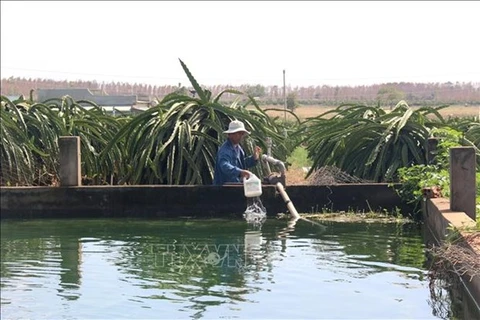
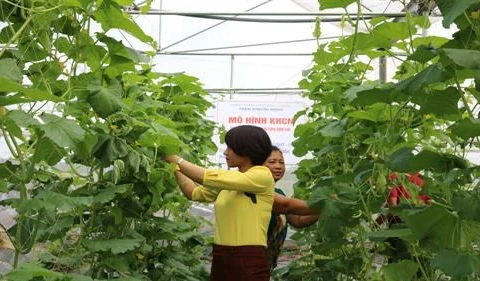
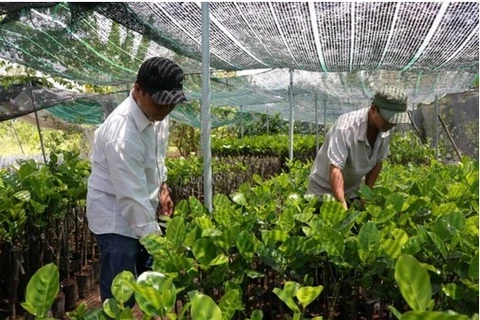
Honeydew melons grown in a net house with drip irrigation in Dong Thap province (Photo: baodongthap.vn)
 Dong Thap (VNS/VNA) – The Mekong Delta province of Dong Thap has encouraged farmers and farming companies to improve the efficiency of their irrigation to increase yields and reduces costs.
They have adopted spray and drip irrigation for nearly 25,000ha of crops.
Efficient irrigation improves yields by 25 percent and saves 45 percent water, according to the province’s Department of Agriculture and Rural Development.
This translates into 20 percent higher incomes. It also helps crops cope well with conditions like drought and climate change.
Le Vu Hung of Lap Vo district’s Tan Khanh Trung commune invested in a drip irrigation system in 2018 for his 4,000sq.m net house where he grows cucumber, honeydew melon and other vegetables fruits.
It helps him grow clean crops and save labour costs since irrigation is controlled automatically.
He can grow four crops a year in the net house and earn an annual income of 600 – 800 million VND (25,800 – 34,500 USD).
Many fruit farmers in Chau Thanh and Lai Vung districts and Cao Lanh city use efficient irrigation systems, thus saving 25.8 million VND (1,100 USD) per hectare per year, according to the department.
The province has provided subsidies to farmers in many districts for building net houses with efficient irrigation systems to grow fruits, vegetables, flowers, ornamental plants, and other crops in recent years.
The province is one of the largest producers in the delta of rice, mango and flower, and 70 percent of its population lives in rural areas.
Yet, efficient irrigation systems remain few and far between, understandably so since the cost of installing them is high and many farmers cannot afford them, according to the department.
Besides, spray irrigation requires large use of power, which the local grid cannot meet since it barely meets household demand.
Many farmers in the province in fact depend on diesel pumps to irrigate their crops.
Authorities encourage farmers to invest in solar power systems for irrigation.
In Thap Muoi district, the Bureau of Agriculture and Rural Development has provided subsidies to some farmers to invest in solar power.
Nguyen Duong Tien of Thap Muoi’s Thanh My commune, spent about 130 million VND (5,600 USD), including 30 million VND worth of subsidy from the bureau, to install a solar system last year.
He now saves 1.3 – 1.5 million VND (56 – 65 USD) a month while irrigating his 1.2ha fruit orchard.
He expects to recover the cost of the solar system within five to six years and the system has a guarantee period of 20 years.
“Using a solar power system can save much money and surplus power can be sold to the power grid.”
Bui Van Son, deputy head of the bureau, said the bureau would collaborate with relevant agencies to further advocate solar power and encourage farmers to invest in it.
“This will help save production costs and increase efficiency”./.
They have adopted spray and drip irrigation for nearly 25,000ha of crops.
Efficient irrigation improves yields by 25 percent and saves 45 percent water, according to the province’s Department of Agriculture and Rural Development.
This translates into 20 percent higher incomes. It also helps crops cope well with conditions like drought and climate change.
Le Vu Hung of Lap Vo district’s Tan Khanh Trung commune invested in a drip irrigation system in 2018 for his 4,000sq.m net house where he grows cucumber, honeydew melon and other vegetables fruits.
It helps him grow clean crops and save labour costs since irrigation is controlled automatically.
He can grow four crops a year in the net house and earn an annual income of 600 – 800 million VND (25,800 – 34,500 USD).
Many fruit farmers in Chau Thanh and Lai Vung districts and Cao Lanh city use efficient irrigation systems, thus saving 25.8 million VND (1,100 USD) per hectare per year, according to the department.
The province has provided subsidies to farmers in many districts for building net houses with efficient irrigation systems to grow fruits, vegetables, flowers, ornamental plants, and other crops in recent years.
The province is one of the largest producers in the delta of rice, mango and flower, and 70 percent of its population lives in rural areas.
Yet, efficient irrigation systems remain few and far between, understandably so since the cost of installing them is high and many farmers cannot afford them, according to the department.
Besides, spray irrigation requires large use of power, which the local grid cannot meet since it barely meets household demand.
Many farmers in the province in fact depend on diesel pumps to irrigate their crops.
Authorities encourage farmers to invest in solar power systems for irrigation.
In Thap Muoi district, the Bureau of Agriculture and Rural Development has provided subsidies to some farmers to invest in solar power.
Nguyen Duong Tien of Thap Muoi’s Thanh My commune, spent about 130 million VND (5,600 USD), including 30 million VND worth of subsidy from the bureau, to install a solar system last year.
He now saves 1.3 – 1.5 million VND (56 – 65 USD) a month while irrigating his 1.2ha fruit orchard.
He expects to recover the cost of the solar system within five to six years and the system has a guarantee period of 20 years.
“Using a solar power system can save much money and surplus power can be sold to the power grid.”
Bui Van Son, deputy head of the bureau, said the bureau would collaborate with relevant agencies to further advocate solar power and encourage farmers to invest in it.
“This will help save production costs and increase efficiency”./.
VNA