Dong Thap to expand fruit cultivation, improve fruit value

The Cuu Long (Mekong) Delta province of Dong Thap plans to increase the area under fruits cultivation to more than 35,000ha by 2025 with a focus on environment-friendly farming methods and developing value chains for fruits.
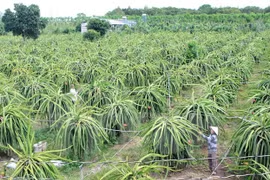
Dong Thap to expand fruit cultivation, improve fruit value ảnh 1A jackfruit orchard in Dong Thap province’s Thanh Binh district (Photo: VNA)

Dong Thap (VNS/VNA) –
The Cuu Long (Mekong) Delta province of Dong Thap plans to increase thearea under fruits cultivation to more than 35,000ha by 2025 with a focus onenvironment-friendly farming methods and developing value chains for fruits.

Italso plans to enhance the means of origin tracing for the fruits and tourismservices involving orchards in the period.

Ithopes to have 928ha of orchards adopting Vietnamese good agricultural practices(VietGAP) standards and 53ha grown to GlobalGAP standards.

Ithas more than 33,000ha of orchards that will produce more than377,000 tonnes of fruits this year, up 43 percent in area and 45.9 percentin output from 2015, according to its Department of Agriculture and RuralDevelopment.

Mango,longan and citrus fruits are the key fruits and are grown in large,concentrated farming areas.

NguyenPhuoc Thien, director of the department, said the rapid growth in fruitproduction has been a big factor in the province’s successful restructuring ofits agriculture.

Theincome for farmers from the province’s key fruits is three to eight timeshigher than from rice, he said.

ACat Chu mango orchard provides an income of 115 million VND (4,960 USD) perhectare per year, while the figures are 261 million VND (11,260 USD) and 850million VND (36,700 USD) for the Edor longan and the Xoan orange.

Underthe province’s agriculture restructuring plan, many farmers with low-yield ricefields have switched to fruits and adopted VietGAP and GlobalGAP standards andadvanced techniques to produce quality fruits that are also exported.

NguyenVan Hai in Thap Muoi district’s Phu Dien commune has switched to growing Thaijackfruit one his one-hectare paddy and has three to four harvests a year. His500 – 700 kilogrammes of fruit per harvest mean he earns 600 million VND (25,900 USD) a year.

Theprovince, the delta’s largest mango producer, has more than 9,650ha under thefruit and an annual output of 127,000 tonnes.

Farmershere use advanced techniques to grow mangoes even in the off-season to andreduce the output during main harvest season to keep prices steady.

Sincethe province grows many different fruits with steady quality, many companieshave invested in processing them.

Thereare 25 small and medium – sized companies that produce more than 60 types ofprocessed fruits and vegetables. 

Ofthem 20 have been identified for the country’s ‘one commune – one product’(OCOP) programme and are sold in supermarkets.

Thiensaid based on the OCOP products, many localities in the province have chosenkey fruits to restructure agriculture and develop value chains.

Theyhave developed concentrated growing areas with value chains to reduceproduction costs and improve farmers’ incomes, he said.

Theprovince has 11 cooperatives, 80 co-operative groups and 58 farmers clubs thathave developed value chains for fruits.

Thereare 133 fruit-growing areas covering a total of nearly 6,000ha that have beengranted production unit codes for export purposes. 

Mostof these areas are under mango, longan, dragon fruit, jackfruit, andrambutan.  

Tobe granted a production unit code, each fruit growing area should be a minimumof 10ha, grow a single kind of fruit and to Vietnamese VietGAP or otherequivalent standards. 

Thefarmers also have to carry out many other tasks like keeping a cultivationdiary for traceability and follow regulations on pesticide use./.
VNA
See more

 Khanh Binh International Land Border Gate in An Giang province.( Photo: VNA)

Vietnam-Cambodia trade gathers pace towards 20 billion USD target

After setting a record of more than 11.3 billion USD in 2025, bilateral trade reached about 8.7 billion USD in the first eight months of 2026, up 8.3% year on year. Vietnam is currently Cambodia’s third-largest trading partner, its second-largest source of imports and second-largest export market.

Vietnamese Ambassador to India Trinh Minh Manh discusses potential areas and strengths for cooperation between Vietnam and India’s Gujarat state. (Photo: VNA)

Vietnam, India’s Gujarat state seek to unlock cooperation potential

Vietnam attaches importance to strengthening cooperation with Indian states boasting strong economic potential, including Gujarat, to further advance the two countries’ Enhanced Comprehensive Strategic Partnership, particularly in the economy, trade and investment, said Ambassador Trinh Minh Manh.

At Nestlé Vietnam factory in Hung Yen province (Photo: VNA)

Vietnam seeks to build stronger ecosystem for FDI

The World Bank has stressed the need to connect global companies with domestic suppliers, improve the business climate and develop supply-chain finance solutions. Those steps will let domestic firms gradually meet requirements on quality, technology, costs and delivery times, and position them to become suppliers to multinational corporations.

Construction of technical infrastructure facilities serving APEC 2027 in Phu Quoc Special Zone, An Giang province. (Illustrative photo: VNA)

Vietnam enters investment grade credit rating category for first time

Vietnam has maintained robust growth, outperforming other Southeast Asian economies. Its ongoing government reforms aimed at streamlining the state apparatus, promoting the private sector, improving the institutional framework and developing capital markets will strengthen the country’s growth potential and economic resilience.

Vietnamese Prime Minister Le Minh Hung and Lao Prime Minister Saleumxay Kommasith witness the presentation of investment certificates and investment cooperation agreements between businesses of the two countries. (Photo: VNA)

Vietnam, Laos strengthen “strategic cohesion” in economic sector

The great friendship, special solidarity, comprehensive cooperation and strategic cohesion between Vietnam and Laos, and between Laos and Vietnam, are an invaluable asset of the Vietnamese and Lao Parties, States and people. It is the responsibility of today's generation to transform this invaluable political asset into new resources for the development of the two countries’ people.

West Food Hau Giang JSC’s factory at the Nam Song Hau Industrial Park – Phase 1, Can Tho city (Photo: VNA)

Southern industrial property market enters new phase of competition

Industrial site selection was previously driven largely by land prices, location and access to markets. However, as supply chains become more complex and manufacturing projects face higher technical requirements, businesses are increasingly assessing sites based on their long-term operational capabilities.

Members of the RoK delegation visit booths showcasing signature agricultural products of Da Lat – Lam Dong. (Photo: VNA)

Lam Dong seeks stronger economic, tourism links with RoK

Lam Dong is particularly interested in sectors in which Korean businesses have strengths, including agriculture, green energy, the circular economy, high-quality tourism, healthcare, education, human resources training and digital transformation, an official said.

Illustrative image (Photo: EVNNPT)

EVNNPT seeks over 224 mln USD in bank loans for grid expansion

Three projects account for part of the financing need, including 13.3 million EUR for the 220kV Ung Hoa substation and connection lines, 18.6 million EUR for the 220kV Tan Viet substation and the 220kV Tan Viet–Gia Loc–Pho Noi line, and 35.3 million EUR for the 220kV substation connecting the Dong Anh–Van Tri transmission line.

At a farm produce supermarket in Hue city (Photo: VNA)

Inflation control key to maintaining growth momentum

Average consumer price index (CPI) rose 4.52% in the first nine months, roughly in line with the National Assembly (NA)'s full-year target, while core inflation climbed 4.26%, the National Statistics Office (NSO) reported. CPI in some localities ran above the national average, including economic hubs Hanoi and Ho Chi Minh City.

According to experts, Vietnam’s relatively attractive valuation could help draw active investors. (Photo: VNA)

Capital-market channels widened after FTSE upgrade: expert

Vietnam officially entered FTSE Russell’s Secondary Emerging Market category on September 21 after reforms to trading, settlement and foreign-investor access. The reclassification gives Vietnamese equities access to a much larger pool of international capital, but also puts them in direct competition with other emerging markets.