Duong Lam first Vietnamese ancient village to become national relic

Hanoi’s Duong Lam ancient village, renowned for its unique houses built with wooden frames and fortified with laterites, still preserves typical features of old villages in the Red River Delta.
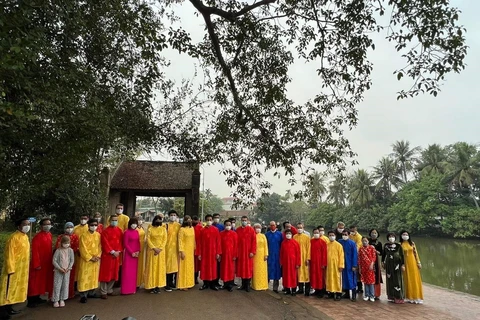
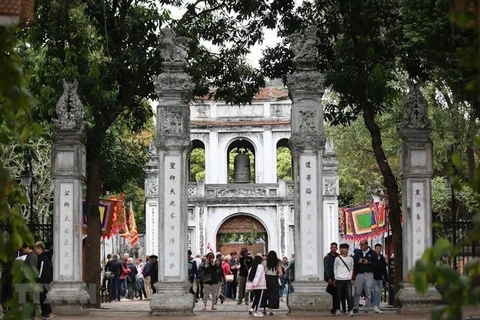
Duong Lam first Vietnamese ancient village to become national relic ảnh 1The gate of Duong Lam village (Photo: VNA)

Hanoi (VNA) - Hanoi’s Duong Lam ancient village, renowned for its unique houses built with wooden frames and fortified with laterites, still preserves typical features of old villages in the Red River Delta.

Located in Son Tay town of the same name district just 44km away from Hanoi’s centre, the village has the typical features of a rural village with a giant banyan tree, fresh water well, and a communal house, along with 956 antique houses dating back 100 to 400 years.

Possessing interesting cultural value and a landscape and architecture typical for a rural area in the Red River Delta, Duong Lam village has long become a popular tourist destination in the capital.

In 2006, Duong Lam became the first village that had been recognised as a national historical and cultural relic. 

Every year, it attracted between an average of between 120,000 and 130,000 visitors, including up to 7,000 foreigners. 

According to Vice Chairman of the Son Tay town People’s Committee Le Dai Thang, great domestic and international attention have been paid to the conservation and promotion of the village in the past decade. 

Ancient land, legendary people
Favourable waterway transportation made Duong Lam a residence of ancient Vietnamese dating back to the Phung Nguyen and Dong Son culture.

It was the hometown of two kings - Phung Hung (761-802) and Ngo Quyen (808-944), and also the birthplace of Envoy Giang Van Minh – an excellent diplomat in the late 16th and early 17th century.

In a 1971 excavation, archaeologists found stone relics from the Hung Kings’ era in the village.

Meanwhile, a survey, co-organised by the Institute of Vietnamese Studies and Development Science under the Vietnam National University – Hanoi and Japan’s Showa Women's University, initially concluded that Duong Lam could be inhabited by people of the Phung Nguyen culture dating back about 4,000 years ago. 

Duong Lam commune is home to a series of ranked relic sites, including the Phung Hung Temple, Ngo Quyen Tomb, Giang Van Minh Temple, Mong Phu communal house, and Mia pagoda. 

Duong Lam first Vietnamese ancient village to become national relic ảnh 2An ancient house yard in Duong Lam (Photo: VNA)

The commune consists of six villages with Mong Phu the biggest among them. 

Duong Lam residents, similar to those in any rural areas in north Vietnam, attach great importance to the gate and the communal house of their village, which are long considered the symbols of prosperity. 

The gate of Mong Phu village was built with four pillars, which were made of four different kinds of excellent ironwoods and erected above four green stones from Quang Ninh province’s Dong Trieu village. The two doors at the gate were made of Erythrophleum fordii wood and the wall built of laterites – a special material used in construction in the Red River Delta region.

Situated at the heart of the village, the communal house, which follows the style of Vietnamese-Muong architecture, features big shiny black pillars made of ironwoods. 

Ancient laterite Vietnamese village 
Laterites can be found almost anywhere in Duong Lam, becoming an integral part of the village. 

Laterites, the key material of walls, gates and wells, are abundant in Mong Phu village, lying under fields, garden ponds, or deep down underground. Laterite, both a soil and a rock type rich in iron and aluminum, is often soft underground but getting harder over time once it is dug up to build houses.

Houses’ walls and fences made of rough dark honey-brown brick-shaped laterites along the village road create a unique charm.

The combination of agriculture and tourism is not new, but for Duong Lam Village, it is a tremendous effort toward building a sustainable industry and helping locals find another source of income apart from their crops, all while providing tourists with a unique experience.

In the past, since there were not many overnight accommodations available in the village, visitors often opted for short day trips. However, these days many local families have opened their doors to strangers for a home-stay experience.

An overnight stay is exactly what people need to fully enjoy what the village has to offer. They can spend the day working with farmers, or listen to traditional musical performances by the village’s artisans.

All of these make up an ideal tourism product, bringing in financial stability and helping the village preserve itself as a pearl in Vietnam’s unique culture./.
VNA

See more

Visitors to the exhibition at the Ho Chi Minh Museum in Hanoi. (Photo: VNA)

Exhibition on Lenin portraits opens in Hanoi

Featuring more than 156 photos of archival paintings, the exhibition introduces visitors to the life and legacy of Lenin, a prominent political theorist, revolutionary leader, and founder of the Soviet state.

Students of the Hung Vuong University visit the exhibition. (Photo: VNA)

International art exhibition bridges Vietnamese, Korean cultures

Through artistic works, the public gain deeper insights into the cultures and people of both nations, contributing to peace, cooperation, and development. The exhibition also helps younger generations better understand a dynamic Vietnam and a culturally rich RoK.

The illustrated book “100 Dieu tu hao Viet Nam” (Photo: nhandan.vn)

Book introduces 100 remarkable facts about Vietnam

The illustrated book “100 Dieu tu hao Viet Nam” (100 Proud Facts about Vietnam) compiles 100 highlights of Vietnam’s legacy across 11 major themes, including heroic history, cultural beauty, literature and the arts, medicine, education, architecture, science, cuisine and community values.

Children perform Xoan folk singing at the cultural camp. (Photo: VNA)

Hung Kings festival opens with vibrant cultural, tourism activities in Phu Tho

Beyond its role as a sacred national commemoration, the event helps promote cultural values, strengthen national unity and enhance cultural exchanges. A notable feature is the flexible organisation in 18 commune and ward clusters, encouraging the localities' participation and enriching the festival’s content.

A corner of the Book Street in Hanoi (Photo: VNA)

Hanoi celebrates Reading Culture Day with book street activities

Organised by the Book Street’s management board in collaboration with publishers and distributors, the programme will brings together 14 publishing and distribution units across 15 booths, offering readers access to a rich and diverse selection of book titles spanning literature, children’s books, life skills, economics, history, science-technology and education, among others.

Vietnam’s Consul General in Osaka Nguyen Truong Son speaks at the 9th Vietnam cultural festival in Osaka on April 19, 2026. (Photo: VNA)

Vietnam cultural festival in Osaka draws tens of thousands of attendees

Saito Naoki, Mayor of Ikuno Ward – where the event took place, expressed his pleasure at the rapid growth of the Vietnamese community in the area. He praised such cultural festivals for helping Vietnamese residents maintain their traditions while fostering mutual understanding and closer ties with Japanese locals.

Urawadee Sriphiromya, Thai Ambassador to Vietnam (third from left); Camila Polo Florez, Colombodian Ambassador to Vietnam (C); and Saadi Salama, Ambassador of Palestine to Vietnam (fifth from left), experience indigenous coffee culture in a coffee garden in Dak Lak. (Photo: doanhnghiepkinhtexanh.vn)

World Coffee Heritage Forum: A dialogue connecting coffee culture, knowledge

The recognition of "The knowledge of coffee cultivation and processing in Dak Lak” as a National Intangible Cultural Heritage marks an important milestone. It affirms the value of indigenous knowledge, creative labour, and the harmonious connection between local livelihoods, culture and nature in the Central Highlands.

The artwork "Harvest Day" by Doan Thi Thu Huong. (Photo: cand.com.vn)

Vietnam to join Venice Art Biennale with first national showcase

As Vietnam makes its debut at the Biennale, the exhibition “Vietnam: Art in a Global Flow” does not seek to assert its position through scale or grand statements, but rather opens up a space for meaningful artistic dialogue - an invitation to listen to subtle voices, contemplate in stillness, and reflect on the capacity to nurture sustained creative energy in a dynamic and ever-evolving art world.

Viet Youth Readiness Hub debuts at the event (Photo: VNA)

Vietnamese Canadian youth hub launched to fight mother tongue erosion

The Viet Youth Readiness Hub is seen as a dedicated platform to connect, support, and empower Vietnamese-Canadian youth. It aims to emerge as a central force to host social events, advance heritage education, foster exchange and integration among young Vietnamese in Canada.

At the event “Vietnamese Language in the heart of Kyushu, Japan” (Photo: VNA)

Vietnamese in Japan revive mother tongue among young generations

While the number of Vietnamese-origin children in Japan is surging, opportunities to actually speak Vietnamese in daily life are vanishing fast. Many children can understand the language but default to Japanese in response, gradually relegating their mother tongue to a secondary role, sometimes even treating it as a “second foreign language” inside their own houses.

A tribute to Hung Kings in Ho Chi Minh City (Photo: VNA)

Hung Kings’ Commemoration Day 2026 to spread sacred values, foster national unity

Following the merger of Phu Tho, Vinh Phuc, and Hoa Binh provinces into the new Phu Tho province last year, the Hung Kings Temple Festival has taken on heightened significance. It now serves not only as a tribute to the ancestral homeland but also a unified cultural platform that extends sacred ancestral values to Vietnamese communities at home and abroad.