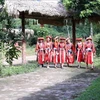
People pay homage to God Linh Hue Dai Vuong at Nghe Dang Dong. (Photo: VietnamPlus)
 Hanoi (VNA) - Experts in the fields of culture and history are striving to restore Nghe Dang Dong, a shrine in Hanoi which saw the birth of a UNESCO-recognised folk game.
The sitting tug-of-war was added to UNESCO's list of Intangible Cultural Heritage of Humanity icons on December 2, 2015.
Typically held near a communal house or shrine, the game sees the teams on the two ends of a rope try to tug it away from the other. The practice is strengthening community solidarity and identity, UNESCO said on its website.
Tug-of-war rituals and games are prevalent in the rice-farming civilisation of East Asia and Southeast Asia as a form for communities to pray for bumper harvests and prosperity. They mark the start of the agricultural cycle and often begin with commemorative rites to local deities.
The game used to be held every year in March of the lunar calendar in Nghe Dang Dong. But since the shrine collapsed, its celebration was moved to nearby Tran Vu Temple, according to elders in Ngoc Tri village.
Historical, cultural values
Secluded deep in a neighborhood in Co Linh Street, Nghe Dang Dong is a familiar place of worship for locals. It had been one of the three shrines in Ngoc Tri village, Thach Ban ward, Long Bien district.
Today, Nghe Dang Dong is surrounded by fallow fields, ponds and lakes. When the ancient architecture nearly collapsed, locals erected a makeshift structure as a place of worship.
Although the structure of Nghe Dang Dong collapsed, it is still one of the three nghe – shrines in the village. Moreover, it is a typical relic of the country’s resistance wars, Professor Le Van Lan said at a recent workshop.
From the end of the 19th century to the August Revolution of 1945 and the wars against France and the US, Nghe Dang Dong was where patriots took refuge, he said, adding that therefore, it is qualified to be classified as a typical revolutionary war relic.
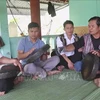
 Professor Le Van Lan speaks at the workshop (Photo: VietnamPlus)
 The ancient relic is left neglected, according to researcher Tran Lam Bien. In fact, there have been many seminars to discuss the reconstruction of communal houses, pagodas, and temples but nghe or shrine has received less attention.
Nghe plays an important role in the cultural and religious life of Vietnamese because it is the place to worship the supreme deity of a village, he said, adding Nghe Dang Dong should be restored as it mirrors the development of the Vietnamese rural society in the past, and has spiritual and cultural values.
 Many statues and objects dating back to the 17th century are now preserved at Nghe Dang Dong. (Photo: VietnamPlus)
 Basis for relic research, restoration
Associate Prof. Dr. Nguyen Duc Nhue, Deputy Director of the Institute of History, said the shrine collapsed between 1964 and 1965, but residents still memorise Nghe Dang Dong’s foundation, scale, and architecture.
“Based on what we have in the place at the moment and in the memory of the local people, scientists can totally restore a full foundation, scale and architecture of Nghe Dang Dong,” he added.
Due to the war, worshipping items of Nghe Dang Dong were moved to Tran Vu Temple. Some local families have also kept objects and parts of the structure of the original shrine.
 Objects related to the shrine (Photo: VietnamPlus)
 According to Dr. Bui The Quan, deputy head of Culture and Information Bureau of Long Bien district, locals look forward to rebuilding Nghe Dang Dong as a way to make cultural life thrive.
Local authorities will consult cultural experts to complete the dossier on the restoration of the shrine and submit it to competent agencies, the official said.
 An ancient well at the shrine (Photo: VietnamPlus)
 Vietnam’s countryside is evolving strongly towards urbanisation. However, relic sites and worshipping places have remained the spiritual connection among the people.
The restoration of relic sites, therefore, is to preserve the soul of villages amid the ongoing urbanisation, said Associate Prof. Dr. Bui Xuan Dinh, an expert in ethnology./.