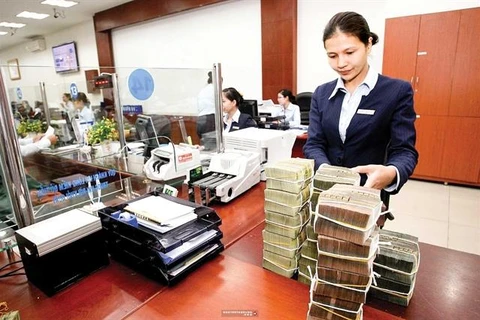
A branch of Vietcombank. Enterprises are expecting policies to unlock the credit flow (Photo: VNA)
 A recent report by the National Private Economic Development Research Board under the Government's Advisory Council for Administrative Procedure Reform showed that enterprises faced unprecedented difficulties in rising global uncertainty.
The report revealed that enterprises in most sectors were seeing significant drops in orders and predicted declines in import-export in the remaining months of this year and early 2023.
The drop in orders mainly came from the tightening of monetary policy to combat inflation and the risk of economic recession in the US and many European countries, which caused consumption and investment demand to fall sharply. In addition, the increasing frequency of trade remedy investigation cases against Vietnamese goods put many Vietnamese at a disadvantage in market access.
Enterprises were also struggling with managing cash flow, including working capital and medium and long–term investment capital, making it difficult for them to maintain operations and prepare for 2023.
"Accessing capital to maintain production and business has been the biggest challenge, especially for the private sector. The problem becomes more serious as the cash flow of enterprises has dried up after more than two years of struggling with the COVID-19 pandemic," the report wrote.
For example, in the steel industry, many enterprises were forced to sell products 30-40% lower than the cost to have operating cash flow while waiting for credit allocation.
In the part-supply industry, signed contracts or real estate assets could previously be used as mortgages for credit. Now, banks do not process the disbursement due to the pressure about remaining credit rooms.
Enterprises in the agricultural sector needed more capital to purchase raw materials when harvest seasons for many crops were coming at the end or beginning of the next year.
Nguyen Toan Thang, Director of the Toan Thang Limited Company, said that it was difficult for small companies like his to get access to banking credit at the moment.
According to To Hoai Nam, Permanent Deputy President of the Vietnam Association of Small and Medium Enterprises (SMEs), although banks had credit packages for SMEs, it remained difficult to access them.
Banks should be more flexible in the evaluation process, Nam said, adding that the Government needed to develop a mechanism to lower lending standards for SMEs to ensure the loans were accessible.
In the context of exhausted credit flow, enterprises were forced to raise capital from other markets, including the stock market and corporate bond market, Can Van Luc, a member of the National Financial and Monetary Policy Advisory Council, said.
Luc cited statistics that the corporate bond market had so far raised 2.47 quadrillion VND but now was in a crisis after violations of real estate companies Tan Hoang Minh and Van Thinh Phat, which also caused a tumble in the stock market recently with the VN-Index falling to around 900 points and the market cap vaporated nearly 19 billion VND.
This year's issuance of the corporate bond market also dropped by 25.2% to 328.9 trillion VND compared to 2021 and on a quarter-on-quarter decline.
Unlock capital flow
Some experts said that a slight increase in the credit growth quota should be considered.
Le Xuan Nghia, an economic expert, said that raising the credit growth quota by 1-2% would help the economy warm up.
However, supervision must be enhanced to ensure the credit flow goes to the right addresses, Nghia said.
Financial expert Huynh Trung Minh said that in the context that enterprises were in high demand for capital, it was necessary to widen credit growth room in the remaining months of this year for sectors such as production, business and export.
He said that credit growth quota should be allocated for banks with high capacity and capital adequacy ratio (CAR), adding that credit should be directed to sectors such as production, business and exports.
The State Bank's message was unambiguous: the central bank is determined to meet a credit growth target of 14% this year with flexibility for macro developments. So far, credit has totalled 11.8 quadrillion VND, a growth of 11%, compared to the 4.8% growth of deposits.
Minh said that it could only be expected that the credit room would expand slightly. This was because banks raised funds to pump capital into the market when credit quotas exist.
Banks should provide working capital, mainly short-term capital, for the economy. On the other hand, enterprises should go to the capital market to raise medium and long-term capital.
Consolidate confidence
Dang Hong Anh, President of the Association of Young Vietnamese Entrepreneurs, said that the most important thing was to rekindle the positive sentiment of investors.
Nguyen Dinh Cung, former Director of the Central Institute for Economic Management, said that it was vital to have a clear, consistent and stable policy message to consolidate market confidence and make enterprises feel secure and motivated to strengthen production and business.
To help enterprises overcome the difficult time, the National Private Economic Development Research Board proposed that the relevant ministries provide regular updates about market fluctuations and consultancies for enterprises to develop their business plans.
Several support policies, such as reductions in value-added tax and fees, should also be prolonged to the end of 2023.
Preferential credit packages should be designed for prioritised sectors and SMEs./.
VNA