EU trade agreement to cut tariffs

After the Free Trade Agreement between EU and Vietnam (EVFTA) comes into effect, the EU will eliminate 85.6 percent of tariff lines which account for 70.3 percent of Vietnamese export value to the EU,
EU trade agreement to cut tariffs ảnh 1Workers of Southern Food Company in HCM City load rice onto a boat for export. The EU will set aside large quotas for VN's unprocessed rice and fragrant rice. Photo: VNA

After the Free Trade Agreement between EU and Vietnam (EVFTA) comes into effect, the EU will eliminate 85.6 percent of tariff lines which account for 70.3 percent of Vietnamese export value to the EU, according to the Ministry of Industry and Trade.

It was announced in early August that after almost three years and 14 official rounds of talks and many mid-term negotiations between ministers, heads of delegations and technical groups, Vietnam and the EU have reached an agreement on all basic points of the EVFTA.

Products to benefit from the pact immediately after it takes effect include honey, fruit and vegetable both fresh and processed, fruit juice, bags and suitcases, and plastic, ceramic and glass products.

Seven years after the agreement takes effect, the EU will eliminate 99.2 percent of tariff lines for Vietnam, equivalent to 99.7 percent of Vietnamese export turnover with the remainder of export turnover enjoying zero-duty tariff rate quotas.

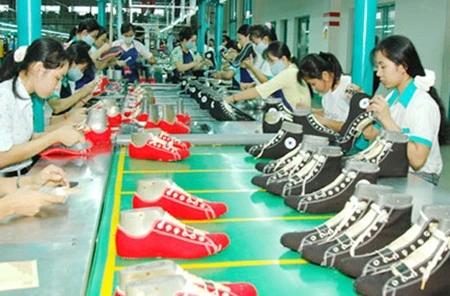
The EU will also eliminate duties on garment, textile, footwear and seafood products excluding canned tuna and fish balls over a seven-year period.

The EU will set aside large quotas for Vietnamese rice both process and unprocessed and fragrant rice. Rice imported to the EU under this quota will enjoy duty free classification, while tariff on broken rice will be phased out and products made from rice will gradually become fully liberalised within seven years.

Vice-versa, almost all EU exports of machinery and appliances will be fully liberalised at entry once the pact comes into force and the rest after five years. Motorcycles with engines larger than 150 cc will be liberalised after seven years and cars after 10 years, except those with large engines (over 3000cc for petrol, over 2500cc for diesel) which will be liberalised one year earlier.

Car parts will be duty free after seven years. Roughly half of EU pharmaceutical exports will be duty free at entry into force and the rest after seven years.

Entire EU textile fabric exports will be liberalised at entry into force. Close to 70 percent of EU chemicals' export will be duty free at entry into force and the rest after three, five and seven years.

Vietnam will also open its market for most EU food products, both primary and processed, allowing EU high quality exports to reach its growing middle class consumers.

The EU is currently the second biggest trade partner and one of the two largest export markets of Vietnam.

Twenty-three of 28 EU member nations had invested in Vietnam by the end of 2014 with over 2,000 valid projects worth more than 37 billion USD. The EU investments are present in almost all important economic sectors of Vietnam.-VNA

VNA

See more

Import and export activities at the Mong Cai border gate. (File photo: VNA)

Vietnam–China crossings see spike in ASEAN fresh produce

Since the start of the summer harvest season, China's two major border gates with Vietnam, Youyi Guan in Pingxiang and Beilun 2 Bridge in Dongxing, have entered their peak period for handling imports of fresh agricultural and seafood products from member states of the Association of Southeast Asian Nations (ASEAN).

Rohit Khurana, an automotive expert at Car Blog India. (Photo: VNA)

Green SM poised to make mark in Indian market

Green SM's strengths, including a dedicated fleet, professional drivers and premium electric limousine models, can help differentiate the company and attract customers seeking higher-quality services in India.

The opening ceremony of the Hue Festival Trade Fair 2026. (Photo: VNA)

Hue Festival Trade Fair 2026 opens with 240 booths

For Hue, the fair is also an opportunity to introduce the image of a dynamic and business-friendly locality while promoting local specialties, One Commune One Product (OCOP) items and outstanding rural industrial products, helping stimulate trade, services, tourism and investment attraction.

Deputy Minister of Finance Cao Anh Tuan at the meeting with the delegation of the RoK Embassy led by Ambassador Choi Young-sam on June 12 (Photo: mof.gov.vn)

Ambassador pledges more contributions to Vietnam – RoK economic links

Deputy Minister of Finance Cao Anh Tuan congratulated Ambassador Choi Young-sam on his successful tenure in Vietnam and praised his contributions to the substantive and productive development of the Vietnam – RoK Comprehensive Strategic Partnership across various fields, including economic and financial cooperation.

The working session between Deputy Minister of Industry and Trade Nguyen Hoang Long and IKC Representative Director and Executive Vice President Atsuhiko Hirano in Hanoi on June 12 (Photo: Vietnamese Ministry of Industry and Trade)

Vietnam, Japan cultivate energy collaboration

Deputy Minister of Industry and Trade Nguyen Hoang Long urged Idemitsu to leverage its role as a strategic shareholder and team up with other partners to respond swiftly to geopolitical shifts, ensuring a stable, sustainable crude oil flow to the refinery.

Leaders of Bamboo Airways and Rakso Holdings Co.Ltd sign an MoU to promote cooperation in the aviation, tourism and service sectors at the forum in Seoul on June 12. (Photo: VNA)

FLC Group seeks to expand investment cooperation in RoK

Ambassador Vu Ho suggested enhancing Vietnam – RoK ties in tourism, aviation and flexible investment models to develop flagship projects meeting high standards, helping herald a new cooperation phase between the two countries.

Delegates press the buttons to launch the Meiko Yen Quang semiconductor manufacturing plant project. (Photo: VNA)

Work starts on 500-million-USD Meiko semiconductor plant in Phu Tho province

The project has an initial investment of more than 500 million USD and will focus on artificial intelligence and space technology-related applications. Once fully operational, it is expected to generate annual revenue of around 530 million USD per year and create approximately 2,000 jobs for local workers.

Coffee, often referred to as the “brown gem” of Lam Dong, is one of the province’s signature agricultural products. (Photo: VNA)

Lam Dong reshapes coffee industry to elevate export value

Lam Dong plans to strengthen branding and trade promotion efforts, develop coffee-growing regions linked to geographical indications, expand digital traceability systems and make greater use of free trade agreements (FTAs) to diversify export markets.

Cargo handling operations at Berths 3 and 4 of the Hai Phong International Gateway Port. (Photo: VNA)

AI reshapes logistics, raising bar for workforce skills

According to the Vietnam Logistics Business Association (VLA), the logistics sector will require around 2.2 million workers by 2030, including 1.6 million employees for logistics service providers and nearly 600,000 personnel supporting logistics operations in manufacturing and trading enterprises.