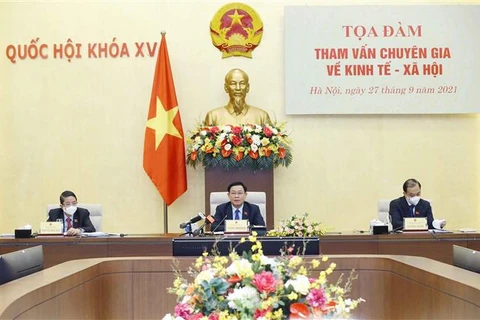
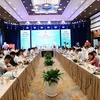
At the consultation (Photo: VNA)
 According to Dr Tran Thi Hong Minh, Director of the Central Institute for Economic Management (CIEM), international organizations have made optimistic, though cautious, assessments on global economic recovery momentum in 2021.
However, research and policy discussions shared the view that the world economic growth recovery is still under the influence of three main risk groups, including complicated developments of the COVID-19 pandemic, geopolitical competition, and inflation and debt risks, she went on.
 Hanoi speeds up COVID-19 vaccination programme for people (Photo: VNA)
 Vietnam's economic prospects may be influenced by a number of factors, including the ability to control the COVID-19 pandemic, the disbursement of public investment, and the ability to ensure production recovery, implement an extensive programme on economic recovery and development and take advantage of the global economy recovery, Minh said.
The institute proposed three phases in the economic recovery programme, with the first one (to last until the first quarter of 2022) to prioritise pandemic prevention and control in combination with macro-economic policies to help businesses survive the difficult situation. The second phase will last through 2023, during which macroeconomic policies should be relaxed to stimulate demand for the economy and create momentum for businesses. In the third phase in the years after 2023, macroeconomic policies will be normalized, the macroeconomic foundation strengthened and more intensive economic institutional reform promoted.
The institute stressed the need to apply flexibly macroeconomic policies in line with scenarios to cope with adverse developments of the world and regional economy, promote export diversification, encourage new economic models in the domestic market, and speed up the implementation of support packages for people and businesses.
Minh suggested the National Assembly pay special attention to law-making work in order to reduce overlap, thus strengthening the legal framework for production and business activities.
 The institute proposes three phases in the economic recovery programme (Photo: VNA)
 A representative from the World Bank proposed four lessons to accelerate the recovery process in Vietnam and help the country enter the new normal situation.
The WB underlined the importance of vaccination against COVID-19 along with testing in controlling the pandemic and minimizing economic losses, adding that it is necessary to find a suitable balance between fiscal policy and monetary policy, and increase social assistance to prevent financial distress among vulnerable groups and inequality from widening.
Vietnam needs to strengthen its resilience through a strong and flexible social assistance system, it said, recommending allocating more capital social assistance programme./.
VNA