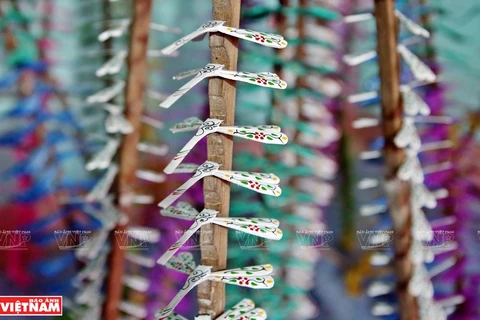
Silver jewelry pieces of Mong people (Photo: VNA)
 Hanoi (VNA) - For a long time, silver jewellery has been thought to possess talismanic qualities in the spiritual life of the Mong people. They believe it can protect health, exorcise evil spirits and bring in happiness.
Silver carving requires meticulous technique
Silver carving requires ingenuity, meticulousness and a strong aesthetic sense. Mong artisans must go through many stages of increasing sophistication to create a silver jewelry piece with specific characteristics to be deemed worthy enough by the community.
To create a piece of silver jewellery, the Mong use many tools including blower, kiln, crucible, casting mould, hammer, iron pliers, anvil, and chisel for the patter.
In the past, the source of the silver used to craft the jewellery was usually silver Indochinese coins that were handed down from generation to generation in Mong families, as well as in other ethnic minority groups.
Nowadays, this type of silver is very rare and expensive. Families seeking silver to commission a piece can buy or exchange livestock for silver with other families in the community.
To make valuable silver products that meet the demands of customers, artisans must have experience in selecting and distinguishing raw materials.
Impure silver is unsuitable for carving as it often breaks and lacks the pure white metallic lustre of its unalloyed variant. This results in a poor-quality product, low price and limited appeal for consumers.
Carved silver jewellery made in Lao Xa, Dong Van of Ha Giang province has unique cultural characteristics. Silver jewellery from Lao Xa is not only delicately crafted but is available in a diverse range of types and styles, including rings, bracelets and necklaces.
Bracelets have two types: flat rings and round rings. The faces of the rings are carved with flowers, leaves or butterflies.
Jewellery meant to protect children and adults when they are sick include anklets, necklaces and bracelets.
The Mong people believe that everything has a soul and the kitchen is overseen by a ‘kitchen god’. Therefore, during the process of carving, artisans usually carry out several rituals to worship for no accidents and risks.
Silver carving of Mong people in Sa Pa, Dong Van
Silver carving represents the development of metalworking techniques of the Mong people in Sa Pa, the northern mountainous province of Lao Cai and contributes significantly to the preservation of traditional culture and spiritual life of the local community.
Silver carvers in Sa Pa use only pure silver to create their distinctive, beautiful products.
With its unique historical, cultural and scientific process, the traditional Mong craft of silver carving in Sa Pa was named on the list of ‘national intangible culture heritage’ in 2013.
Meanwhile, Lao Xa village in Sung La commune is another cradle of traditional Mong silver carving in the northern mountainous province of Ha Giang.
Silver carving is a traditional craft that plays a very important role in the cultural life of ethnic people on the Dong Van plateau. Silver jewellery is a popular dowry item that Mong parents offer when their children get married. For that reason, silver carving has been maintained and developed by the Mong.
For centuries, when local people wanted to order a piece of silver jewellery, they would go straight to Lao Xa. They still do so this day.
Silver carving has been preserved for generations by many families. In order to preserve the tradition of their ancestors, silver carving skills are only taught to children and grandchildren within the family.
High-quality silver-carving products created in Lao Xa are made using a multi-stage process. From silver burning, casting, manipulating shapes on the anvil to patterning and polishing, silver carving requires craftsmen to be gifted, skillful and meticulous. Silver craftsmen must also be persistent for many years to pursue a successful career and achieve the quintessential skills needed to be a master carver.
Along with traditional colourful dress and costumes, silver jewellery from Lao Xa has long adorned the colourful life of the ethnic minority people in Dong Van plateau./.