Factors contribute to Vietnam’s success in garment & textile industry

According to fibre2fashion.com, Vietnam has become the world’s leading textiles and garments exporter.
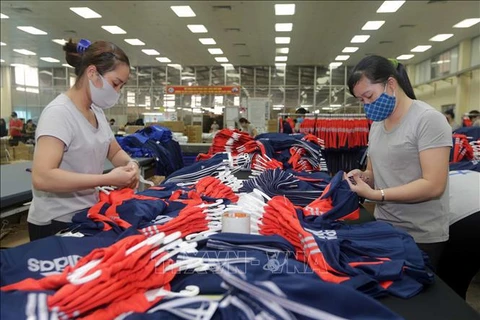
Factors contribute to Vietnam’s success in garment & textile industry ảnh 1Vietnam has become the world’s leading textiles and garments exporter (Photo: VNA)

Hanoi (VNA) - According to fibre2fashion.com,Vietnam has become the world’s leading textiles and garments exporter.

Textileand garment exports play an important role in the country’s economy, accounting forabout 12.52% of export turnover. This shows the importance and influence ofthis industry on Vietnam’s trade.

Over the recent decades, Vietnam has recorded high growth inthe industry and become a major supplier of garments.

Despite difficult and challenging situation, Vietnamis expected to achieve high economic growth in terms of capital expenditurethanks to a strong increase in foreign direct investment (FDI) and investmentin infrastructure.
  
The Vietnamese government has identified the need toinvest in domestic infrastructure. Investment in power infrastructuredemonstrates Vietnam’s commitment to common infrastructure development.

The textile industry, including synthetic textiles,plays an important role in Vietnam’s exports. Vietnam has also made efforts toimprove the business environment and promote sustainable practices in thetextile and garment industry. With its continued economic development, Vietnamcontinues to attract investors and strengthen its presence in global trade.

Vietnam has been making efforts to promote sustainableactivities in the textile and garment industry. The government has initiatedplans to improve environmental standards, energy efficiency and wastemanagement.

Sustainable materials are increasingly being developedsuch as organic cotton and recycled fibers to reduce environmental impact.

Customers, especially those representing major brandsand international brand chains, are restructuring global supply chains to meetstringent sustainability goals with regard to environmental performance.

Fiber2fashion.com said that Vietnam has really becomeone of the leading textile and garment suppliers in the world.

Vietnam’s success in this industry can be attributedto many factors such as natural resources as the country has a suitable climatic conditionsfor growing cotton and natural fibers, an open economy which has implementedeconomic reforms and actively participated in international trade, low laborcosts which helps to attract FDI, and stable cross-border trade with stablecross-border trade through many agreements.

These factors, together with investment ininfrastructure, skills development and production capacity, have spurred thedevelopment of Vietnam’s textile and garment industry.

Vietnam has attracted major international brands andretailers and has become an important source of supply./.
VNA

See more

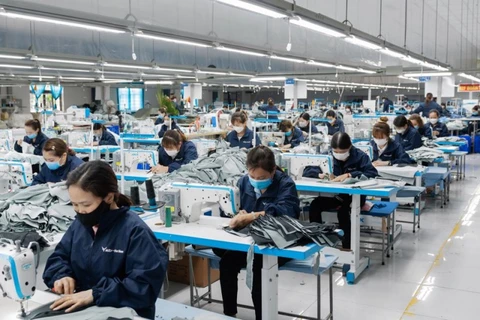
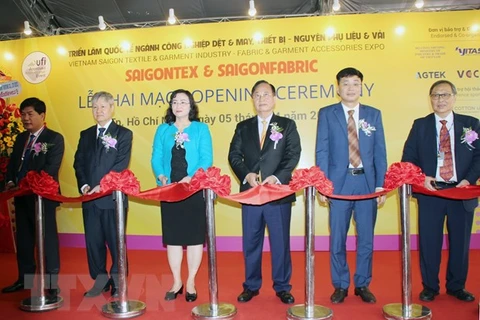
Illustrative image (Photo: VNA)

Australia announces import conditions for Vietnamese pomelos

Australia’s formal publication provides an important legal basis, marking the completion of the review, assessment and agreement on technical requirements for fresh Vietnamese pomelos. This represents a significant step forward in market access, creating favourable conditions for relevant agencies, localities and businesses to prepare for export activities in the coming time.

Containers of fresh Vietnamese durian for export are subject to a full-chain traceability system. (Photo: VNA)

First “green lane” durian shipment exported to China

​Under the “green lane” process, quality control begins at the cultivation stage, including soil sampling and monitoring, and continues through harvesting and processing, with traceability labels attached to trees and applied to fruit at the time of picking. It also allows plant quarantine procedures and the issuance of certificates of origin (C/O) directly in the localities where the orchards are located.

Delegates at the Vietnam Expo 2026 (Photo: VNA)

Vietnam pushes for deeper auto supply chain ties with RoK

The RoK stood as Vietnam’s largest foreign investor with more than 95.2 billion USD in registered capital as of February 2026, or about 18% of all foreign cash flowing in, with thousands of active projects. In January-February alone, the RoK led the pack with nearly 2 billion USD in pledges, grabbing a whopping 32.7% of total registered capital and showing no signs of slowing down.

More than 600 tourism firms, 15 countries and territories, and 34 provinces and cities are promoting destinations and introducing tourism products at the fair (Photo: VNA)

Digital transformation key to elevating Vietnam’s tourism: official

Speaking at the opening of the Vietnam International Travel Mart (VITM) 2026 in Hanoi on April 10, Deputy Minister of Culture, Sports and Tourism Ho An Phong noted that despite challenges in 2025, Vietnam largely fulfilled its socio-economic development goals. Tourism remained a bright spot, recording 21.5 million foreign arrivals and 135.5 million domestic visitors, with total revenue exceeding 1 quadrillion VND (37.9 billion USD).

A drone sprays fertiliser over rice fields. (Photo: VNA)

Low-altitude economy emerges as new growth driver for Vietnam

The UAV technology is particularly effective in addressing challenges faced by ground infrastructure, especially in densely populated urban areas and remote regions. Smart aerial devices also enable real-time data collection, improving governance, decision-making and digital transformation across industries.

Passengers at Cat Bi Airport in Hai Phong city (Photo: VNA)

Aviation sector ensures fuel supply for April 30–May 1 peak

Aviation fuel suppliers are actively negotiating and diversifying supply sources both domestically and internationally, while strengthening coordination, storage and distribution capacity to meet immediate demand. These efforts aim to support airlines in optimising operations and maintaining stable flight schedules.