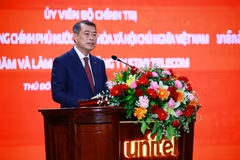
Nguyen Quoc Cuong, Chairman of the Vietnam Farmers Union, tells NongThon Ngay Nay (Countryside Today) about the role of farmers intransforming Vietnam into a modern, industrial nation.
Q: Willyou please further elaborate on Vietnamese farmers' place in thenational campaign to build infrastructure for rural areas?
A:The image of Vietnamese farmers in this period of renewal is in linewith the Party and Government's policies in the agricultural field.
I should say, our country's renewal process started with agriculture,the country's primary industry. In that process, farmers are the maincontributors to innovation and success. After two years implementing therenewal campaign, our poor country, frequently hit by hunger andpoverty, for the first time in 1989 became a rice exporter.
Since then, in addition to rice, Vietnam has also become a majorexporter of coffee, pepper, cashew nuts, aqua products and others.
In 2014 alone, we earned 31 billion USD in export turnover from aqua products.
In short, I can say our farmers are a mainstay in the national fightagainst poverty and hunger, as well as in bringing new, prosperous livesto our countryside.
Q: Will you please tell us about the Vietnam Farmers' Union's new farmer model?
A: Resolution 26 from the 10th tenure of the Party Central Committeedefined objectives, tasks and measures to sustainably develop farmingcommunities and rural areas in the context of our economy, in theprocess of deepening international integration.
In thatdocument, the Party said farmers and rural areas are an important partof the nation's strategy for industrialisation and modernisation, aswell as in national construction and defence.
In short, theresolution's key objective was to develop modern agricultural methods,in which farmers were the key players in building a new rural areas.
Whether we succeed or not depends heavily on agriculture and rural areas.
In my opinion, the new model farmer should possess five main characteristics. They are as follows.
First is the new ideology. Farmers should change their productionmethods to incorporate value chains and international integration.
Second is the new awareness. Farmers are the masters, and they shouldalways be pro-active in applying new technology in production andmarketing.
Third is the practice of a new cultural lifestyle.
Fourth is to enhance the fine cultural traditions of the Vietnamese nation in a creative and innovative manner.
The last point is the resolute commitment to getting rid of poverty and becoming wealthy.
In my opinion the farmer should also have a wealth of knowledge aboutagricultural practices, and the science and technology that must beapplied in agricultural production. He or she must be hard-working andwilling to cooperate. And last but not least is their awareness aboutenvironment protection.-VNA