FDI sector significantly contributes to Vietnam’s economy

The foreign direct investment (FDI) sector has become an important part in Vietnam’s economy, with remarkable contributions to the country’s socio-economic development.
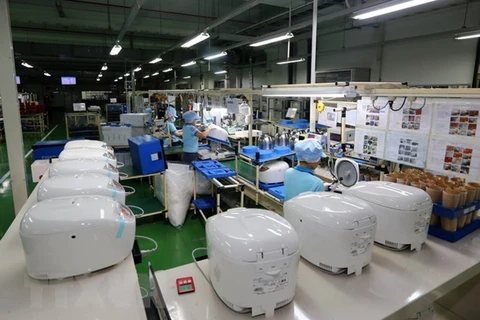
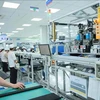
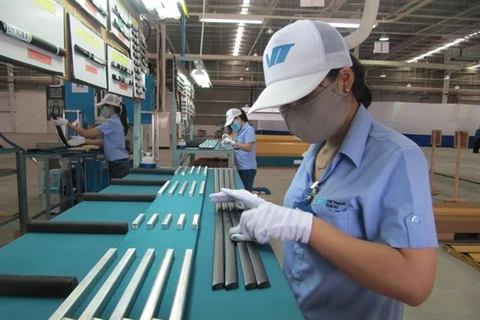
FDI sector significantly contributes to Vietnam’s economy ảnh 1A phone charging cable production line of the KSD Vina Co. Ltd, invested by the Republic of Korea, in Thai Nguyen province (Photo: VNA)

Hanoi(VNA) – The foreign direct investment (FDI) sector has become an important partin Vietnam’s economy, with remarkable contributions to the country’s socio-economicdevelopment.

As of April 2018, Vietnam had attracted 25,524 FDI projects with totalregistered capital of more than 320 billion USD from 126 countries andterritories across the world, according to the Foreign Investment Agency (FIA)under the Ministry of Planning and Investment.

Minister of Planning and Investment Nguyen Chi Dung said the FDI sectorcontributes about 25 percent to social investment capital and 20 percent to thegross domestic product (GDP).

Close to 58 percent of total FDI capital has went to the processing andmanufacturing industries, helping Vietnam increase the value of products andcreate a shift in domestic economic sectors in a more positive and competitiveway.

In 2017, the FDI sector made up 72 percent of total export value and generatedabout 3.5 million direct jobs and 5 million indirect employments.

FIA Director Do Nhat Hoang said FDI has flown into all 63 cities and provincesnationwide. The southern largest economic hub of Ho Chi Minh City tops the listwith 44.7 billion USD in registered FDI, accounting for 13.8 percent of the totalinvestment.

The southern province of Binh Duong ranks second with 30.7 billion USD,accounting for 9.5 percent of the total investment, followed by the capitalcity of Hanoi and Dong Nai province with 27.7 billion USD and 27.34 billionUSD, respectively.

The Ministryof Planning and Investment is drafting a strategy to draw FDI in 2018-2023 withthe assistance of the World Bank (WB).

Economists suggested Vietnam change its FDI attraction policies, focusing onhigh-quality projects applying new cutting-edge technologies, having stronginfluence on the economy and supporting domestic business development.

WB experts advised the country to draw FDI based on technology, labour skillsand production value chains.

Vice Chairman of the People’s Committee of Vinh Phuc province Le Duy Thanh saidthere should be mandatory policies for foreign businesses while investing inVietnam such as requiring them to ensure a localisation rate of 60 percent insteadof 10 percent at present.

Vietnam remained an attractive destination for foreign investors in 2017 withtotal registered FDI capital hitting a record high of 35.88 billion USD, up44.4 percent against last year.

The most attractive sectors were manufacturing-processing industries, electricityproduction and distribution and real estate.

Among 115 countries and territories investing in Vietnam in 2017, Japan toppedthe list, with 9.11 billion USD, making up 25.4 percent of total amount.

It was followedby the Republic of Korea with 8.49 billion USD or 23.7 percent of the FDI, andSingapore with 5.3 billion USD or 14.8 percent.-VNA
VNA
See more

A Vinh Long official introduces signature local products to Korean guests. (Photo: VNA)

Vinh Long courts Korean investment in key sectors

Vice Chairman of the provincial People’s Committee Nguyen Truc Son vowed to accompany investors and provide them with optimal conditions, while building a transparent and stable business environment to secure long-term engagement from foreign enterprises, particularly those from Daejeon.

Delegates at the launching ceremony (Photo: VNA)

Digital platform on overseas market development launched

With Vietnam’s network of 64 trade offices overseas, Deputy PM Son noted that connecting them through a modern digital platform could help establish a unified national trade information system that operates efficiently, transparently and with strong forecasting capacity.

The Government’s issuance of Decree No. 72/2026/ND-CP revising preferential import tariffs on several petrol products and raw materials is a timely move to diversify supply sources. (Photo: VNA)

Fuel import tariff cuts strengthen Vietnam’s energy resilience: experts

Economic expert Dinh Trong Thinh said revising fuel import tariffs helps diversify supply sources and reduce reliance on traditional markets, thereby strengthening Vietnam’s ability to cope with potential global supply shocks. Ensuring access to multiple energy sources is also vital for safeguarding national energy security, he added.

Leaders of Dak Lak province inspect IUU fishing prevention and control efforts at Phu Lac fishing port, Hoa Hiep ward. (Photo: daklak.gov.vn)

Dak Lak readies for EC mission on anti-IUU fishing efforts

Dak Lak province is completing preparations for an upcoming European Commission (EC) inspection on efforts to combat illegal, unreported and unregulated (IUU) fishing, with a view to having the fisheries “yellow card” removed.

Vietnamese Ambassador to Argentina Ngo Minh Nguyet speaks at the event. (Photo: VNA)

Vietnam, Argentina promote trade, investment cooperation

On relations with South America, Nguyet noted that in December 2025, Vietnam and the Southern Common Market (MERCOSUR) announced the launch of negotiations for a Preferential Trade Agreement (PTA). She expressed her hope that the agreement will be signed soon, thereby further boosting trade and investment between Vietnam and MERCOSUR member states, including Argentina.

Customers buy petrol at a Petrolimex petrol station in Tran Hung Dao ward, Hung Yen province. (Photo: VNA)

PM orders stronger measures to ensure stable petrol supply

The MoIT was instructed to direct key petrol producers and traders to proactively develop supply plans to guarantee adequate fuel provision for distribution systems, maintain regular sale operations, and sell products at listed prices. It must also closely monitor developments in global and domestic petrol markets and adopt appropriate management measures when necessary.

Farmers in Ca Mau province use combine harvesters to harvest rice. (Photo: VNA)

PM orders coordinated measures to stabilise rice production and markets

The Minister of Agriculture and Environment is tasked with instructing local authorities to closely monitor production developments, improve forecasting capacity, strengthen pest control measures, and proactively respond to adverse weather conditions to protect crops, maintain planned yields and output, and reduce production costs.

A worker refuels a vehicle at a petrol station in Hung Yen province. (Photo: VNA)

Fuel prices slashed as stabilisation fund used

According to a joint decision by the Ministry of Industry and Trade and the Ministry of Finance, the price of RON95-III petrol – the most widely used grade – fell by 3,880 VND to 25,240 VND (0.95 USD) per litre.

Customers purchase petrol at Station No. 03 (Petrolimex Hung Yen) on Quang Trung Street, Tran Hung Dao ward, Hung Yen province. (Photo: VNA)

Hung Yen takes measures to curb speculation, stabilise fuel market

Petrolimex Hung Yen maintains regular reserves of about 5,500 cubic metres at directly managed outlets and roughly 2,000 cubic metres at franchised stations. The provincial Department of Industry and Trade has ordered closer monitoring of supply and demand and retail prices to detect shortages or unjustified price hikes.

The automobile assembly line of the Honda Phuc Yen factory in Phu Tho province (Photo: VNA)

Honda Vietnam sees decline in motorcycle, car sales

Sales of both motorcycles and automobiles by Honda Vietnam declined in February, dropping 19.6% and 41.8% year-on-year, respectively, according to the company’s latest business results released on March 11.

Team 2 of the Hanoi Market Surveillance Sub-department inspects operations of a Petrolimex petrol station on Tran Quang Khai street (Photo: VNA)

Hanoi maintains stable supply of petrol, LPG

The Hanoi Market Surveillance Sub-department said petrol and LPG trading activities across the city remain stable, with supply largely meeting demand despite volatility in global energy prices.