Firms get updates on EU regulations on imported agricultural products, foods

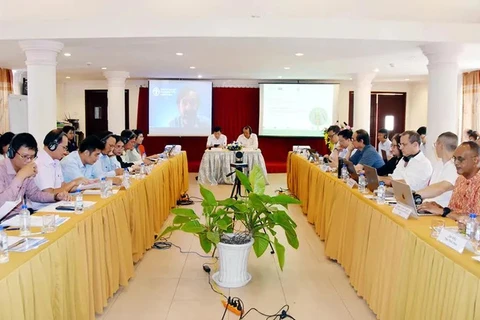
The European Commission’s Directorate-General for Health and Food Safety (DG-SANTE), in collaboration with the Vietnam Sanitary and Phytosanitary Notification Authority and Enquiry Point (Vietnam SPS), held a conference disseminating regulations on imports of agricultural products and foods of plant and animal origin into the EU market on May 7.

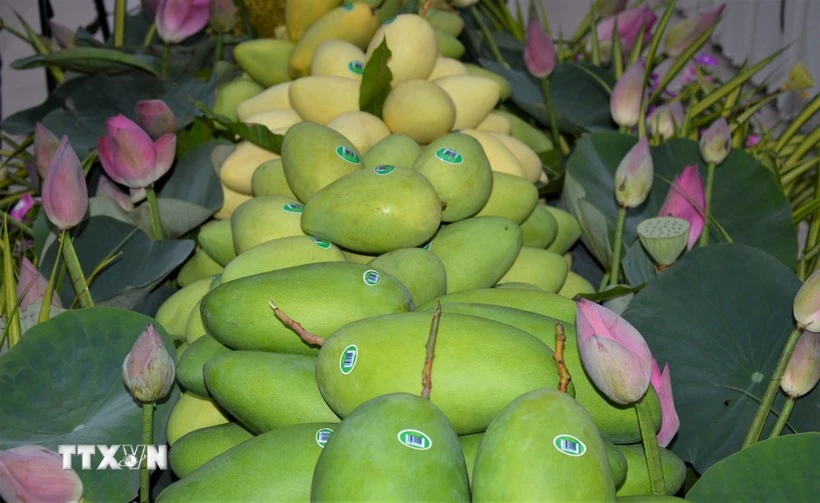
Vietnamese mango (Photo: VNA)

Hanoi (VNA) – The European Commission’s Directorate-General for Health and Food Safety (DG-SANTE), in collaboration with the Vietnam Sanitary and Phytosanitary Notification Authority and Enquiry Point (Vietnam SPS), held a conference disseminating regulations on imports of agricultural products and foods of plant and animal origin into the EU market on May 7.

Recently, the EU has introduced a number of separate requirements for imported composite products. According to Sylvie Coulon, senior expert at DG-SANTE, with this move, the regulation on the percentage of processed products of animal origin will no longer be valid. And the new one is stricter to better protect consumers.

To comply well with new requirements, Sylvie Coulon advised businesses to understand correctly what composite products are, adding they are foods that contain products of plant origin and processed products of animal origin.

At the conference, the DG-SANTE introduced in detail relevant regulations on hygiene and food safety for composite products and products of non-animal origin; rules of origin, as well as a residue monitoring plan on these products, along with quarantine measures based on international practices issued by the World Trade Organisation (WTO).

Le Thanh Hoa, Director of Vietnam SPS Office, said that although the EU-Vietnam Free Trade Agreement (EVFTA) has been in effect for nearly four years, there remain shortcomings and difficulties, especially those related to food safety regulations as well as others on the environment and sustainable development.

Hoa showed his hope that the EU will continue to support the Vietnam SPS Office to update information and regulations related to food safety to businesses when exporting products to the EU; and help strengthen the capacity of Vietnam's food safety control system as well as animal and plant quarantine network.

In 2023, Vietnam's agricultural, forestry and fishery export turnover to the European market reached about 5.3 billion USD, making it Vietnam's third largest market, after the US and China./.
VNA

See more

A livestream session promotes green-skinned pomelos grown in Cho Lach commune, Vinh Long province. (Photo: VNA)

E-commerce reshapes rules of game

Once fixed fees, payment fees, infrastructure charges and service packages are included, sellers may have to spend around 24.5-27.6% of their revenue on platforms. The figure shows that the era of easy selling and low costs in e-commerce has officially come to an end.

Ho Chi Minh City targets third-quarter growth of over 11% (Photo: VNA)

Ho Chi Minh City targets third-quarter growth of over 11%

Ho Chi Minh City will continue to implement drastic measures to achieve double-digit growth, targeting GRDP growth of at least 11.07% in the third quarter of 2026, 9.43% in the first nine months and 12.3% in the fourth quarter, with a view to completing the full-year goal of 10% or more.

MM Mega Market An Phu supermarket in Ho Chi Minh City is brightly decorated for the National Day holiday. (Photo: VNA)

Domestic consumption up over 13%, tourism continues strong growth

The total retail sales of goods and consumer service revenues in August were estimated at 679.8 trillion VND (26 billion USD), up 1.6% from the previous month and 14.9% year-on-year. In the January-August period, the figure reached 5.24 quadrillion VND, representing a 13.3% increase year-on-year.

A production line of Onaga Co., Ltd. (Japan) at HANSSIP (Photo: nhandan.vn)

Hanoi moves to maintain appeal to FDI inflows

In the first eight months of 2026, the capital city attracted more than 3.7 billion USD in FDI, equivalent to 83% of the plan set for the year. Newly registered FDI exceeded 572 million USD across 450 projects, up 175.78% in project numbers and 209.46% in capital compared to the same period last year. Additional registered capital topped 492 million USD, while capital contributions and share purchases exceeded 2.6 billion USD.

Saigon Marina IFC is the first private-sector project contributing to realising the goal of developing the Vietnam International Financial Centre in Ho Chi Minh City. (Photo: VNA)

VIFC offers various opportunities to attract forein investment

Turning the VIFC into an effective channel for international capital will require clear rules, quality projects and strong connections between investors and domestic businesses. Meeting these requirements will be key to transforming investor interest into concrete capital flows and investment projects in Vietnam.

Production line at Yadea Vietnam’s smart manufacturing plant, which has an investment of more than 100 million USD, in Tan Hung Industrial Park, Bac Ninh province. (Photo: VNA)

Development model for new era – An inevitable trend

International organisations broadly agree that shifting the growth model from reliance on traditional factors toward technology and innovation is no longer an option for Vietnam, but an imperative of the times.

At a commune administrative service centre in Hung Yen province (Photo: VNA)

Government determined to cut administrative procedures to drive double-digit growth

Resolution No. 258/NQ-CP, dated August 31, 2026, calls for substantive and comprehensive reform, with a focus on maximum cuts and simplification of administrative procedures and business conditions. It also seeks to shift management from pre-licence inspection to post-licence inspection based on risk management, while strengthening real-time, data-driven oversight and putting people and businesses at the centre of public services.

(Illustrative photo: VNA)

Vietnam eyes entry into 40-billion-USD Southeast Asian CCS market: experts

A clear, transparent and stable legal framework would not only enable Petrovietnam to play a leading role in new energy development but also strengthen investor confidence, encouraging both domestic and foreign enterprises to invest, transfer technology and cooperate in developing large-scale CCS projects.

Durian is stockpiled at a company warehouse in Dong Gia Nghia ward, Lam Dong province, for sorting and distribution to the market. (Photo: VNA)

Vietnam targets durian exports of around 4 billion USD in 2026

In the first eight months, Vietnam's durian export revenue was estimated at 1.95 billion USD, of which exports to China alone fetched 1.85 billion USD or 95%. The country is working very hard to earn 4 billion USD from durian exports this year.