Firms urged to carefully study market, partners when exporting to Israel

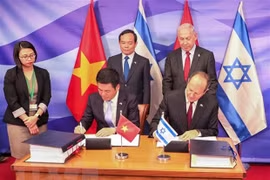
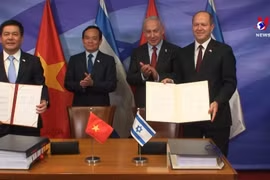
The Vietnam - Israel Free Trade Agreement (VIFTA), which was signed last month, has opened up new opportunities for Vietnamese goods to enter an important market in the Middle East.
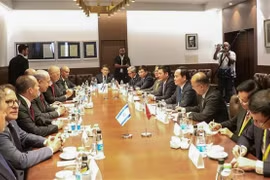
Firms urged to carefully study market, partners when exporting to Israel ảnh 1Currently, Israel is the 5th largest trading partner and the 3rd largest export market of Vietnam in the Middle East. (Photo: VNA)

Tel Aviv (VNA) –  The Vietnam - Israel Free Trade Agreement (VIFTA), which was signed last month, has opened up new opportunities for Vietnamese goods to enter an important market in the Middle East.

However, in the context of international trade with manypotential risks of fraud, businesses need to be fully equipped with thenecessary information and skills to be able to optimise business efficiency andtake advantage of the agreement, Vietnamese Trade Counselor in Israel LeThai Hoa has said.

Hoa said that in general, Israeli enterprises do businessdynamically, quickly adapt to market fluctuations, and transact quickly. They alwaysactively look for partners and customers through many different channels. They havediverse demands and stable purchasing power, and high solvency.

Israeli businesses are willing to deposit or pay in advance,prefer to meeting directly with their partners and see goods at the factory. Theyoften approach separate supply partners. They want to buy directly from manufacturers, not through intermediaries.

Hoa emphasised that Vietnamese businesses when transacting anddoing business with partners in the Israeli market need to carefully studythe markets and partners. In some cases, it is necessary to verify thelegal status of the partners, especially new ones.

He said businesses also need to master foreign tradetechniques, customs and practices in international trade; and sign contractswith strict content on payment terms, goods quality standards, packaging,delivery deadlines, and dispute resolution.

Hoa suggested that for export activities to Israel to achievehigh efficiency, businesses also need to focus on offering processed productswith high added value, competitive prices and appropriate quality.

He noted that Israel is a market with typical specific characteristicsrelating to people and religion. Jewish businesses often require exporters tohave Kosher certification, while Arab businesses require exporters to haveHalal certification for certain types of goods, especially food.

In addition, businesses also need to regularly follow developmentson the political and security situation in Israel, because this is a sensitive area for conflictsand instability affecting the entire region.

Hoa said to promote the implementation of VIFTA, in the comingtime, the Vietnam Trade Office in Israel plans to organise activities which providerelevant parties with information about the agreement and promote connections between the business communities of the two countries.

Currently, Israel is the 5th largest trading partner and the 3rdlargest export market of Vietnam in the Middle East, after the UAE and Turkey.The structure of import and export goods between Vietnam and Israel iscomplementary. The goods that Israel needs to import are also export productswith the strength of Vietnam and vice versa. Every year, about 70 Vietnamese items are exported to Israel.

Meanwhile, Israeli businesses are increasingly interested in theVietnamese market and partners, considering Vietnam as one of the importantstable suppliers in Asia, especially for mobile phones, agricultural products, seafood,processed foods, beverages, household goods, and electric machinery, and electronic products.

In addition, according to the negotiation content in VIFTA, someagricultural products such as eggs, meat, potatoes, carrots, cauliflower,mushroom, honey, and tuna are granted tariff quotas by Israel with an in-quotatax rate of 0%. Many fashion items, processed footwear and finished products willbe exempt from tariffs as soon as the agreement comes into effect.

According to Hoa, in recent years, Israel often faces a shortageof dairy products of all kinds, due to high demand of consumers  and insufficientdomestic production.

Therefore, the Israeli Government must continuously adjusttrade policies on imports for this item, applying mainly the abolition ofimport duties and tariff quotas for dairy products to increase supply. That isan opportunity for Vietnamese businesses to boost dairy exports to Israel inthe near future, he said./.
VNA

See more

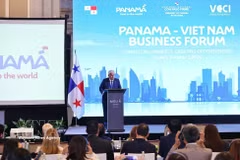
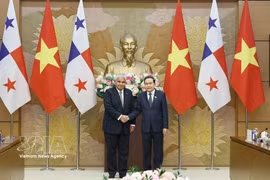
Panamanian President José Raúl Mulino speaks at the Panama-Vietnam Business Forum on October 7 in Hanoi. (Photo: VNA)

Vietnam, Panama seek to expand economic cooperation

In the presence of President Mulino, VCCI and the Chamber of Commerce, Industries and Agriculture of Panama signed a memorandum of understanding (MoU) to strengthen cooperation, enhance trade and investment promotion programmes, and support bilateral investment and trade.

Ministry updates on Vietnam-US reciprocal trade agreement talks

Ministry updates on Vietnam-US reciprocal trade agreement talks

The US is one of Vietnam’s major trading partners and holds paramount importance to the country’s exports. The conclusion of the bilateral trade agreement will help establish a stable and balanced trade framework toward sustainable development and open up greater opportunities for cooperation between the two countries.

MICE visitors enjoy services at Song Be Golf Resort in Ho Chi Minh City. (Photo: VNA)

Ho Chi Minh City shifts MICE tourism from venues to experiences

Ho Chi Minh City boasts significant advantages for MICE tourism, with the central area offering strengths in finance, trade and services; Binh Duong in industry, exhibitions and business connectivity; and Ba Ria-Vung Tau and Con Dao in marine tourism, resorts, ecology and distinctive experiences.

National Brand products are on display at the Vietnam National Brand International Forum. (Photo: VNA)

Vietnam's national brand value jumps 45% to over 462 bln USD

Deputy Minister of Industry and Trade Luong Hoang Thai outlined Vietnam's National Brand Programme 's achievements, the role of business community and plans for brand development in a press interview ahead of the 10th Vietnam National Brand Product recognition ceremony on October 16.

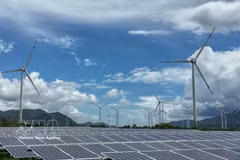
Khanh Hoa province possesses significant advantages for renewable energy projects and new energy sectors. (Photo: VNA)

New value chains from two industrial – renewable energy centres

To implement the revised Power Development Plan VIII, the Ministry of Industry and Trade has proposed establishing two inter-regional renewable energy industrial and service centres in the northern and southern regions to develop the renewable energy sector and a complete value chain.

WB Senior Environmental Specialist and Task Team Leader Stephen Ling speaks at the working session (Photo; VNA)

Ca Mau, WB cooperate in sustainable fisheries development

Scheduled to run from 2026 to 2029, the project aims to develop the local fisheries sector and deepen global integration, while adapting to climate change and protecting the environment through infrastructure upgrades, technological innovation, and better management and production capacity.

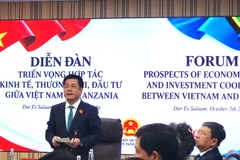
Vice President of the Vietnamese National Assembly Nguyen Hong Dien speaks at the forum. (Photo: Vietnam Trade Promotion Agency)

Tanzanian businesses seek greater cooperation, investment opportunities with Vietnam

Attending the forum during his working visit to Tanzania, Vice President of the National Assembly Nguyen Hong Dien said the two economies were highly complementary. Tanzania has strengths in natural resources, agriculture, energy, its domestic market and its strategic position in East Africa, while Vietnam has advantages in manufacturing and processing, high-tech agriculture, electronics, telecommunications and international trade.

The automatic ticketing system that uses electronic identification, authentication, biometric recognition and cashless payment for passengers on the Cat Linh-Ha Dong railway line in Hanoi. (Photo: VNA)

Cashless payments open gateway to financial inclusion

Cashless payments continued to grow rapidly in the first eight months of 2026. The number and value of cashless transactions rose 34.56% and 13.26% year-on-year, respectively, while online transactions increased 46.57% in number and 21.77% in value.