First international circus gala opens in HCM City

First international circus gala opens in HCM City
First international circus gala opens in HCM City ảnh 1 An animal circus performance (Photo VNA)

HCM City (VNA) –
The first international circus gala kicked off in Ho Chi Minh City onFebruary 16, the first day of the Lunar New Year 2018.

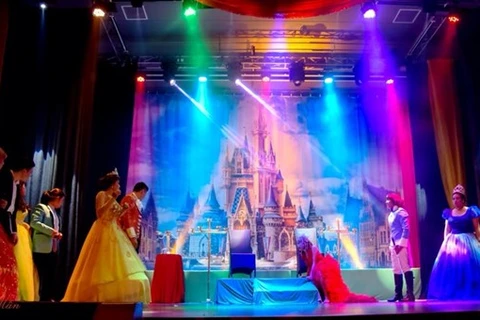
More than 50 circusperformers from Vietnam, Russia, the US,Ukraine and Mongolia werebrought together at the event.

According to theorganising board, domestic and foreign artists have practised hard over thepast few months to show the best performances to audiences.

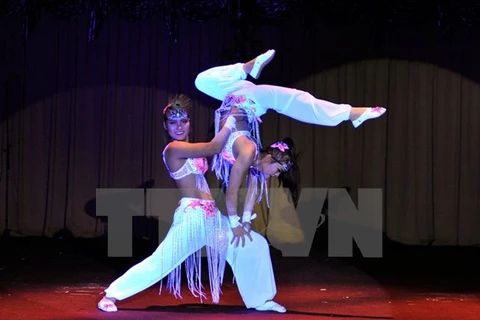
Notably was thered-nose clown Rostyslav Biliak from Russia and young female artist SattraLaura Ortega from the US with the risk performance with thin strips of silk.

Artists from Ukraine and Mongolia wowed the audiences withspectacular acrobatics performances.

In addition, childrenwere attracted by fabulous animal circus shows.

The circus gala willrun until March 18 at Gia Dinh Park,Go Vap district, HCM City, then come to the central city of Da Nang and the northeastern province of Quang Ninhtill April 15.-VNA
VNA
See more

Visitors to an exhibition and test-drive programme for electric vehicles organised in Cau Giay ward, Hanoi, on May 16 by the municipal People's Commitee and relevant agencies. (Photo: VNA)

Hanoi proposes subsidies to accelerate shift to electric vehicles

Under a draft resolution currently open for public feedback by the municipal People’s Committee, residents with permanent or temporary residence registration in Hanoi for at least two consecutive years, who own petrol-powered motorbikes registered before the resolution takes effect, will be eligible for support when purchasing electric motorbikes priced at 10 million VND or more.

The copyright crackdown is broadly viewed as an inevitable step in Vietnam’s cultural industry development. (Illustrative photo: VNA)

Healthy digital content market in the making

The sharper crackdown is rapidly redrawing how online entertainment is distributed and consumed, while gradually reshaping public awareness and responsibility toward copyright protection.

A view of Place Ho Chi Minh in Persan, France. (Photo: VNA)

Place preserving memories of President Ho Chi Minh in France

Although there is little publicly available documentation confirming exactly when Place Ho Chi Minh was established, French urban historians suggest that most streets and public spaces named after the Vietnamese leader in France emerged between the 1960s and 1980s, during the height of anti-war movements and solidarity campaigns supporting Vietnam across working-class towns and left-leaning suburbs around Paris.

Vietnamese Ambassador to Bangladesh Nguyen Manh Cuong speaks at the seminar. (Photo: VNA)

President Ho Chi Minh’s thought on national unity remains relevant today

President Ho Chi Minh's ideology of national unity continues to carry profound significance amid growing global challenges, including conflicts, social divisions and economic instability. His message of solidarity, consensus and placing national interests above sectional differences remains a valuable lesson for many developing nations.

Assoc. Prof. Dr. Nguyen Duc Son presents the decision establishing the Vietnamese Language Proficiency Test Council in Japan to a representative of the Vietnam Studies Centre in Japan. (Photo: VNA)

Japan hosts first standardised Vietnamese language proficiency test

As bilateral ties between Vietnam and Japan continue to expand, demand for Vietnamese language learning in Japan has also grown rapidly among OVs, educational institutions, businesses and Japanese people interested in Vietnam. Against this backdrop, the introduction of a standardised proficiency test is expected to provide an official and widely recognised benchmark for Vietnamese language skills.

The “I Love My Fatherland" Journey 2026 kicks off in Nghe An province on May 16. (Photo: VNA)

"I Love My Fatherland” journey features diverse activities

The “I Love My Fatherland” journey will span seven stages across historical and cultural sites and “red addresses” nationwide. There will be a combination of education on traditions, field-based programmes, and digital communications.