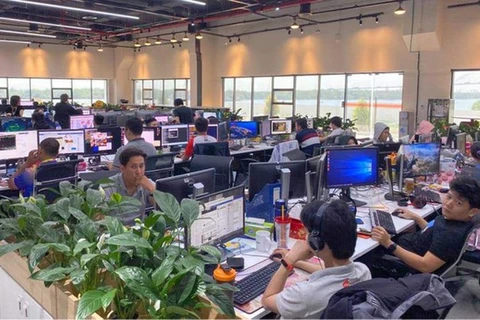
In Vietnam, the game industry has been growing strongly over the last 10 years to earn over 500 million USD in annual revenue. (Photo: game4v.com)
 Hanoi (VNA) – The game industry in Vietnam is considered lucrative, but it is facing a number of difficulties that need to be addressed at the soonest in order to level up to its full potential.
Huge potential of game industry
In 2022, there were nearly 3.2 billion video game players around the world, and the industry generated some 182.9 billion USD in revenue. The figures are forecast to hit 3.79 billion players, or over 47% of the global population, and 212.4 billion USD in revenue in 2026.
Vu Quoc Huy, Director of the Vietnam National Innovation Centre (NIC), said the game industry is one of the eight focal areas expected to help the country make development breakthrough and promote a growth model based on science, technology, and innovation.
In Vietnam, the industry has been growing strongly over the last 10 years to earn over 500 million USD in annual revenue, ranking fifth in Southeast Asia. More than half of the country’s population have accessed video games for entertainment, statistics show.
Huy noted that the game industry has created many jobs in game programming and design that have high economic value and competitiveness. It also holds chances to become a valuable export sector helping promote Vietnam’s position in global value chains.
The country now ranks second in Southeast Asia when it comes to game downloads which increase about 10% annually. In the world, it is among the top 10 in terms of the download number and the top 30 in terms of revenue.
Given the statistics, Dao Viet Anh, startup and developer manager at Microsoft in Vietnam, described the country as a video game power in Southeast Asia.
According to a 2022 report by mobile data and analytics firm App Annie, Vietnam tops the Australia - New Zealand - Southeast Asia region as it is home to up to five of the 10 biggest game distributors in the region, namely Amanotes, OneSoft, GameJam, VNG, and Arrasol. It also has many programmers capable of making games qualified to be supplied on Google and Apple stores.
Apple estimated that around 180,000 Vietnamese people are developing mobile apps, and those working in the game industry account for the most.
Meanwhile, the Ministry of Information and Communications (MIC) said Vietnam ranks seventh among the global mobile game distributors, and about half of the world’s most famous games at present are contributed by Vietnamese people.
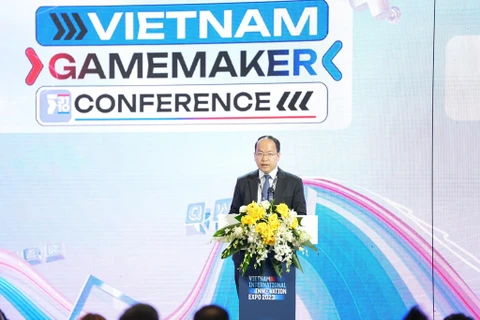
The ministry targeted that the game industry’s revenue will increase from 600 million USD to 1 billion USD in five years.
 The Vietnamese game industry’s revenue is hoped to increase from 600 million USD to 1 billion USD in five years. (Photo: VNA)
 Difficulties need to be tackled
In Vietnam, the industry is still facing social prejudices as many people believe video games are addictive, have negative impact on players, and are money- and time-consuming.
Apart from those prejudices, Le Quang Tu Do, Director of the MIC’s Authority of Broadcasting and Electronic Information, pointed out the shortage of policy, tax, and financial assistance for the industry to develop and compete with foreign games right in the domestic market.
A true ecosystem for the game industry hasn’t taken shape in Vietnam while businesses in the sector have yet to make use of their advantages to cooperate with one another. Distributors haven’t found out many Vietnamese games having truly high quality, he said.
The industry is also struggling with a shortage of high-quality human resources, Do noted, adding that Vietnam needs up to 30,000 personnel for the game industry.
NIC Director Huy held that to turn the game industry into a truly valuable one that has strong competitiveness and generates many high-value jobs, it is necessary to develop an international-quality workforce and a diverse ecosystem in which stakeholders stay united and support each other to grow.
Meanwhile, La Xuan Thang, distribution director of VNGGames at VNG Corporation, said the game industry needs to be officially recognised as an economic sector and an important pillar of the digital economy so as to devise an appropriate management strategy and development roadmap.
Once the industry receives proper recognition from society and authorities and has skilled manpower able to access global technological trends, Vietnam will have quality games and attract more foreign investment so that to the industry can become a pillar of the digital economy, he continued.
MIC built a development roadmap for the game industry in the 2022 - 2027 period which focuses on settling major issues, including the creation of favourable mechanisms and policies, market management, and support for manpower training. Aside from helping domestic game developers connect with foreign partners, it has also been working to attract foreign investment funds and businesses to the industry in Vietnam./.