Vietnamese Party chief’s article highlights experience in creative application of Marxism-Leninism

German historian: Vietnamese Party chief’s article highlights experience in creative application of Marxism-Leninism

German historian and veteran journalist Gerhard Feldbauer has hailed the significance of Party General Secretary Nguyen Phu Trong’s article “Several theoretical and practical issues on socialism and the pathway towards socialism in Vietnam”.
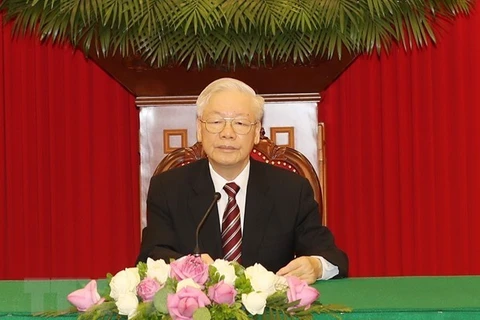
German historian: Vietnamese Party chief’s article highlights experience in creative application of Marxism-Leninism ảnh 1Party General Secretary Nguyen Phu Trong (Photo: VNA)

Berlin (VNA) – Germanhistorian and veteran journalist Gerhard Feldbauer has hailed the significanceof Party General Secretary Nguyen Phu Trong’s article “Several theoretical andpractical issues on socialism and the pathway towards socialism in Vietnam”.

Feldbauer said the article gave acomprehensive, insightful and thorough analysis of the path chosen by Vietnamsince the victory of the August Revolution 1945. He pointed out that throughout its leadership process, the Communist Party of Vietnam creatively applied Marxism-Leninism in the country’s specific conditions to deal with various complex and difficult issues, providing valuable experience to not only Vietnam but also many countries in the world.

Gerhard Feldbauer stressed that the CPV and its members have stayed consistent to the road of building socialism. He noted that the CPV now has more than 5.1 million members, 60 percent of whom are young people, which refuted allegations that young Vietnamese are no longer interested in politics or socialism. 

According to him, Vietnam ison the way toward a modern and socialist-oriented industrialised economy. Fromits starting point as a poor nation due to war aftermaths, Vietnam has become one of the world’s mostvibrant and fastest-growing economies in Southeast Asia with an annual growthof 6-8 percent before the COVID-19 pandemic.

Since it began the renewal process,Vietnam has signed a number of bilateral deals and joined internationalorganisations such as the International Monetary Fund, the World Bank, and mostrecently the European Union – Vietnam Free Trade Agreement (EVFTA).

On the back of the EVFTA, Vietnam became theEU’s second biggest trade partner in ASEAN. In 2018, Vietnam exported goods andservices worth over 35 billion EUR to the EU, mostly apparel, mobile phones andaccessories and spent over 10 billion EUR on goods from the bloc.

About challenges faced by the country on thepath toward socialism, Feldbauer said the key point is to affirm the leadership of the CPV and defeat every attempt to lower or eliminate the role of the Party. He also suggested Vietnam crackdown on corruption and stay close with the people in all aspects.

He expressed his belief thatunder the CPV’s leadership, Vietnam will always overcome any difficultperiods in history.

Feldbauer also underlined the great role of President Ho Chi Minh in every victory of Vietnam’s revolution, and lauded the tireless and unyielding fighting spirit of the Vietnamesepeople, considering it a prerequisite for successes of the Vietnam’srevolution.

Feldbauer, 88, used to work as a reporter of the German Democratic Republic’s ADN news agency in Hanoi. He and his wife – photo correspondentIrene, worked in Hanoi from 1967 to 1970. With a doctoral degree on Vietnam history, he wrote 15 books, four of them aboutVietnam./.

VNA

See more

WB plans over 3 bln USD in financing for Philippines

Indonesia, RoK eye stronger creative economy collaboration

Assessing the prospects for cooperation, Minister Teuku Riefky Harsya said that under the Strategic Partnership between the two countries, there are significant opportunities to promote cooperation in production, talent exchange, digital game development and other technology-related fields that would benefit the creative industries of both Indonesia and the RoK.

Thailand targets 33 million foreign visitors this year

Thailand targets 33 million foreign visitors this year

TAT forecasts that Thailand will welcome 33 million international tourists in 2026, generating about 1.55 trillion THB (47.5 billion USD) in revenue, along with 200.4 million domestic trips, expected to generate about 1.1 trillion THB.

​ Thailand secures deal to export 500 tonnes of durian to China

​ Thailand secures deal to export 500 tonnes of durian to China

The highlight of the visit was the signing of a memorandum of understanding (MoU) between producers of Sisaket volcanic durian and the Huizhan market for the supply of 500 tonnes of durian. The agreement is expected to expand the market share of Thai fruit in China while enhancing the value of products protected by geographical indications.

UK backs Indonesia’s OECD accession

UK backs Indonesia’s OECD accession

The UK and Indonesia have launched an Economic Growth Partnership and pledged to work together to address technical barriers to trade, enhance regulatory transparency, and facilitate investment and business activities.

Thai broadcaster Jasmine International (JAS) inks an eleventh-hour deal for World Cup rights.

Thai broadcaster secures FIFA World Cup 2026 rights at last minute

JAS finalised the 70-million-USD agreement with FIFA on June 11. The deal grants the company exclusive rights to broadcast not only the FIFA World Cup in 2026 and 2030 but also a wide range of FIFA competitions through 2030, including men's and women's football tournaments, futsal, beach soccer, the FIFA Club World Cup and FIFA eSports events.

Underground cooling solution helps Singapore ease energy demand

Laos, Japan agree to strengthen bilateral cooperation

Lao Prime Minister Sonexay Siphandone and his Japanese counterpart Takaichi Sanae have reaffirmed their commitment to deepening the Comprehensive Strategic Partnership between the two countries, with a particular focus on expanding economic, trade, and investment cooperation.

Thailand imposes stricter rules for online advertisers

Thailand imposes stricter rules for online advertisers

Under the regulations, platforms must establish systems to verify the identities of individuals or organisations wishing to place advertisements before they are published. The measure aims to prevent criminal groups from using advertising space to lure victims or commit technology-related crimes that are causing significant damage.