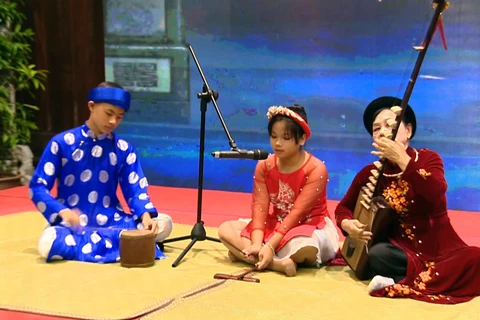
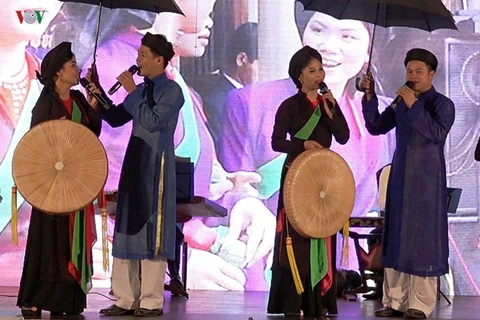
Image on Google's homepage on February 23 which depicts artists performing ca tru (Photo: VNA)
 Hanoi (VNA) – An image of artists performing ca tru (ceremonial singing) was featured on Google’s homepage on February 23, which was the ca tru founders commemoration day.
A representative of Google said that the move was to raise public awareness of traditional folk arts which are facing the risk of oblivion, as well as encourage the young generation to explore the unique and diverse cultural and art forms of Vietnam.
Taking into account the precious nature of an invaluable historical relic and the difficulty of its safeguarding, UNESCO is dedicated to protecting the practice and inscribed ca tru on the List of Intangible Cultural Heritage in Need of Urgent Safeguarding.
Ca tru is a complex form of sung poetry found in the north of Vietnam using lyrics written in traditional Vietnamese poetic forms.
A ca tru group comprises three performers: a female singer who uses breathing techniques and vibrato to create unique ornamented sounds, while playing the clappers or striking a wooden box, and two instrumentalists who produce the deep tone of a three-stringed lute and the strong sounds of a praise drum.
Some ca tru performances also include dance. The varied forms of ca tru fulfil different social purposes, including worship singing, singing for entertainment, singing in royal palaces and competitive singing.
Ca tru has 56 different musical forms or melodies, each of which is called “the cach”. Folk artists transmit the music and poems that comprise ca tru pieces by oral and technical transmission, formerly, within their family line, but now to any who wish to learn.
The art genre appeared in the North around the 15th century and thrived until the early 20th century. Since then, it has decreased in popularity due to the spread of modern recreational and cultural activities./.
A representative of Google said that the move was to raise public awareness of traditional folk arts which are facing the risk of oblivion, as well as encourage the young generation to explore the unique and diverse cultural and art forms of Vietnam.
Taking into account the precious nature of an invaluable historical relic and the difficulty of its safeguarding, UNESCO is dedicated to protecting the practice and inscribed ca tru on the List of Intangible Cultural Heritage in Need of Urgent Safeguarding.
Ca tru is a complex form of sung poetry found in the north of Vietnam using lyrics written in traditional Vietnamese poetic forms.
A ca tru group comprises three performers: a female singer who uses breathing techniques and vibrato to create unique ornamented sounds, while playing the clappers or striking a wooden box, and two instrumentalists who produce the deep tone of a three-stringed lute and the strong sounds of a praise drum.
Some ca tru performances also include dance. The varied forms of ca tru fulfil different social purposes, including worship singing, singing for entertainment, singing in royal palaces and competitive singing.
Ca tru has 56 different musical forms or melodies, each of which is called “the cach”. Folk artists transmit the music and poems that comprise ca tru pieces by oral and technical transmission, formerly, within their family line, but now to any who wish to learn.
The art genre appeared in the North around the 15th century and thrived until the early 20th century. Since then, it has decreased in popularity due to the spread of modern recreational and cultural activities./.
VNA