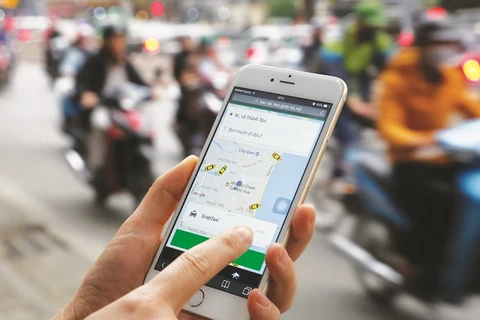
Grab cars seen in a parking lot in Hanoi during a promotion campaign by the Singapore-based raid-hailing tech firm (Photo: baogiaothong.vn)
 Hanoi (VNS/VNA) - Vietnam must identify, implement and build management models for sharing economy applications in the country’s major sectors such as banking and transport to ensure a fair business playground and protect all involved parties, said economics experts at a conference on the sharing economy in Hanoi on October 10.
The conference was organised by the Central Institute of Economic Management (CIEM) to share knowledge and support the implementation of sharing economy models in governmental ministries, agencies and other shareholders.
Deputy head of CIEM Nguyen Thi Tue Anh urged governmental bodies to open up to new concepts and practices by allowing pilot programmes to test new economic models, and to replace antiquated and obsolete regulations.
While not yet reaching a sizeable scope, the sharing economy model has huge potential for growth in Vietnam, said Dr Nguyen Manh Hai, head researcher of CIEM’s social affairs study.
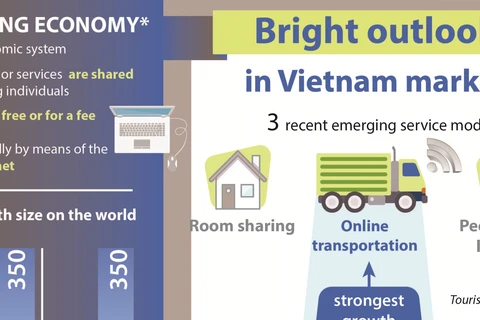
He cited massive adaptation of transport technology firms such as Grab, Uber and Didi Chuxing since 2014 and home-sharing models such as Airbnb, which lists some 6,500 homes in Vietnam. In addition, other sharing economy models are starting to emerge including home repair, construction and fintech services.
Despite its rapid proliferation, the Government showed a lack of focus in providing a legal framework to regulate sharing economy models, Hai said. For example, getting a business licence may prove to be an arduous process because many said the models were not even included in the country’s business registration system.
There are currently no laws to support and manage sharing economy activities, making it near impossible for governmental agencies to ensure fair business competition and the quality of goods and services provided or protect consumers’ rights.
Furthermore, in the absence of effective laws, businesses may be able to get away with not fulfilling their financial duties to the State with consumers’ private data being exposed to security threats.
Nghiem Thanh Son, head of the Department of Payment at the State Bank of Vietnam, said measures such as a Regulatory Sandbox – a framework set up by financial sector regulators that allows small scale, live testing of new products and services in a controlled environment – could address many of the sticking points in the fintech sector.
“The central bank supports innovation and encourages all businesses to perform extensive testing of new [financial] products to make sure the legitimate rights of businesses and consumers are protected,” said Son.
The transport sector’s laws and regulations were especially antiquated and can no longer accommodate the rapid growth of modern economic models, let alone ensure a fair business playground or protect consumers, said Ngo Vinh Bach Duong, head of economic laws from the Institute of State and Law.
Duong said the Government should reduce business conditions for modern economic models instead of trying to fit aged regulations currently applied to traditional business models on modern ones. Policymakers must also place greater emphasis on protecting consumers’ rights./.
The conference was organised by the Central Institute of Economic Management (CIEM) to share knowledge and support the implementation of sharing economy models in governmental ministries, agencies and other shareholders.
Deputy head of CIEM Nguyen Thi Tue Anh urged governmental bodies to open up to new concepts and practices by allowing pilot programmes to test new economic models, and to replace antiquated and obsolete regulations.
While not yet reaching a sizeable scope, the sharing economy model has huge potential for growth in Vietnam, said Dr Nguyen Manh Hai, head researcher of CIEM’s social affairs study.
He cited massive adaptation of transport technology firms such as Grab, Uber and Didi Chuxing since 2014 and home-sharing models such as Airbnb, which lists some 6,500 homes in Vietnam. In addition, other sharing economy models are starting to emerge including home repair, construction and fintech services.
Despite its rapid proliferation, the Government showed a lack of focus in providing a legal framework to regulate sharing economy models, Hai said. For example, getting a business licence may prove to be an arduous process because many said the models were not even included in the country’s business registration system.
There are currently no laws to support and manage sharing economy activities, making it near impossible for governmental agencies to ensure fair business competition and the quality of goods and services provided or protect consumers’ rights.
Furthermore, in the absence of effective laws, businesses may be able to get away with not fulfilling their financial duties to the State with consumers’ private data being exposed to security threats.
Nghiem Thanh Son, head of the Department of Payment at the State Bank of Vietnam, said measures such as a Regulatory Sandbox – a framework set up by financial sector regulators that allows small scale, live testing of new products and services in a controlled environment – could address many of the sticking points in the fintech sector.
“The central bank supports innovation and encourages all businesses to perform extensive testing of new [financial] products to make sure the legitimate rights of businesses and consumers are protected,” said Son.
The transport sector’s laws and regulations were especially antiquated and can no longer accommodate the rapid growth of modern economic models, let alone ensure a fair business playground or protect consumers, said Ngo Vinh Bach Duong, head of economic laws from the Institute of State and Law.
Duong said the Government should reduce business conditions for modern economic models instead of trying to fit aged regulations currently applied to traditional business models on modern ones. Policymakers must also place greater emphasis on protecting consumers’ rights./.
VNA