Hang Bac street - birthplace of Hanoi’s silver jewellery

Hang Bac is viewed as the “most expensive” among Hanoi’s 36 old streets. In the past, people living on this street relied on three major jobs, involving silver ingot and jewellery making, and money exchange.
Hang Bac street - birthplace of Hanoi’s silver jewellery ảnh 1Steps to create silver jewellery in Hang Bac street (Photo: Vietnam Pictorial)
Hanoi (VNA) - Hang Bac is viewed as the“most expensive” among Hanoi’s 36 old streets. In the past, people living onthis street relied on three major jobs, involving silver ingot and jewellerymaking, and money exchange.

Those three jobs originated from threecraft villages famous for making gold and silver jewellery in the north of ChauKhe in Hung Yen province, Dong Xam in Thai Binh province and Dinh Cong inHanoi.

In the 15th century, Minister of InteriorLuu Xuan Tin, a native of Chau Khe village of Hung Yen, was assigned by a courtof the later Le Dynasty (1428 – 1789) to set up a workshop making silver ingotsin the Thang Long imperial city, which is currently Hanoi.

At that time, silver ingots and gold barswere used as money. Tin brought artisans from Chau Khe to the capital toestablish the workshop. After a while, along with making ingots, artisans beganmaking patterns for gold and silver jewellery.

In the early years of the 19th century,under the reign of the Nguyen Dynasty (1802–1945), the workshop was relocatedto the central imperial city of Hue. Most of Chau Khe artisans remained inThang Long and set up a community at the area which is now Hang Bac street.

From then on, artisans of Dinh Cong andDong Xam craft villages came to settle down in the street. That marked thebirth of Hang Bac street which specialises in crafting gold and silverjewellery in Hanoi.

Along with the manufacturing and trading ofsilver, shops in the street exchanged silver ingots for chips. Therefore, inthe colonial rule of France, the street’s name in French was Rue de changeurs(silver-exchange street).

Various sophisticated gold and silverjewellery works were crafted by artisans in Hang Bac street. In technicalterms, experts classify their products into two types, including those withoutpatterns such as rings and women and children’s earrings and bracelets, andthose with patterns.

Artisans in Hang Bac street usually make typicalpatterns in their gold and silver jewellery, with four mythical creatures ofdragon, kylin, turtle and phoenix being the most popular. The image of dragonis crafted with the nimble hands of the artisans under a number of themes.Different styles such as eight creatures, eight valuables and eight types offruits, among others, are also meticulously crafted in gold and silver platesand trays.

On gold and silver objects, artisans couldalso carve the images of human or plants symbolising people’s virtues in theeastern culture of truc (small bamboo), mai (ochna flower), orchid andchrysanthemum.

In all carved jewellery made of gold andsilver, there are two prominent characteristics, which are artistic form andmeticulous and lifelike patterns.

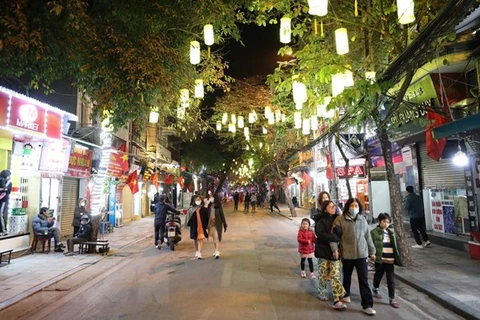
Foreign tourists show special interest whentouring Hang Bac street which house various sophisticated silver stuff (Photo:Vietnam Pictorial)

At present, the street stretches only about0.5 km, but there are hundreds of ateliers of all sizes established bysilversmiths and goldsmiths. Many of those shops are equipped with machines ofmodern technologies from foreign countries, yet there are still families whomaintain the traditional method of manually crafting jewellery.

Not only keeping the job which is passed downto by ancestors, residents in Hang Bac street are also able to maintain thetraditional lifestyle of the people in Hanoi’s Old Quarter. Many households aregood at doing business and become rich, but they still lead a humble life andvalue trust, and stand ready to support others in life as well as in doingbusiness./.
VNA

See more

A performance at the opening ceremony of the Hue International Music Week 2026 on June 13. (Photo: VNA)

Hue International Music Week 2026 opens

Audiences will enjoy a diverse musical palette ranging from V-pop, K-pop, J-pop and alternative pop to flamenco and other emerging international performance trends.

Foreigners explore Vietnamese silk at the Yen Thai communal house in Hanoi. (Photo: VNA)

Vietnamese silk gets modern pitch inside Hanoi communal house

Storytelling about preserving traditional crafts, paired with experiential activities within heritage spaces, is seen as an effective way for Vietnamese craft village products to continue to shine and claim their place in contemporary life, said an insider.

Book displays and introductions help foster a love of reading and spread reading culture throughout the community. (Photo: VNA)

Vietnam seeks strong global presence for its children's books

Vietnamese children’s literature has steadily expanded its presence in international literary circles in recent years. From a few notable titles earning recognition in respected competitions, the sector has shown encouraging progress in bringing Vietnamese stories to readers around the world.

A stall offering discounted combo meals of bread and drinks at the fourth Banh mi Festival in Ho Chi Minh City on April 23 (Photo: VNA)

Ho Chi Minh City ranks among world’s top culinary destinations

According to Time Out, the appeal of Ho Chi Minh City’s cuisine lies in its creativity, much of which was shaped during challenging periods in history. Iconic dishes such as banh mi (sandwiches) and com tam (broken rice) are highlighted as examples of this resourcefulness.

The international short documentary film festival “Viet Culture in Motion” officially opens at the Saint-André des Arts cinema in Paris on June 11 (Photo: organising board)

Vietnamese youth tell cultural stories on European screen

The international short documentary film festival “Viet Culture in Motion” highlights the efforts of young Vietnamese and overseas Vietnamese filmmakers to introduce Vietnam’s culture and people to international audiences through documentary storytelling. It has brought together professional filmmakers, screenwriters and cultural and film activists from Vietnam and abroad.

Delegates to the 107th meeting of the AIMF Executive Bureau 2026 (Photo: VNA)

Hue spreads heritage city values within Francophone community

Its participation marked an important step for the central city of Hue to expand its international partnerships, deepen integration with municipalities worldwide, and cement its role and standing as a dynamic and responsible heritage city within the Francophone network.

With its rich history, aesthetic grace, and spiritual meaning, the lotus stands as a central symbol in defining Hue’s cultural identity. (Photo: tapchidongnama.vn)

Lotus Festival lights up Hue’s summer

Scheduled for June 19-21 at Bong Lai Islet on Tinh Tam Lotus Lake in Phu Xuan ward, one of Hue’s most renowned scenic landmarks and a symbol of royal garden art, the festival draws inspiration from the lotus’s enduring beauty in court culture. The event aims to honour local heritage while offering visitors a distinctive summer tourism experience.

The “Vietnam Pavilion” at Aldea Global 2026 (Photo: VNA)

World Cup 2026: Vietnam leaves distinct mark at global cultural showcase

The “Vietnam Pavilion” at Aldea Global 2026 offers Mexican visitors and international guests an opportunity to explore the country’s rich cultural heritage, history and people through exhibitions, tourism promotion activities, traditional arts presentations and displays of representative cultural products.

Michelin Guide Vietnam recognises 11 one-Michelin star restaurants (Photo: Michelin Guide Vietnam)

Local ingredients, cultural roots propel Vietnam’s Michelin journey

One of the clearest examples is Hieu Luc, a modest fish soup eatery on Hai Ba Trung Street in Hanoi, which has been included in the Michelin Selected category for the second consecutive year. Known for its clear, delicately sweet broth made from freshwater perch and mustard greens, the restaurant serves a traditional specialty from Hung Yen province.

Delegates attending the ASEAN City Leaders Conference 2026 visit the Imperial Citadel of Thang Long on June 9. (Photo: VNA)

ASEAN city leaders explore Hanoi’s heritage sites

At the Imperial Citadel of Thang Long, delegates visited the Doan Mon Gate and learnt about the formation and development of the ancient capital through different historical periods at display spaces. They also explored the Kinh Thien Palace’s Dragon Steps (large stone steps with dragon carvings), regarded as the political and ceremonial centre of the imperial citadel during successive Vietnamese dynasties.

Ly Hoang Nam is Asia's No. 1 pickleball player. (Photo: webthethao.vn)

Ly Hoang Nam tops Asian pickleball rankings

Vietnam boasts five players in the DUPR Asian top 10, with Nam leading the rankings on 6,267 points ahead of competitors from the Philippines, India, Hong Kong (China) and Chinese Taipei.