Hanoi acknowledges artisans’ role in intangible cultural heritage preservation

The important role of artisans in the preservation and upholding of intangible cultural heritage values in Hanoi was highlighted at a seminar held by the municipal Department of Culture and Sports on September 27.
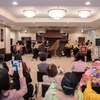
Hanoi acknowledges artisans’ role in intangible cultural heritage preservation ảnh 1A performance of "ca tru" singing, a world intangible cultural heritage in need of urgent safeguarding, at the seminar. (Photo: VNA)

Hanoi (VNA) – The important role of artisans in the preservation and upholding of intangible cultural heritage values in Hanoi was highlighted at a seminar held by the municipal Department of Culture and Sports on September 27.

Officials, representatives of organisations involved in cultural activities, and artisans shared the view that artisans of folk arts are holding the knowledge about and keys of the practice of intangible cultural heritage, so the preservation, teaching, creation, and promotion of heritage values depend much on them.

They also emphasised artisans’ active role in protecting and bringing into play heritage values to build up the cultural values and strength of the Vietnamese people, including Hanoians, to meet the demand for sustainable development of the country.

Tran Thi Van Anh, Deputy Director of the Hanoi Department of Culture and Sports, said the city has offered financial support for the persons holding the titles of People’s Artisan and Meritorious Artisan. So far, 14 of the 18 People’s Artisans and 101 of the 113 Meritorious Artisans have received 3.59 billion VND (147,200 USD) in total support under a resolution of the municipal People’s Council.

In addition, district-level authorities have also helped with the establishment of exemplary intangible cultural heritage clubs which will be provided with 50 million VND each upon their inception and 20 million VND in annual aid for their activities.

The city has also offered financial assistance to artisans to help with the teaching of intangible cultural heritage to younger generations, she noted.

All the moves are meant to encourage artisans to continue preserving, passing down, and bringing into play heritage values, according to the official./.

VNA

See more

UNESCO Director-General Khaled El-Enany (Photo published by VNA)

UNESCO, countries welcome Vietnam-led cultural initiative

UNESCO Director-General Khaled El-Enany hailed the UN General Assembly’s proclamation of the International Decade of Culture for Sustainable Development (2027–2036), thanking Vietnam for promoting the initiative, as well as all co-sponsoring countries, members of the core group and the Group of Friends for Culture at the UN for their support.

The Miss World 2026 event in Nha Trang is a showcase of global cultures. (Photo: Miss World 2026 Organising Board)

Miss World 2026 contestants showcase global cultures in Nha Trang

Hosting the final activities and grand final of Miss World 2026 offers Khanh Hoa an opportunity to promote its natural landscapes, cultural heritage and people to international audiences, while attracting visitors to Nha Trang during the National Day holiday.

Border residents and visitors join cultural, sports and tourism activities in Long Sap commune, Son La province. (Photo: QuVNA)

Vietnam-Laos border communities strengthen bonds of friendship

Through the programme, Son La aims to showcase the nature, culture and people of Long Sap, promote traditional cultural values alongside sustainable tourism, boost tourism and trade, and foster stronger cooperation contributing to sustainable socio-economic development in Long Sap and the Moc Chau National Tourism Area.

Young girls at a buckwheat flower valley in Tuyen Quang province. (Photo: VNA)

Culture industries open new growth opportunities for Tuyen Quang

Following its administrative merger, Tuyen Quang is home to 46 ethnic groups, with ethnic minorities accounting for more than 70% of its population. The province has 794 historical and cultural relic sites and 871 intangible cultural heritage items, including 53 recognised as national intangible cultural heritage.

Visitors explore Hà Nội’s master urban plan through a 3D mapping display at the Hà Nội Museum. (Photo: VNA)

Museums enter the digital age

From 3D displays and virtual tours to AI assistants and digital collections, museums across Vietnam are rethinking how heritage is preserved, presented and experienced, with technology opening new ways for the public to connect with the past.