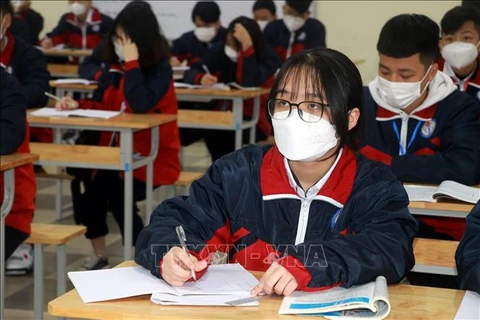
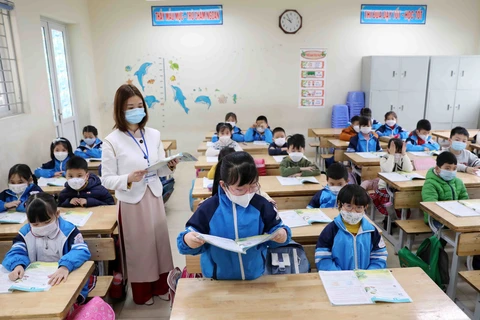
Children at a primary school in Hoan Kiem District, Hanoi - Illustrative image (Photo: VNA)
 Truong Huu Khanh, permanent vice chairman of HCM City’s Infectious Disease Association, said it's time for Hanoi to re-open schools completely, as HCM City has done.
There are many reasons to do this now, he said.
The number of children infected with COVID-19 in Hanoi is believed to be significant. Most children living with parents or relatives who are infected with COVID-19 have also caught the virus, he said.
However, children infected with the Omicron variant often have very mild symptoms and recover quickly, he said.
The handling of COVID-19 students in schools is also simple, he added.
For a number of weeks, Hanoi has recorded the country's highest daily number of COVID-19 cases. The capital city's Department of Health earlier this month announced that Omicron is the dominant COVID variant in the capital.
Children could still contract COVID-19 when they stay at home. Therefore, it’s time to re-open the schools, the vice chairman said.
The benefits of sending children to school are that children could focus more on the lessons while their parents or caregivers could focus on their work, according to Khanh.
For preschool children, in the first six years of their life, the important issue is not absorbing knowledge but learning about emotions, how to work in groups and interacting with the outside environment.
“So, sending the children to school is very necessary and important,” he said.
Associate Professor Dinh Duy Khang from the Institute of Biotechnology under the Vietnam Academy of Science and Technology also told the Suc khoe & Doi song (Health & Life) online newspaper that he agreed with sending preschool and primary school children back to school now.
Khang said the consequences of letting children stay at home for too long would be much greater than the risks of COVID-19.
The children could face psychological issues as well as problems in their emotional, intellectual, and physical development if they do not go to school or stay at home for too long, he said.
He said that it was necessary not to be negligent, but it was also necessary to restore normal life, he said.
The closure of schools, triggered by the COVID-19 pandemic, had caused great disruptions to the development of young children, he said, noting schools should now reopen, while safely adapting and flexibly responding to the pandemic.
Pham Thu Nga, 35, of Tay Ho district, a mother of a female second-grader and a two-year-old boy said she really wanted the preschool and primary school to reopen soon.
Nearly a year since the preschools and primary schools in 12 districts of Hanoi were closed due to the pandemic, Nga still had to work from home to take care of her two children, she said.
“It’s so hard to both work and take care of the children,” she said.
When the children stay at home all day, it was difficult to control their use of smartphones, laptops and televisions, she said.
“Limitations in social interaction also make me very worried about the children's mental health,” she added.
Although her children did not go to school, they were still infected with COVID-19, she said.
Tran Ngoc Lan, 32, of Ha Dong district, said she still felt concerned about sending her children back to school now.
“I have heard about some severe developments of COVID-19 such as Multisystem Inflammatory Syndrome in Children (MIS-C), so I feel anxious about my children being infected with COVID-19,” she said.
“A mother always worries about the safety of her children, so do I,” she said.
Khanh said children, who are infected with COVID-19, have a high fever and chills, but they often do not have the fever for more than 48 hours.
“Taking care of a child with COVID-19 is not different from a child with common viral fever,” he said.
Parents should not abuse nasal spray or arbitrarily use drugs to treat COVID-19 for the children. After 48 hours, the child would eat and play normally again, he said.
"Only children with obesity or serious underlying diseases such as kidney failure, end-stage liver failure, severe growth retardation and severe congenital heart disease, are prone to severe developments of COVID-19," he said.
Therefore, parents should not worry too much when their children are infected with COVID-19, he said.
“Going to school means learning directly, playing with friends and communicating with teachers,” he said. This the best time to let the children come back to school".
However, we should still follow the Ministry of Health’s 5K messages: Khau trang (facemask) – Khu khuan (disinfection) – Khoang cach (distance) – Khong tu tap (no gathering) – Khai bao y te (health declaration), he said.
Additionally, medical experts say that when sending children to school, of course, there will still be new cases of COVID-19 in a class.
Thus, the class can be divided into small groups. If a case of COVID-19 is reported, the handling process should be contained in the group, the medical experts said.
Schools need to prepare for scenarios when a COVID-19 student is reported in a class. The simplest way to handle it is to let the student stay at home until he or she fully recovers and the class will still operate as normal. Like seasonal flu, schools have to order that children, who have a fever or show signs of easily contagious disease, do not go to school.
Besides, children, who go to school, need to wash their hands frequently and do not share cups or food with other children.
Moreover, parents must be optimistic and take appropriate COVID-19 prevention measures for their children./.
VNA