Hanoi speeds up process to 'green' public transport

Hanoi has been taking moves to 'green' public transport, especially when people in the capital city show their increasing interest to means of transport like electric vehicles and metro lines.

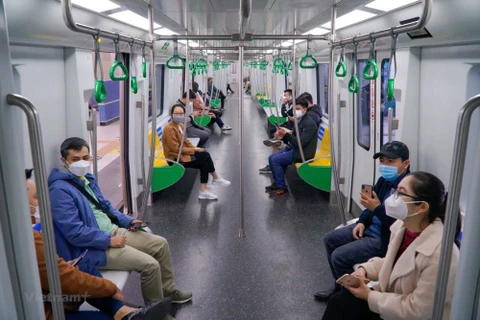
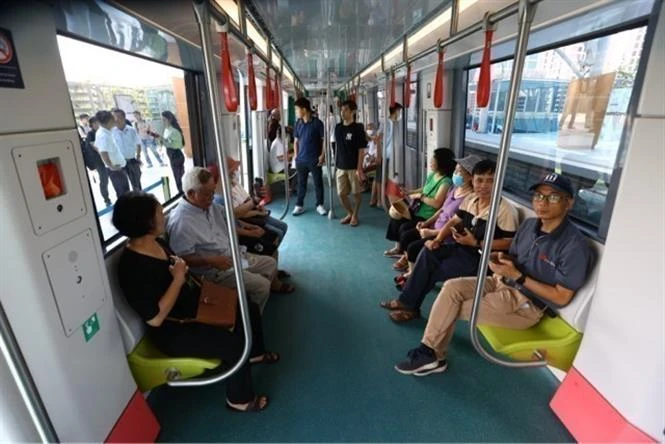
Passengers use the 8.5-km elevated section of the Nhon-Hanoi Station metro line in the first day of commercial operation on August 8. (Photo: VNA)

Hanoi (VNA) – Hanoi has been taking moves to 'green' public transport, especially when people in the capital city show their increasing interest to means of transport like electric vehicles and metro lines.

According to General Director of Hanoi Railway Co. Ltd. Vu Hong Truong, the Nhon - Hanoi Station metro service has attracted over 393,000 passengers in its first week of operation.

To put this in perspective, this was 2.3 times the number of people using the Cat Linh – Ha Dong line, also in Hanoi, during the same period.Between August 8 and 15, trains made 200 trips daily on the new route.

The number of passengers soared to 115,000 on August 11.

The Cat Linh–Ha Dong line conducted 930 trips to carry over 165,000 passengers during its first week of operation three years ago.

Meanwhile, a recent survey found that 20% of Cat Linh-Ha Dong metro service users who are also car owners said that they stop driving to use the metro services.

That is an evidence for the increasing interest of people to green transport, Truong said.

According to the official, public passenger transport has three development stages.

In the first stage, it’s supposed to serve people who have no means of transport. In the second stage, it competes with personal vehicles.

Currently, urban railways in Hanoi have gone through the two first stages and are aiming to become popular.

Every 1,000,000 hours of travel by urban railways will help reduce 100 tonnes of gas emissions, and bring a value of about 30 billion VND (1.2 million USD), Truong said.

Thai Ho Phuong, Director of the Hanoi Traffic Management and Operation Centre, said that the National Assembly has passed the amended Law on the Capital, in which, there are regulations on environmental protection and fossil energy conversion.

Hanoi is the first locality in Vietnam to issue a resolution to implement the Prime Minister’s decision on green energy transition programme by 2030. Accordingly, the city plans to have 50% of its vehicles run on electricity, and the other 50% turn into gas-powered vehicles during this period. In 2024, the city gives priority to electric vehicles.

With ten green bus routes operating in the city, Hanoi has reduced emissions by 36,500 tonnes of CO2, equivalent to planting 1.68 million trees.

Currently, Hanoi has "green" buses, "green" urban railways and subsidies for people to go green, Phuong said, emphasising that the Government, the city and businesses are also actively participating in the capital's green transition process./.
VNA

See more

A performance at the meeting with over 1,000 overseas Vietnamese in Ho Chi Minh City on February 6 evening to celebrate the upcoming Lunar New Year (Tet). (Photo: VNA)

Ho Chi Minh City hosts pre-Tet gathering with overseas Vietnamese

Nguyen Van Duoc, Deputy Secretary of the municipal Party Committee and Chairman of the municipal People’s Committee, attributed the southern metropolis’s socio-economic development achievements partly to important contributions by OV entrepreneurs, scientists, experts, and intellectuals worldwide through investment activities, knowledge transfer, market connection, and promotion of the city’s image.

Aerial view of Co To Island. (Photo: VNA)

Co To to offer free vessel trips to/from island on 29th day of last lunar month

To meet rising demand from residents returning home for Tet and visitors travelling to the island, transport operators in Co To will continue daily passenger and cargo services to/from the island until the 29th day of the last lunar month, with operations resuming from the second day of the first lunar month (February 18).

PM orders stronger transport measures to ensure traffic safety during Tet. (Illustrative photo: VNA)

PM orders stronger transport measures to ensure traffic safety during Tet

To accommodate surging travel demand and keep transport operations running smoothly, the PM instructed relevant bodies to boost transport capacity, particularly public passenger services, to ensure seamless connections at railway stations, airports, bus terminals and ferry ports. Authorities were told to ensure that no travellers are left stranded or delayed in returning home for Tet due to a shortage of transport, while strictly preventing fare gouging and unlawful price hikes. Proactive measures to curb traffic accidents and congestion during the peak holiday period were also highlighted.

Politburo member and Permanent member of the Party Central Committee’s Secretariat Tran Cam Tu presents gifts to the elderly in Da Nang city on February 5. (Photo: VNA)

Permanent member of Party Central Committee's Secretariat pays Tet visit to Da Nang

Politburo member and Permanent member of the Party Central Committee’s Secretariat Tran Cam Tu reaffirmed that the Party and State consistently uphold the principle of placing the people at the centre, stressing that caring for their material and spiritual well-being is both the goal and the driving force of national development.

The delegation Inspects anti-IUU fishing efforts at Hung Thai Port, Long Hai commune. (Photo: VNA )

Ho Chi Minh City's efforts to combat IUU fishing examined

The inspection aimed to identify grassroots-level difficulties, promptly address technical bottlenecks, require telecommunications enterprises to upgrade their systems, and advise the Government and relevant ministries and sectors on refining mechanisms and policies.

Representatives of Hanoi units sign a coordination mechanism for piloting public interest civil litigation (Photo: VNA)

Hanoi launches pilot mechanism for public interest civil litigation

The coordination framework is designed to ensure that the People’s Procuracy can promptly, fully and accurately access information related to public interest civil cases; facilitate the swift and effective verification and collection of documents and evidence; and strengthen the responsibilities of agencies, organisations and individuals in fulfilling their mandates to protect the civil rights of vulnerable groups and public interests.