HCM City announces approved land use master plan

The approved land-use master plan for HCM City will have significant impact on the city’s development in the future, Nguyen Toan Thang, Director of the municipal Natural Resource and Environment Department, said.
HCM City announces approved land use master plan ảnh 1HCM City announces approved land use master plan. (Photo: VNA)

HCM City (VNS/VNA) – The approved land-use masterplan for HCM City will have significant impact on the city’s development in thefuture, Nguyen Toan Thang, Director of the municipal Natural Resource andEnvironment Department, said.

Speaking at a meeting last weekend to announce theGovernment’s resolution No.80/2018 on the city’s adjusted land-use master planto 2020, Thang discussed the results of land use in the 2011-2015 period.

“The land-use master plan exploited land potential as animportant resource for urban development, but several goals have not beenreached, and there has been limited efficiency in land use as well asenvironmental protection,” he added.

Insufficient investment and site-clearance problems were themajor land-use problems facing the city, he said.

By the end of 2015, around 2,100 hectares of thecity’s urban land had not been transferred for land-use goals under theapproved master plan.

From now to 2020, the city’s agricultural land will beadjusted downward to 88,000 hectares compared with the 118,000 hectares in 2010.

Meanwhile, non-agricultural land has risen to nearly 189,000hectares, 1,080 hectares higher than the national target. In 2010, it coverednearly 91,000 hectares.

The land used for infrastructure development in the city isestimated to total around 35,000 hectares, an increase of 15,233 hectares incomparison with 2015. Residential land in the urban area will cover 1,250hectares.

To implement the adjusted master plan, Thang suggestedfocusing on five solutions: investment, policies, climate change adaptation,agricultural land fund protection, and implementation.

Thang said the city would also prioritise investments in foursatellite urban areas.

In the east, the satellite urban area will be located in LongTruong ward in District 9 near the HCM City - Long Thanh – Dau Giayexpressway, on a total area of 280 hectares.

In the west, the satellite urban area will be located in Tan Kien commune in BinhChanh district near National Highway Number 1, on a total area of 200 hectares.

In the south, it will be located in the A zone in the South SaiGon Urban Area with the backbone road of Nguyen Huu Tho Boulevard, on a totalarea of 110 ha.

And in the north, it will be located in the North-West urbanarea near National Road 22, on a total area of 500 hectares.

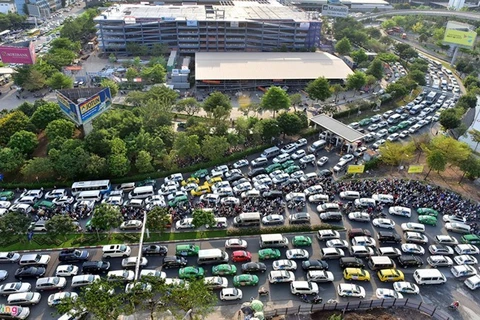
To limit the traffic flow to the downtown area, the city willalso invest in transportation to connect residential areas and the metrosystem, now under construction; and public welfare works like schools,hospitals and entertainment facilities.

“The adjusted land-use master plan has updated many standardsin urgent fields, especially for climate change, which has become more seriousin HCM City,” said Hoang Tung, deputy director of the municipal Master Plan andArchitecture Department.

“During the 2020 – 2025 period, half of the land in HCM Citywill be used for urbanisation,” he added.-VNS/VNA
VNA
See more

Visitors to an exhibition and test-drive programme for electric vehicles organised in Cau Giay ward, Hanoi, on May 16 by the municipal People's Commitee and relevant agencies. (Photo: VNA)

Hanoi proposes subsidies to accelerate shift to electric vehicles

Under a draft resolution currently open for public feedback by the municipal People’s Committee, residents with permanent or temporary residence registration in Hanoi for at least two consecutive years, who own petrol-powered motorbikes registered before the resolution takes effect, will be eligible for support when purchasing electric motorbikes priced at 10 million VND or more.

The copyright crackdown is broadly viewed as an inevitable step in Vietnam’s cultural industry development. (Illustrative photo: VNA)

Healthy digital content market in the making

The sharper crackdown is rapidly redrawing how online entertainment is distributed and consumed, while gradually reshaping public awareness and responsibility toward copyright protection.

A view of Place Ho Chi Minh in Persan, France. (Photo: VNA)

Place preserving memories of President Ho Chi Minh in France

Although there is little publicly available documentation confirming exactly when Place Ho Chi Minh was established, French urban historians suggest that most streets and public spaces named after the Vietnamese leader in France emerged between the 1960s and 1980s, during the height of anti-war movements and solidarity campaigns supporting Vietnam across working-class towns and left-leaning suburbs around Paris.

Vietnamese Ambassador to Bangladesh Nguyen Manh Cuong speaks at the seminar. (Photo: VNA)

President Ho Chi Minh’s thought on national unity remains relevant today

President Ho Chi Minh's ideology of national unity continues to carry profound significance amid growing global challenges, including conflicts, social divisions and economic instability. His message of solidarity, consensus and placing national interests above sectional differences remains a valuable lesson for many developing nations.

Assoc. Prof. Dr. Nguyen Duc Son presents the decision establishing the Vietnamese Language Proficiency Test Council in Japan to a representative of the Vietnam Studies Centre in Japan. (Photo: VNA)

Japan hosts first standardised Vietnamese language proficiency test

As bilateral ties between Vietnam and Japan continue to expand, demand for Vietnamese language learning in Japan has also grown rapidly among OVs, educational institutions, businesses and Japanese people interested in Vietnam. Against this backdrop, the introduction of a standardised proficiency test is expected to provide an official and widely recognised benchmark for Vietnamese language skills.

The “I Love My Fatherland" Journey 2026 kicks off in Nghe An province on May 16. (Photo: VNA)

"I Love My Fatherland” journey features diverse activities

The “I Love My Fatherland” journey will span seven stages across historical and cultural sites and “red addresses” nationwide. There will be a combination of education on traditions, field-based programmes, and digital communications.