HCM City metro on schedule

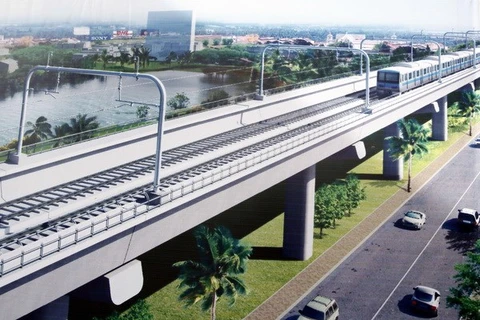
The first line of the subway in HCM City, the Ben Thanh – Suoi Tien metro, is quickly taking shape, three years after construction kicked off.
HCM City metro on schedule ảnh 1The first line of the subway in HCM City, the Ben Thanh-Suoi Tien metro, is taking shape (Photo: VNA)

The first line of the subway in HCM City, the Ben Thanh – Suoi Tien metro, is quickly taking shape, three years after construction kicked off.

Together with the construction of underground stations near the municipal Opera House and Ben Thanh Market, the above-ground part of the route is developing quickly near Hanoi Highway from the Saigon Bridge to Suoi Tien Theme Park.

The project broke ground in August 2012. It is expected that in a few years, the route will connect with urban areas, the National University and a new Eastern Bus Station.

Tuoi Tre (Youth) newspaper has quoted Chu Son Binh, Deputy Director of Ben Thanh – Suoi Tien Metro Project Management Board, as saying that with advanced technology from Japan, the installation of girders on the route would be completed by 2017.

At the Thao Dien Metro Station, one of 14 stations on the metro route, more than 80 engineers and workers prepared to cast concrete for the station, 26m wide and 130m long.

As the workers have three months to complete station construction, they have divided their work in three shifts.

Ben Thanh will be the central station connecting other lines and Suoi Tien will be considered the point that links eastern parts of the city and neighbouring provinces.

According to the plan, from Suoi Tien, the line will extend to the proposed Long Thanh Airport in Dong Nai province.

The North – South Railway from Hanoi to HCM City will connect with the Suoi Tien station on the metro.

All of the 14 stations will be built with different architectural designs.

Of the 11 above-ground stations, the Tan Cang Station will receive most passengers with loading capacity of 154,000 passengers per day, and Suoi Tien with 147,000 passengers per day.

The Rach Chiec Station is designed to receive 107,000 passengers per day.

Construction of underground stations is also going well. Concrete casting has been in progress at Opera House Station.

Tran Van Hieu, 42, one of 100 workers at the site, said he expected the metro to significantly change the city's infrastructure.

"My son is now studying high school in my hometown. I'm very happy that he will be able to ride the subway when he comes here to study at university," Hieu said.

In January 2007, the Prime Minister published a decision outlining the transport development plan for HCM City up to 2020.

The objective is to build a network of eight urban railways and three other lines which will be either light rail or monorail.

The plan was modified in 2009, with Line 3 being split into two.

It was also decided to connect Lines 1, 3A and 3B to provide a through service in the future. However, so far only two projects have begun, despite several studies and interest from investors.-VNA
VNA

See more

The dialogue and business networking forum between CPTPP senior officials and business leaders is held in Ho Chi Minh City on July 22, as part of the 2026 CPTPP Senior Officials' Meeting (SOM3) hosted by Vietnam. (Photo: VNA)

Public-private dialogue unlocks CPTPP potential

The CPTPP has evolved beyond tariff reductions into a broad framework covering goods, services, investment and digital trade. Its success, however, ultimately depends on businesses' ability to turn commitments into new investment, stronger supply chains and innovative business models.

Tourists on Nha Trang beach in Khanh Hoa province (Photo: VNA)

Promoting integrated governance to advance sea-based economy

Khanh Hoa has positioned itself as the renewable energy industrial and service hub for the south-central and southern regions. Its economic development strategy identifies four key growth drivers, all built on the foundation of the marine economy.

An overview of the seminar entitled "Opportunities and challenges for market development in Turkish market" (Photo: Ministry of Industry and Trade)

Türkiye offers export potential for Vietnamese food producers: seminar

Türkiye’s target of lifting total exports of goods and services to more than 400 billion USD in 2026 could create additional opportunities for Vietnamese agricultural products, food and beverages, said Ta Manh Cuong, director of the Trade and Investment Promotion Support Centre.

SSC Vice Chairman Bui Hoang Hai speaks at the opening of the programme on July 21. (Photo: VNA)

Vietnam boosts crypto market oversight capabilities

Diederik Van Wersch, Chainalysis' ASEAN Regional Director, noted that Vietnam has a high level of crypto asset adoption, offering significant opportunities for innovation while creating greater demands for oversight and risk management.

Vietnam Railways has introduced a range of tourism, heritage and dedicated train services, attracting growing numbers of passengers. (Photo: VNA)

Railways reinvent themselves with tourism, heritage trains

One of the most notable successes is the premium Hoa Phuong Do (Flamboyant Flower) train operating between Hanoi and Hai Phong city. Since entering service in May 2025, the train has completed nearly 3,000 trips and carried around 1.33 million passengers.

Representatives of relevant parties witness the arrival of the shipment. (Photo: VNA)

First Czech pork shipment officially enters Vietnamese market

A Czech diplomat described the arrival of the first container as the successful outcome of a long and complex market-opening process involving years of negotiations, regulatory approvals and close cooperation between Czech and Vietnamese authorities.

A view of financial buildings in downtown Ho Chi Minh City along the Saigon River. (Photo: VNA)

HSBC: Vietnam’s growth, macroeconomic stability to face tougher test in H2

In a recently released report, Vu Binh Minh, CFA, Associate Director, FX Trading, Markets and Securities Services at HSBC Vietnam, said Vietnam’s economy has built a relatively favourable position in the first six months of the year with GDP expanding 8.18% – the highest first-half growth rate in recent years – as key growth drivers have operated in tandem.

Ha Tay Shoes has secured numerous export orders from the US and European markets. (Photo: VNA)

CPTPP strengthens free trade, expands global economic connectivity

Since taking effect, the CPTPP has significantly expanded Vietnam's access to major markets across North America, the EU, and the Asia-Pacific, contributing to strong export growth in key sectors such as textiles and garments, footwear, and agricultural, forestry and fishery products. The agreement has also encouraged greater investment into Vietnam by promoting regional production networks and clearer rules of origin.

Tan Mingming, Deputy Director of the Foreign Affairs Office of the Dezhou Municipal People’s Government. (Photo: VNA)

Chinese firms put Vietnam on expansion radar

Tan Mingming, Deputy Director of the Foreign Affairs Office of the Dezhou Municipal People’s Government, told Vietnam News Agency reporters that the city has spent years deliberately tightening its links with the Association of Southeast Asian Nations (ASEAN), with Vietnam seen as a key partner.

A perspective of the Viettel Military Industry and Telecoms Group's high-tech semiconductor chip manufacturing plant at Hoa Lac Hi-Tech Park. (Photo: Viettel)

Hanoi builds momentum as Vietnam's semiconductor hub

As Hanoi continues to strengthen its semiconductor ecosystem, the city is creating a new growth driver for both the capital and the country, enhancing Vietnam's technological capabilities and paving the way for deeper integration into the global semiconductor value chain.

Clams are processed for export at the factory of Thanh Hoa Seafood Import-Export JSC in Thanh Hoa province. (Photo: VNA)

Vietnam steps up export to achieve 550-billion-USD target

Against a backdrop of persistent uncertainty in global commerce, the Government is implementing a broad range of measures to strengthen export growth during the remainder of the year. These include expanding overseas markets through economic diplomacy, maximising the benefits of free trade agreements (FTAs), streamlining administrative procedures, reducing logistics costs, improving access to credit and helping businesses overcome trade barriers. Authorities are also encouraging deeper processing, official cross-border exports and greater market diversification to improve the competitiveness of Vietnamese products.