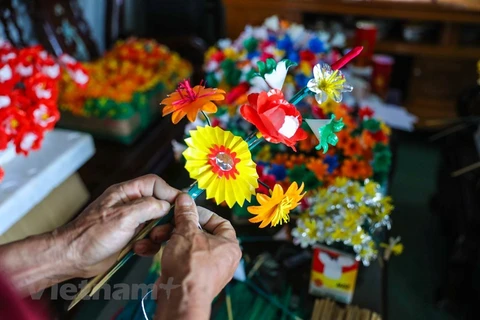
Foreign visitors enjoy Thanh Tien paper flower-making experience (Source: thuathienhue.gov.vn)
 Thua Thien-Hue (VNA) - The ancient capital of Hue in central Thua Thien-Hue province has for many years managed to preserve craft villages which have become destinations for tourists from both at home and abroad.
Hue was the capital of Vietnamese monarchy dynasties for more than 300 years (1636-1945), including 13 dynasties of the Nguyen family, the last feudal dynasty of Vietnam. The city, therefore, became a gathering place of many traditional crafts, including unique crafts originating from the system of office crafts or ancient craft villages serving the royals and the elites exclusively.
After hundreds of years, Hue today is still a palatial city with golden palaces, citadels, mausoleums, temples and countless treasures from feudal times, which makes the city a unique cultural heritage.
Creating that unique and massive heritage complex was none other than the royal craftsmen and artisans of the Nguyen dynasty. There were masters of handicrafts in Hue as well as from all over the country who were summoned to the capital by the Nguyen kings to serve the royals. With skillful hands and great creativity, the artisans created masterpieces of art that satisfied the royals and remained as priceless treasures.
During the Nguyen dynasty, there was a special agency that looked over the crafts, which was the craft-office. The main task of the office was to supervise the construction of palaces, the creation of palace items as well as the minting of money and weapons and shipbuilding. Under the umbrella of this craft-office system, there were bureaus of crafts such as carpentry, masonry, casting, ceramics, jewelry, embroidery and carving, which gathered talented craftsmen and artisans from all over the country.
According to history, from the reign of King Gia Long (1802-1820) to the beginning of King Tu Duc’s reign (1847-1883), the number of craftsmen in Hue was enormous due to the need for construction in the capital. Workers directly working for the royals alone reached into the thousands.
The royal craftsmen of the Nguyen dynasty were all selected for their outstanding skills and talent. Some were so talented they were honored by the kings with titles and property. For example, there is the father and son of goldsmiths Cao Dinh Do and Cao Dinh Huong, who are considered to be the ancestors of Hue's jewelry industry. They were given authority positions for their talent and contributions during the Tay Son dynasty and continued to be respected and allowed to keep their titles during the reign of King Gia Long, so that the jewelry industry could be preserved and to prosper in Hue.
Another example was master carpenter Nguyen Van Kha, from An Nong village, Phu Loc district, Thua Thien Hue province. He was authorized by King Khai Dinh to look over the construction, renovation and designing of the palaces and temples in Hue. The king bestowed on him these 4 words “the most talented hands” and granted him the privilege of not having to bow down to the king and the freedom to ride a rickshaw when going in and out of the forbidden city.
The story of artist Phan Van Tanh lying on his back using his legs to paint the “Nine dragons hidden in the clouds” on the ceiling of Thien Dinh palace of Khai Dinh’s tomb is also well-known in the history of Vietnamese painting.
Thanks to those excellent craftsmen, the Nguyen dynasty built a system of citadels, palaces, mausoleums and temples and created countless valuable items such as statues, bells, crests, cauldrons and cannons. Many of these artifacts are now national treasures.
Today, Hue still astonishes visitors with its magnificent palaces, and charms them with the beauty of golden shimmering tiles and glorious paintings and many other precious treasures. All of these are the imprints of the Nguyen dynasty’s craft-office system, or more precisely, the mark of skillful hands and creative minds of the royal artisans of Hue.
According to research, the territorial expansion of the Nguyen lords, then the capital formation of the two dynasties Tay Son and Nguyen, brought businessmen and skilled workers from all over the country to come to Hue to seek opportunities. The process gradually transformed the city into a homeland of Vietnamese traditional crafts, where many crafts and skilled craftsmen had incredible conditions and opportunities to flourish.
For example, in 1868, when the French occupied Cochinchina, the governor of Cochinchina Pierre-Paul Marie de La Grandière asked the Hue Royals to send two talented mosaic workers to Saigon to teach the craft. By 1877, Vietnamese shell-inlayed woodwork was sent to a craft fair in France.
The Nguyen dynasty was the period when Hue traditional crafts flourished, with many craft villages and craftsmen getting their names in the history books. For example, Phuoc Tich village was so well-known for its pottery that from the reign of King Minh Mang (1820-1841) to King Khai Dinh (1916-1925), the villagers each month were requested to send 30 pieces of pottery to the palace. The village's unglazed ceramic products were sold to Japan even back then.
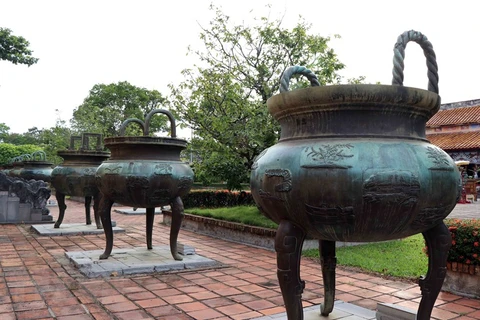
Another story was Tien Non villagers with their outstanding lacquer skills. Craftsmen of the village were assigned by King Khai Dinh to restore gilded lacquer in Hue’s Citadel. It is also worth mentioning the copper casting village of Phuong Duc and the jewelry village of Ke Mon. Legend has it that these two craft villages created many masterpieces, many of which are now national treasures. These include the Nine Dynastic Urns, Nine Holy Cannons, a bronze bell in Thien Mu pagoda, a gold seal “Sac menh chi bao” and the gold book “De he thi”.
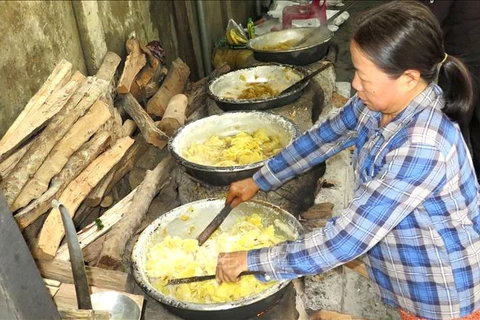
According to the research of Vu Thanh Huy at Hue University, the province of Thua Thien Hue currently has 110 craft villages consisting of nearly 30 traditional crafts and groups of crafts. Many have been formed and developed over a long period of time and some newer crafts were imported. Many crafts have been successfully preserved and well developed such as bronze casting, fine art carpentry and the processing of agricultural products.
Currently, Thua Thien Hue province has many policies, programmes and research projects being implemented with the aim to restore and develop traditional crafts. This includes identifying the development of handicrafts and craft villages as one of the key programs on socio-economic development in order to accelerate the industrialization and modernization of agriculture and rural areas.
In order to strengthen the honor and promotion of Hue traditional crafts, since 2005, Thua Thien Hue has organized the Hue Traditional Craft Festival periodically in odd years, introducing a significant cultural event imprinted with Hue culture. According to Dr. Phan Thanh Hai, Director of the Provincial Department of Culture and Sports of Thua Thien Hue, the festival not only promotes and encourages traditional crafts, but also creates opportunities for skilled craftsmen from all over the country to gather to exchanges and improve their skills.
After nearly 300 years since the Nguyen lords entered the land of Hue, many Vietnamese traditional crafts followed the people's footsteps into this sacred land, helping to build a facet of cultural identity for the Hue people, as well as generating livelihoods and economic and social development for the ancient capital.
With the efforts of the city’s administration and local artisans, the local craft villages have been preserved and developed, thereby contributing to Hue’s socio-economic and tourism development./.