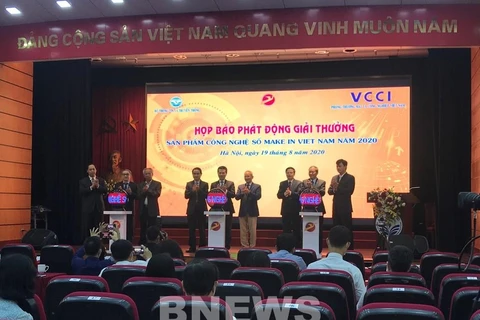
Deputy Prime Minister Pham Binh Minh speaks at the conference (Photo: VNA)
 HCM City (VNS/VNA) - High-quality human resources will play a decisive factor in the success of the country’s digital transformation process, Deputy Prime Minister Pham Binh Minh said at a conference held in Ho Chi Minh City on October 30.
“The government has identified digital transformation as one of the most important long-term goals amid the COVID-19 outbreak,” said Minh, who is also Minister of Foreign Affairs.
The country aims to form a digital government, economy and society while simultaneously establishing digital businesses that have a global competitive capacity.
In addition to a high-quality workforce, science and technology application as well as innovation are also important to reach these goals, according to Minh.
Digital transformation is affecting all fields, including health, education, transport, finance-banking, tourism, agriculture, logistics, environment and energy.
“To develop the digital economy where no one is left behind”, Vietnam will need to address the lack of highly skilled human resources, he said.
The country lacks at least 400,000 trained staff in the information technology sector, and IT training programmes have not met the demand, he noted.
The government has approved a national digital transformation programme which sets a target of becoming a digital society over the next decade.
The digital economy is projected to make up some 20 percent of Vietnam’s GDP over the next decade. The next five to 10 years will be an important phase of digital transformation, according to Minh.
The World Economic Forum predicts that by 2022 the digital economy will account for 60 percent of the world’s GDP.
The pandemic has disrupted the global supply chain and posed challenges to all sectors, but Vietnam should consider it “an invaluable opportunity for speeding up digital transformation”, Minh said.
Minh spoke highly of the massive contributions made by HCM City to national development, especially in digital transformation.
Dang Minh Khoi, Deputy Minister of Foreign Affairs and Chairman of the State Committee for Overseas Vietnamese, noted that more than 5.3 million Vietnamese live in 130 countries and territories. The overseas Vietnamese business community includes at least 6,000 people connected to Vietnam via technology and business fields.
Every year, about 500 overseas Vietnamese experts return to Vietnam to invest in many fields, he said. Overseas Vietnamese have invested in 3,000 projects with total registered capital of more than 4 billion USD, creating many jobs.
Nguyen Thanh Phong, Chairman of the municipal People’s Committee, said the city has dual goals of forming a digital government, economy and society, while establishing digital businesses that have a global competitive capacity.
In July, city authorities introduced a scheme based on the national digital transformation programme, he said.
The city aims to become a smart city with e-government, e-enterprises and an electronic society by 2030, he said. By 2030, the city targets offering all public services online provided through multiple means, including mobile devices.
A database will be set up that will assist in the development of an e-government, e-economy, and electronic society by 2030.
The city also wants to seek advice on how to make the most of the overseas remittances sent to the city, worth some $5 billion annually, according to Phong.
Tran Quoc Phuong, Deputy Minister of Planning and Investment, said due to the global recession and financial instability amid the pandemic, digital transformation must be considered a top priority.
The country needs to remove difficulties to access credit by people and businesses affected by the pandemic, as well as speed up the disbursement of public investment, especially ODA, he said.
Dr. Nguyen Tri Hieu said that Vietnam should develop plans to become a digital economy and not lag behind the “new normal” state of the world. To do this, businesses need to have better access to capital.
He recommended that the State Bank of Vietnam provide a credit package of up to 300 trillion VND (12.96 billion USD) to support individuals and businesses affected by the pandemic.
Prof. Tran Ngoc Anh, a Vietnamese-American, noted that multinational corporations are diversifying the supply chain to reduce risks, which has opened up new opportunities for Vietnam.
The country should mobilise huge resources from overseas Vietnamese professors, doctors and researchers willing to share their knowledge and insights to build a specific strategy for socio-economic development, he added.
Phan Thanh Son, Director of FPT Group’s Business Strategy Division, emphasised the major role of science, technology and innovation in business development./.
“The government has identified digital transformation as one of the most important long-term goals amid the COVID-19 outbreak,” said Minh, who is also Minister of Foreign Affairs.
The country aims to form a digital government, economy and society while simultaneously establishing digital businesses that have a global competitive capacity.
In addition to a high-quality workforce, science and technology application as well as innovation are also important to reach these goals, according to Minh.
Digital transformation is affecting all fields, including health, education, transport, finance-banking, tourism, agriculture, logistics, environment and energy.
“To develop the digital economy where no one is left behind”, Vietnam will need to address the lack of highly skilled human resources, he said.
The country lacks at least 400,000 trained staff in the information technology sector, and IT training programmes have not met the demand, he noted.
The government has approved a national digital transformation programme which sets a target of becoming a digital society over the next decade.
The digital economy is projected to make up some 20 percent of Vietnam’s GDP over the next decade. The next five to 10 years will be an important phase of digital transformation, according to Minh.
The World Economic Forum predicts that by 2022 the digital economy will account for 60 percent of the world’s GDP.
The pandemic has disrupted the global supply chain and posed challenges to all sectors, but Vietnam should consider it “an invaluable opportunity for speeding up digital transformation”, Minh said.
Minh spoke highly of the massive contributions made by HCM City to national development, especially in digital transformation.
Dang Minh Khoi, Deputy Minister of Foreign Affairs and Chairman of the State Committee for Overseas Vietnamese, noted that more than 5.3 million Vietnamese live in 130 countries and territories. The overseas Vietnamese business community includes at least 6,000 people connected to Vietnam via technology and business fields.
Every year, about 500 overseas Vietnamese experts return to Vietnam to invest in many fields, he said. Overseas Vietnamese have invested in 3,000 projects with total registered capital of more than 4 billion USD, creating many jobs.
Nguyen Thanh Phong, Chairman of the municipal People’s Committee, said the city has dual goals of forming a digital government, economy and society, while establishing digital businesses that have a global competitive capacity.
In July, city authorities introduced a scheme based on the national digital transformation programme, he said.
The city aims to become a smart city with e-government, e-enterprises and an electronic society by 2030, he said. By 2030, the city targets offering all public services online provided through multiple means, including mobile devices.
A database will be set up that will assist in the development of an e-government, e-economy, and electronic society by 2030.
The city also wants to seek advice on how to make the most of the overseas remittances sent to the city, worth some $5 billion annually, according to Phong.
Tran Quoc Phuong, Deputy Minister of Planning and Investment, said due to the global recession and financial instability amid the pandemic, digital transformation must be considered a top priority.
The country needs to remove difficulties to access credit by people and businesses affected by the pandemic, as well as speed up the disbursement of public investment, especially ODA, he said.
Dr. Nguyen Tri Hieu said that Vietnam should develop plans to become a digital economy and not lag behind the “new normal” state of the world. To do this, businesses need to have better access to capital.
He recommended that the State Bank of Vietnam provide a credit package of up to 300 trillion VND (12.96 billion USD) to support individuals and businesses affected by the pandemic.
Prof. Tran Ngoc Anh, a Vietnamese-American, noted that multinational corporations are diversifying the supply chain to reduce risks, which has opened up new opportunities for Vietnam.
The country should mobilise huge resources from overseas Vietnamese professors, doctors and researchers willing to share their knowledge and insights to build a specific strategy for socio-economic development, he added.
Phan Thanh Son, Director of FPT Group’s Business Strategy Division, emphasised the major role of science, technology and innovation in business development./.
VNA