In climate change-hit Tien Giang, rice farmers switch to fruits, vegetables

More rice farmers in the Mekong Delta province of Tien Giang have switched to other crops as part of efforts to adapt to climate change.
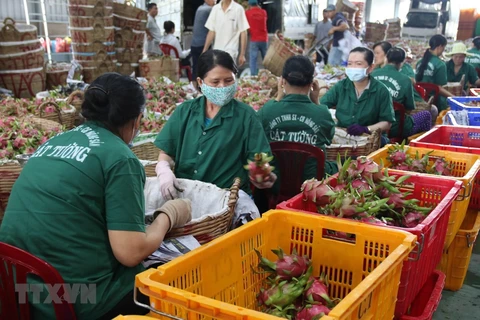
In climate change-hit Tien Giang, rice farmers switch to fruits, vegetables ảnh 1At a dragon fruit orchard in Tien Giang province (Photo: VNA)

Tien Giang (VNS/VNA) -
More rice farmers in the Mekong Deltaprovince of Tien Giang have switched to other crops as part of efforts to adaptto climate change.

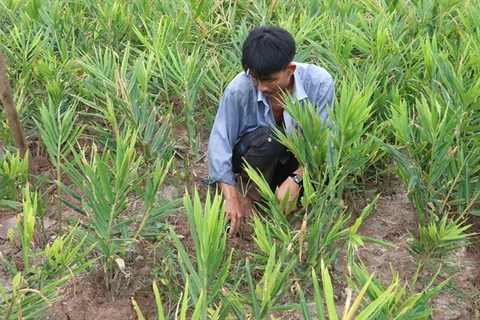
In Cai Lay and CaiBe districts in the upstream area of the Tien River, atributary of the Mekong, they either switched completely or rotated rice withother crops in the ongoing 2019 -2020 dry season,according to the provincial Department of Agriculture and Rural Development.

Cai Be now uses more than 5,300ha of low-yield rice paddiesto grow speciality fruits and rotates vegetables and rice on another 1,200ha.

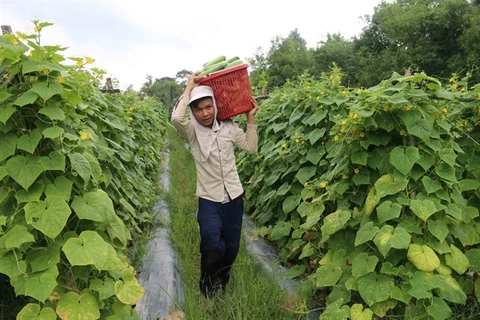
Pham Van Thanh, head of the Cai Be Bureau of Agriculture andRural Development, said farmers had grown many high-value vegetables likebitter gourd, cucumber and onion.

They have short growing periods and high yields, and requireless water and offer higher profits than rice, according to Thanh.

Farmers who grow vegetables in the two districts earn threeto five times more than from rice, according to the department.

Tran Ly Ngu Binh, head of the Cai LayBureau of Agriculture and Rural Development, said to enable rice farmers toswitch to other crops, the district has upgraded irrigation canals and builtnew ones to ensure sufficient water.

Cai Lay has invested more than 29.6 billion VND (1.3million USD) so far this year in 67 irrigationprojects.

Cai Be has spent more than 56 billion VND (2.4million USD) to build 167 irrigation projects,dredge canals and upgrade sluices to keep out saltwater.

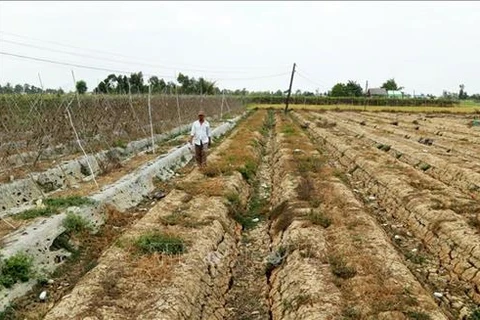
Drought and saltwater intrusion have affected nearly 60,000haof crops in the 2019 -2020 dry season in theprovince’s western region, which includes the two districts and Cai Lay town.

They include more than 23,000ha of rice and 36,000ha ofspeciality fruits.

Besides improving irrigation facilities, the localities havealso installed water salinity testing devices along rivers.

The Cai Be District People’s Committee has installed 25 ofthem in communes along the Tien River to measure salinity on a daily basis.

Communes and farmers have hundreds more of the devices. 

In Cai Lay, in areas that lack saltwater prevention dykes,authorities have told farmers how to store water and keep out saltwater in theHam Luong River, one of theprovince’s largest.

Authorities regularly provide information about saltwaterintrusion and the schedule for opening and closing sluices to farmers so thatthey know when to draw water from rivers and canals for irrigation.  

The province has transported water from other places to savespeciality fruit crops, which are facing a severe shortage of water due todrought and saltwater intrusion.

Around 2,275ha of fruit orchards have been affected by thewater shortage, with 2,186ha being damaged by 30 – 70 percent and the rest bymore than 70 percent.

Tien Giang, the country’s largest fruit producer, has morethan 77,700ha under fruits, which include specialty fruits like Lo Renmilk apple, Hoa Loc mango, Ngu Hiep durian, and Cho Gaodragon fruit.

The province grows more than 1.5 million tonnes annually./.


VNA

See more

Ahmad Haikal Hasan, Head of the Halal Product Assurance Organising Agency (BPJPH) of Indonesia, speaks at the seminar (Photo: VNA)

Indonesia ready to cooperate with Vietnam in halal sector

Ahmad Haikal Hasan, Head of the Halal Product Assurance Organising Agency (BPJPH) of Indonesia, described Vietnam as a “potential supplier” of halal products with the capacity to play a larger role in the market, particularly in the fast-moving consumer goods (FMCG) sector. He revealed a plan to visit Vietnam next week to discuss the country’s progress in the global halal industry.

Delegates perform the opening ceremony. (Photo: VNA)

Thailand Week 2026 opens in Hanoi

The event brings together more than 100 companies, including Thai enterprises and Vietnamese importers, across about 120 booths. It features a wide range of Thai products aligned with consumer trends in Vietnam, including food and beverages, health and beauty, mother-and-baby and pet products, fashion and jewellery, household goods and tourism services.

Illustrative image (Photo: VNA)

Vietnam remains Singapore’s third-largest seafood supplier in 2025

Data released by the Accounting and Corporate Regulatory Authority of Singapore (ACRA) show that Singapore spent 125.5 million SGD (97.7 million USD) importing seafood from Vietnam last year, up 10.7% year on year, accounting for 10.3% of the city-state’s total seafood import market.

Workers assemble mobile phone components at Diem Thuy Industrial Park in the northern province of Thai Nguyen. (Photo: VNA)

Electronics exports surpass 107 billion USD in 2025

With an export turnover of 107.75 billion USD in 2025, computers, electronic products and components not only maintained their position as Vietnam’s largest export by value, but also contributed more than half of the overall increase in the country’s export turnover in 2025.

Experts said that Vietnam’s economic outlook continues to be underpinned by stable foreign direct investment inflows and public investment, which is playing an important role in driving growth. (Photo: thoibaotaichinh.vn)

Foreign investors maintain strong confidence in Vietnam’s market

Looking ahead to 2026, prospects remain bright as manufacturing, economic growth and foreign investment in Vietnam are expected to stay robust, with the country forecast to post the highest growth rate in the region this year, according to Adam Sitkoff, Executive Director of the American Chamber of Commerce (AmCham) in Vietnam.

Toy production at a Hong Kong-invested factory (Photo: VNA)

Vietnam targets deeper market penetration in Hong Kong in 2026

Vietnam-Hong Kong trade hit 62.3 billion USD in the first 11 months of 2025, soaring 73.1% annually. Vietnamese exports to Hong Kong amounted to 36.8 billion USD, a 90.6% hike, ranking fourth among Hong Kong’s import sources, while imports from Hong Kong stood at 25.5 billion USD, up 52.9% and ranking third.

Vietnam’s start-up market enters restructuring phase

Vietnam’s start-up market enters restructuring phase

In 2026, venture capital inflows into Vietnam’s start-up ecosystem are expected to recover gradually, though in a more selective manner. VinVentures forecasts that capital will focus on start-ups that have survived the rigorous screening of 2024–2025, possess clear business models, strong commercialisation capacity, and the ability to generate real cash flows.