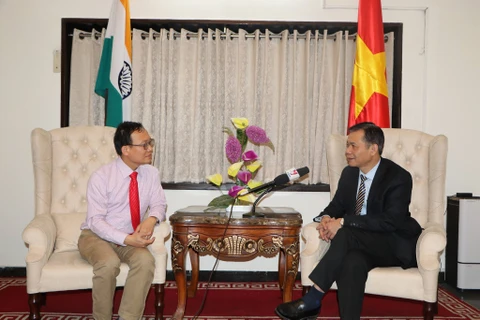
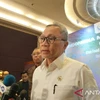
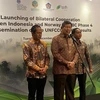
Professor, Dr. Pankaj Jha (R) in an interview with the Vietnam News Agency correspondent. (Source: VNA)
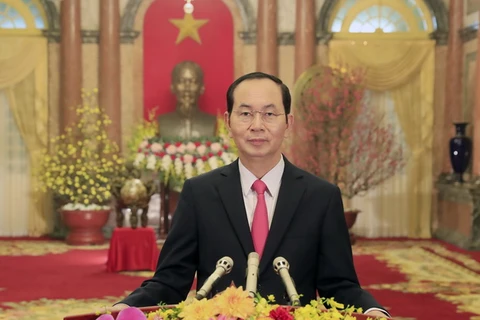
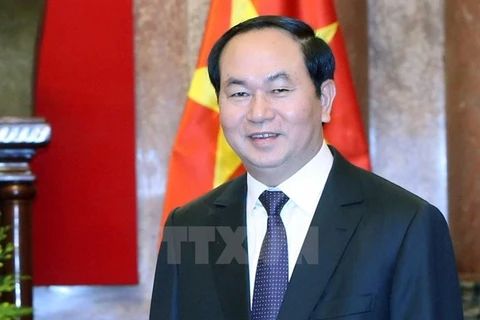
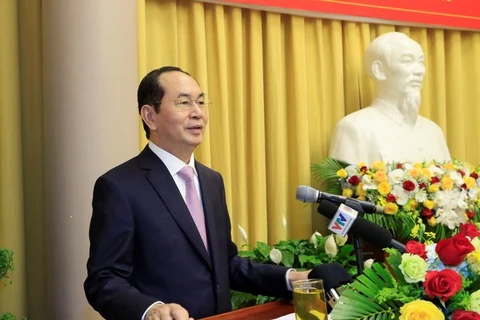
 New Delhi (VNA) – An Indian scholar has hailed Vietnamese President Tran Dai Quang's upcoming visit to India as a significant event given the fact that the Vietnamese President has a very positive attitude towards the bilateral ties and has a fair knowledge about the status of the relationship between the two countries.
In an interview granted to the Vietnam News Agency ahead of President Tran Dai Quang’s visit to India (March 2-4), Professor, Dr. Pankaj Jha, a senior faculty member with Jindal School of International Affairs (JSIA) and is also Editor-in- Chief of the JSIA Journal, said in the last three years, the hyper activism in India-Vietnam relations has manifested itself into opening of new vistas of cooperation between the two sides.
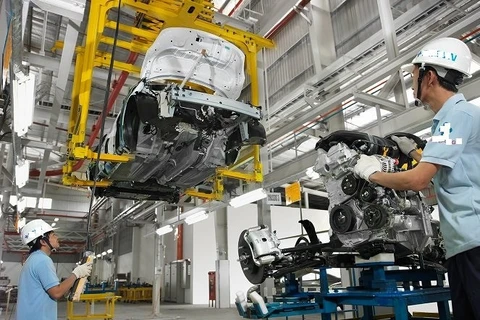
This includes areas such as political understanding on areas of critical interest, defence and strategic areas, increasing trade and investment, building capacities in manufacturing, education, health, energy, agriculture sector, increasing tourism and culture ties, connectivity (both infrastructure and digital), increasing lines of credit and explore new areas of developmental partnership.
The professor noted that the visits of PM Modi, India’s foreign minister and National Security Adviser have been well complemented by the visits of the Vietnamese Prime Minister during the recently concluded India- ASEAN Summit, Deputy Prime Minister and Foreign Minister, the General Secretary of the Communist Party of Vietnam, the Chairperson of the National Assembly of Vietnam and now the President.
He stressed that it clearly manifested the fact that the two countries are willing to take the relationship to a new level and the slow momentum has now been raised to accelerated interaction.
“Given the fact that Vietnam is one of the fastest growing economies in Southeast Asia and India is the fastest growing economy in Asia, there is bound to be mutual cooperation,” Prof. Pankaj Jha said, adding that the trade and investment between India and Vietnam are bound to grow and the sectors which might see the surge include education, health, low tech manufacturing and also agriculture.
According to him, President Quang’s visit must now address issues related to working out a common agenda for the Action Plan 2018-2020 to implement and also undertake measures to fructify the elements of the Comprehensive Strategic Partnership which was signed during the visit of Prime Minister Modi to Vietnam.
He noted that there is a need to work out elements of further cooperation in the fields of defence and defence manufacturing, space cooperation, regular annual high-level defence and strategic dialogue, service-to-service cooperation in particular defence aviation, signalling, radars, and promoting regular naval ship visits. The two countries need to work out an annual plan on extensive training and capacity building, facilitate easy defence equipment procurement along with deferred payment plan or utilising Lines of Credit, and work on joint venture in developing critical technologies.
The scholar was also of the view that between the two sides there is a need for discussion on how to empower different regional mechanisms such as ADMM and also Extended ASEAN Maritime Forum.
According to him, those organisations have the potential to address and initiate dialogue on critical issues but have been working below potential.
He added that the two sides must look into new technologies which are developing in the civilian domain which includes artificial intelligence, robotics and also work in the areas such as metallurgy and developing composite materials.
Regarding the position and role of Vietnam in India's "Act East Policy", Professor Pankaj Jha said the ties between the two countries goes a long way back, citing the well-known friendship between Ho Chi Minh and Nehru, then Indian PM and Rajendra Prasad, then Indian President. He also noted that the rooted personality of Ho Chi Minh inspired many nationalist leaders across India and he was an icon among the Indian masses.
According to the scholar, in fact, India- Vietnam ties were unaffected by the end of cold war, and the relationship has been durable and close. Therefore, Vietnam holds an important place in India’s Act East policy and is one of the horizons of the policy.
The best thing is that both sides want to enhance the goal-oriented ties in different fields, Prof. Pankaj Jha said, stressing that the need of the hour is to work out an action plan and implement it to the best of capacities.
He said the political understanding between the two sides is very intense and Vietnam’s support to India’s Security Council membership shows the trust between the two sides. India has also supported Vietnam in international institutions. The two countries are members in East Asia Summit and ASEAN related institutions which provide platforms for further developing the understanding and cooperation and work towards maintaining peace and harmony in the region.
Professor Pankaj Jha suggested that there is still great potential for bilateral cooperation in areas such as research and development in defence, joint venture in non-lethal weapons development, metallurgy, maintenance and repairs, space, artificial intelligence, agriculture, fisheries, animal husbandry, floriculture, sericulture, power generation and energy efficiency, disaster management, early warning systems, and exchange of intelligence and information.
At the same time, he noted that in terms of financial architecture and developing the capital markets, there is a need to exchange of information and developing complementarities so that investment can be easy. Further, the problem between the two countries is that they are competitors for the same set of goods in the international market which includes, pepper, coffee, tea and rice.
Prof. Pankaj Jha also pointed to the problems in customs harmonisations and the really long list of negative list items in the bilateral trade, which do constrain the possibility of trade enhancement, adding that it is necessary to prune down the negative list from the two sides.
Dr. Pankaj Jha teaches national, international security, and defence strategy to postgraduate students at Jindal School of International Affairs (JSIA). He was Director (Research) with Indian Council of World Affairs for more than two and half years (2014-2017). He has more than 80 articles/academic papers in both refereed and non–refereed journals, and has authored two books on India and China in Southeast Asia: Competition or Cooperation (2013) and India and the Oceania: Exploring Vistas of Cooperation (2016).-VNA
VNA