Indonesia sets up agency to handle investment in new capital

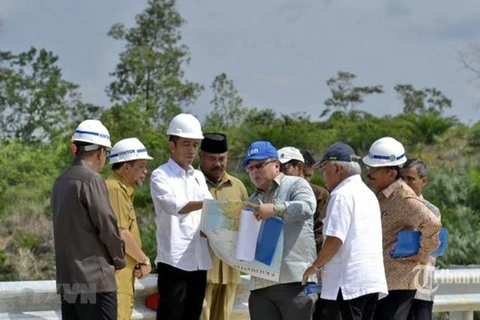
The Indonesian Government will introduce a special agency whose main task is to deal with foreign and domestic investment in the new capital city in East Kalimantan province.
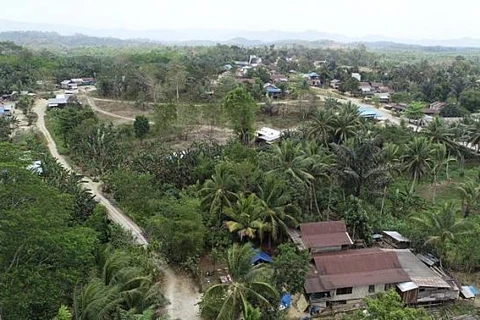
Indonesia sets up agency to handle investment in new capital ảnh 1An aerial view of East Kotawaringin, East Kalimantan province, the area chosen to house the new capital of Indonesia (Photo: AFP/VNA)

Jakarta (VNA) – The Indonesian Government willintroduce a special agency whose main task is to deal with foreign and domesticinvestment in the new capital city in East Kalimantan province.

Speaking after a cabinet meeting on February 26,National Development Planning Minister Suharso Monoarfa said the new agencywill have powerful authority to license potential investors without the consentof the existing Investment Coordinating Board (BKPM).

He noted that investors from the Republic ofKorea, Japan, Spain, the US and Germany have expressed interests in taking partin the construction of the new capital city. However, no deal has been madebecause the government is still working on selecting projects that need foreigninvestment and determining the financing schemes.

Chief investment minister Luhut BinsarPandjaitan said the new agency will be led by an official of the ministeriallevel, and President Joko Widodo is currently selecting candidates.

Suharso said the government expects to carry outthe construction of basic infrastructures of the new capital later this yearafter the master plan is finalised.

If everything goes as planned, by the first halfof 2024, the new city will be able to function as the new capital,according to him.

The new capital city will be built in a new areathat traverses North Penajam Paser and Kutai Kartanegara districts in EastKalimantan.

The capital relocation project is expected to costthe government around 33 billion USD, 19 percent of which to be paid for by thestate budget and the rest by local and foreign investors./.
VNA
See more

Fitch downgrades Philippines’ outlook to ‘negative’. (Illustrative photo: Reuters)

Fitch downgrades Philippines’ outlook to ‘negative’

The Outlook revision reflects rising risks to the Philippines' strong medium-term growth prospects from recent disruptions to public investment, exacerbated in the near-term by elevated exposure to the ongoing global energy shock.

The Singapore Maritime Technology & Research Roadmap is aimed at advancing the sector’s efficiency and sustainability. (Photo: businesstimes.com.sg)

Singapore unveils new roadmap to boost innovation in maritime sector

The Singapore Maritime Technology & Research Roadmap is aimed at advancing the sector’s efficiency and sustainability. It highlights priorities – including digital technologies, decarbonisation and operational integration – to boost resilience, productivity and innovation in Singapore’s maritime ecosystem. It also addresses structural issues such as manpower, land and sea space limitations.

Malaysia considers establishing strategic petroleum reserve

Malaysia considers establishing strategic petroleum reserve

Malaysia, which was previously a net exporter, has now become a net importer due to declining domestic production and rising consumption, with demand estimated at around 800,000 barrels per day compared to production of about 400,000 barrels per day.

Indonesia to halt diesel imports from July

Indonesia to halt diesel imports from July

The move is part of the Indonesian Government’s efforts to strengthen national energy independence by utilising palm oil as an alternative fuel, said Agriculture Minister Andi Amran Sulaiman.

Malaysia’s growing microplastics crisis is largely self-inflicted, driven by domestic waste, weak recycling practices and everyday plastic use, said experts. (Photo: New Straits Times)

Malaysia seeks solutions to microplastic crisis

Microplastics originating from domestic waste and wastewater are increasingly entering the food chain, posing serious threats to seafood safety and the livelihoods of coastal communities.

The new mass emergency alert system SG Alert, which will be used during emergencies such as major fires, chemical or terror incidents, seen on an Apple and Android device on Apr 17, 2026. (Photo: CNA)

Singapore launches new national emergency alert system

SG Alert in Singapore uses cell broadcast technology, enabling alerts to be delivered within seconds without requiring mobile data or collecting personal information. Unlike conventional SMS, which may be delayed during network congestion or depend on internet connectivity, the system ensures fast and reliable message delivery. Alerts can be sent islandwide or targeted to specific affected areas.