Industry 4.0’s opportunities, challenges to heat up WEF ASEAN

The World Economic Forum on ASEAN (WEF ASEAN), slated for September 11-13 in Hanoi, will offer a chance for countries to share experience in utilising opportunities and addressing challenges generated by the fourth Industrial Revolution.
Industry 4.0’s opportunities, challenges to heat up WEF ASEAN ảnh 1The fourth meeting of the organisation board of the WEF ASEAN 2018 (Source: VNA)

Hanoi (VNA) – The World Economic Forum on ASEAN (WEFASEAN), slated for September 11-13 in Hanoi, will offer a chance for countriesto share experience in utilising opportunities and addressing challengesgenerated by the fourth Industrial Revolution.

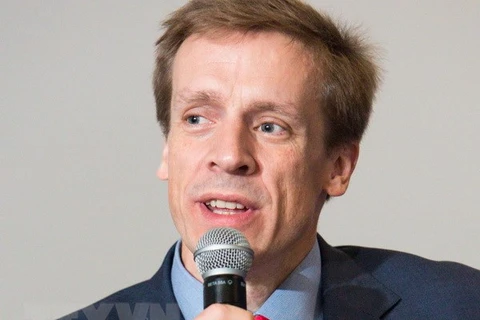
Chargé d'Affaires of the Singaporean Embassy in Vietnam Tan Wei Ming said the event’stheme “ASEAN 4.0: Entrepreneurship and the fourth Industrial Revolution” matchesthe priorities of the WEF and the Association of Southeast Asian Nations(ASEAN).

ASEAN can adapt to new conditions, he said, suggesting theten-member group equip its residents with skills and knowledge and improve thequality of human resources among its member nations.

Besides, ASEAN should focus on innovation and self-resiliance tomeet the requirements of the fourth Industrial Revolution and a changing world,apply new technologies and ensure that none are left behind during development,the diplomat said.

ASEAN is the world’s sixth largest economy with a combinedpopulation of 630 million, of whom 260 million are internet users. The numberis expected to climb to 480 million in 2020.

About 60 percent of Vietnam’s 93-million population areunder 35 years old and able to quickly access new technologies, with 55 percentof the population internet users.

The country is striving to become one of the top ten softwareoutsourcing providers in the world, with about 1 million labourers in the information-technologysector.

Google and Temasek Foundation International forecast that theinternet economy of Southeast Asia will hit200 billion USD by 2025, equivalent to 6 percent of regional GDP.

Vietnamese Deputy Foreign Minister Bui Thanh Son suggested governmentsof ASEAN countries and businesses focus on self-resilience and seek newsolutions to adapt to a world driven by new technologies.

Vietnam is gearing towards sustainable development through improving growth quality andutilising opportunities of the fourth Industrial Revolution to improveproductivity and competitiveness, moving higher up the global value chain, hesaid.

Phan Hoang Lan, head of the Department of Market Development andScience-Technology under the Ministry of Science and Technology, listed severalmechanisms and policies approved and issued by Vietnamese Prime Minister NguyenXuan Phuc to support startups.

She gave the example of a decision to support the nationalinnovative startup ecosystem under which most of the startups focus oninformation and communication technology (ICT) and IT in general.

The International Labour Organisation (ILO) estimated about 56percent of labourers in the five ASEAN member countries of Malaysia, Indonesia,the Philippines, Thailand and Vietnam are facing the risk ofbeing replaced by new technologies in the next two decades.

Justin Wood, head of the Asia-Pacific region of the WEF, toldVietnam News Agency the fourth Industrial Revolution will impact all countriesworldwide at different levels.

He said low production costs and cheap labour will no longer aidthe competitiveness of countries like Vietnam, suggesting these nationsprove their competitiveness in other spheres.

The WEF ASEAN 2018 is expected to feature 60 discussions, focusingon issues regarding governments, businesses and residents in ASEAN amidst thefourth Industrial Revolution.-VNA

VNA

See more

FPT University students during class. (Photo: VNA)

AI reshaping Vietnam’s semiconductor ecosystem

To meet rising semiconductor industry demand, the Government has launched the Semiconductor Workforce Development Programme, which aims to train more than 50,000 semiconductor engineers and graduates by 2030 and develop key laboratories, research hubs and enterprise-linked training models.

A corner of the exhibition at the Vetnam Space Museum in Hoa Lac Hi-tech Park in Hanoi (Photo: VNA)

Major prospects for Vietnam’s space technology

Vietnam could adopt a mission-based service procurement model, prioritising projects with clear social and economic benefits, while investing strategically in domestic capabilities, standardising data, elevating remote sensing data to national data status, and gradually localising space products.

Prime Minister Pham Minh Chinh chairs the fifth meeting of the Government’s Steering Committee for science, technology, innovation, digital transformation and Project 06 in Hanoi on November 15, 2025. Photo: VNA

PM pushes for reforms in sci-tech, innovation, digital transformation

Prime Minister Pham Minh Chinh asked participants to propose priority tasks and breakthrough measures ahead, including removing obstacles, accelerating capital disbursement, simplifying procedures, promoting data reuse to cut paperwork, and offering maximum support to citizens and enterprises.

Illustrative image (Photo: VNA)

Da Nang remains Vietnam’s fastest 5G city

The city has held the top spot since the start of this year. Its 5G performance is almost 1.5 times higher than runner-up Hai Phong (429.53 Mbps) and even the capital Hanoi (415.73 Mbps).

Participants in the Vietnam–India Innovation Gateway Bootcamp (Photo: VNA)

Vietnam, India boost innovation cooperation

Bui Trung Thuong, Trade Counsellor at the Vietnamese Embassy in India, highlighted the shift in Vietnam–India relations from traditional cooperation to partnerships based on innovation, technology, and digital transformation.

Illustrative photo (Photo: VNA)

Vietnam emerges as new hotspot for AI data centre investment

A wave of investment in artificial intelligence (AI) data centres is sweeping across Vietnam, with both domestic and international corporations announcing multi-billion-USD projects that are set to transform the country into a rising hub in the regional AI infrastructure map.

An overview of the international seminar, themed “Building resilience against online frauds and scams in Southeast Asia: Spotlight on Vietnam". (Photo: VNA)

Experts propose anti-scam solutions suited to Vietnam’s conditions

Vietnam’s digital transformation has achieved remarkable progress. However, similar to other countries in the region, online scams and fraud cases are on the rise. Last year, authorities recorded 10,000 online fraud cases, with estimated losses of nearly 759 million USD.

Minister of Science and Technology Nguyen Manh Hung speaks at the Vietnam Open Technology Forum 2025 in Hanoi on November 3. (Photo: VNA)

Vietnam looks to develop, master digital technology through open standards

Vietnam has chosen to pursue this direction — developing open technologies, open-source software, and open data — to enable individuals and enterprises to co-create new values. With this approach, it will become a technology-driven nation that both benefits from and contributes to global knowledge.