Inflation predicted to stay below 4 percent in 2018: Ministry

The Ministry of Finance (MoF) has outlined three scenarios for inflation in 2018, with the consumer price index (CPI) in all circumstances staying below 4 percent, the target set by the National Assembly.
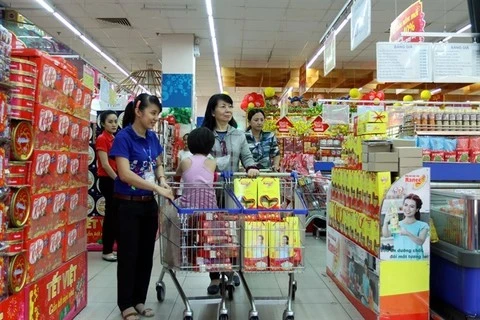
Inflation predicted to stay below 4 percent in 2018: Ministry ảnh 1Illustrative image (Source: VNA)

Hanoi (VNA) - The Ministry of Finance (MoF) has outlined threescenarios for inflation in 2018, with the consumer price index (CPI) in allcircumstances staying below 4 percent, the target set by the National Assembly.

In the first scenario, food prices are expected to remain relatively stable andonly rise slightly during the holidays.

Hikes in health care costs in the first quarter are projected to increase theCPI by 0.17 percent, while wage increases and higher power costs will drive upthe CPI by 0.14 percent and 0.1 percent respectively.

A 5 percent increase each in petrol and gas prices will lift the CPI by 0.28percent and 0.06 percent respectively.

After factoring in these price rises, the average CPI in 2018 is expected torise by 3 percent.

In the second scenario, which is largely the same as the first one, with theexception that pork prices rise by 7 percent at the end of the year and petroland gas prices increase by 10 percent, the average CPI in 2018 will rise by 3.4percent.

Meanwhile the average CPI will increase by 3.9 percent in the third scenario,assuming a 15 percent rise in pork prices and 15 percent hikes in petrol andgas prices with other price increases the same as in the first scenario.

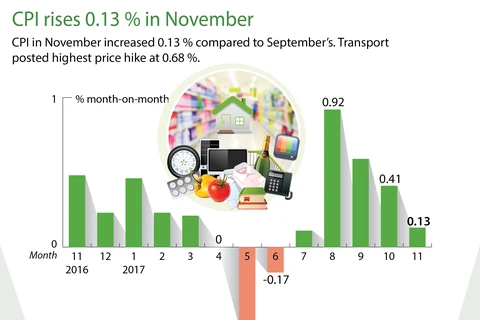
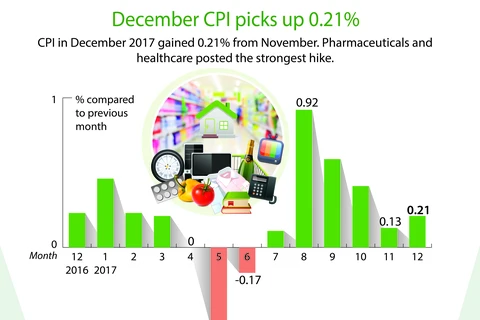
According to the General Statistics Office (GSO), Vietnam’s average inflationin 2017 fell from 5.22 percent in January to 3.61 percent in November.

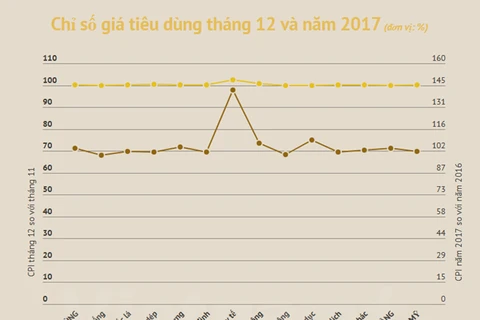
The year 2017 is considered a successful year in inflation control, as theaverage CPI increased 3.53 percent over 2016 and 2.6 per cent compared toDecember 2016, fulfilling the target of keeping the rate under 4 percent forthe whole year, GSO Nguyen Bich Lam said during a meeting last week.

Lam pointed out major reasons behind the CPI rise, including hikes in theprices of health care and education services, as well as an increase inregional minimum wage.

At the same time, domestic fuel prices in 2017 rose 15.49 percent compared to2016, contributing 0.64 percent in CPI increase for the whole year.

The price of construction materials was up 5.23 percent due to increases in theprices of sand and steel. Rising prices of essential goods in the global marketalso pushed the import price index up by 2.57 percent and export price index upby 2.93 percent; the Producer Price Index (PPI) expanded by 2.82 percent.

Lam underscored that a record number of 16 storms were seen in 2017, whichpushed up the prices of food and foodstuff in affected localities, especiallycentral provinces.

Meanwhile, there were a number of factors helping rein in inflation, includinga downturn of 2.6 percent in food prices in 2017, helping reduce the overallCPI by about 0.53 percent.

GSO Director Nguyen Bich Lam attributed the success in meeting the inflationtarget for the year to efforts of ministries in encouraging businesses’involvement in stocking goods and stabilising the market.

The Ministry of Finance had kept a close watch on market developments, whilecoordinating with the Ministry of Industry and Trade to manage fuel prices, hesaid.-VNA

VNA

See more

The Ministry of National Defence's inter-agency inspection team visits La Gi Fish Port in Phuoc Hoi ward, Lam Dong province. (Photo: VNA)

Lam Dong's IUU fishing prevention efforts inspected

According to the Lam Dong provincial IUU Fishing Prevention Steering Committee, all 8,177 fishing vessels measuring at least 6 metres in length have been registered and updated in the national fisheries database VNFishbase.

A member of Minh Quang Cooperative in Hung Yen province works on a farm. (Photo: VNA)

Vietnam aims to link half of farm cooperatives with enterprises by 2030

The Ministry of Agriculture and Environment will promote links between cooperatives, enterprises, science and technology organisations and other economic entities along with carrying out programmes to develop concentrated agricultural, forestry and fisheries raw material areas and enhance value chain production.

The night-time economy is increasingly seen as an important avenue for Vietnam’s tourism sector to extend visitors’ stays (Photo: VNA)

Revitalising growth momentum for night-time economy

The night-time economy has moved beyond being merely an add-on service to become a new growth driver for tourism. Night-time activities can “awaken” familiar heritage spaces and breathe new life into them. Art, light and music experiences after dark can create distinctive attractions while meeting the desire of middle- and high-end visitors to explore cultural depth.

A livestream session promotes green-skinned pomelos grown in Cho Lach commune, Vinh Long province. (Photo: VNA)

E-commerce reshapes rules of game

Once fixed fees, payment fees, infrastructure charges and service packages are included, sellers may have to spend around 24.5-27.6% of their revenue on platforms. The figure shows that the era of easy selling and low costs in e-commerce has officially come to an end.

Ho Chi Minh City targets third-quarter growth of over 11% (Photo: VNA)

Ho Chi Minh City targets third-quarter growth of over 11%

Ho Chi Minh City will continue to implement drastic measures to achieve double-digit growth, targeting GRDP growth of at least 11.07% in the third quarter of 2026, 9.43% in the first nine months and 12.3% in the fourth quarter, with a view to completing the full-year goal of 10% or more.

MM Mega Market An Phu supermarket in Ho Chi Minh City is brightly decorated for the National Day holiday. (Photo: VNA)

Domestic consumption up over 13%, tourism continues strong growth

The total retail sales of goods and consumer service revenues in August were estimated at 679.8 trillion VND (26 billion USD), up 1.6% from the previous month and 14.9% year-on-year. In the January-August period, the figure reached 5.24 quadrillion VND, representing a 13.3% increase year-on-year.

A production line of Onaga Co., Ltd. (Japan) at HANSSIP (Photo: nhandan.vn)

Hanoi moves to maintain appeal to FDI inflows

In the first eight months of 2026, the capital city attracted more than 3.7 billion USD in FDI, equivalent to 83% of the plan set for the year. Newly registered FDI exceeded 572 million USD across 450 projects, up 175.78% in project numbers and 209.46% in capital compared to the same period last year. Additional registered capital topped 492 million USD, while capital contributions and share purchases exceeded 2.6 billion USD.

Saigon Marina IFC is the first private-sector project contributing to realising the goal of developing the Vietnam International Financial Centre in Ho Chi Minh City. (Photo: VNA)

VIFC offers various opportunities to attract forein investment

Turning the VIFC into an effective channel for international capital will require clear rules, quality projects and strong connections between investors and domestic businesses. Meeting these requirements will be key to transforming investor interest into concrete capital flows and investment projects in Vietnam.

Production line at Yadea Vietnam’s smart manufacturing plant, which has an investment of more than 100 million USD, in Tan Hung Industrial Park, Bac Ninh province. (Photo: VNA)

Development model for new era – An inevitable trend

International organisations broadly agree that shifting the growth model from reliance on traditional factors toward technology and innovation is no longer an option for Vietnam, but an imperative of the times.

At a commune administrative service centre in Hung Yen province (Photo: VNA)

Government determined to cut administrative procedures to drive double-digit growth

Resolution No. 258/NQ-CP, dated August 31, 2026, calls for substantive and comprehensive reform, with a focus on maximum cuts and simplification of administrative procedures and business conditions. It also seeks to shift management from pre-licence inspection to post-licence inspection based on risk management, while strengthening real-time, data-driven oversight and putting people and businesses at the centre of public services.

(Illustrative photo: VNA)

Vietnam eyes entry into 40-billion-USD Southeast Asian CCS market: experts

A clear, transparent and stable legal framework would not only enable Petrovietnam to play a leading role in new energy development but also strengthen investor confidence, encouraging both domestic and foreign enterprises to invest, transfer technology and cooperate in developing large-scale CCS projects.