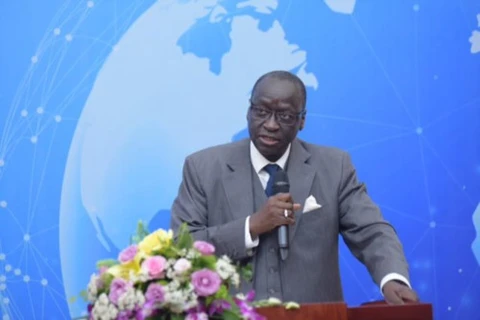
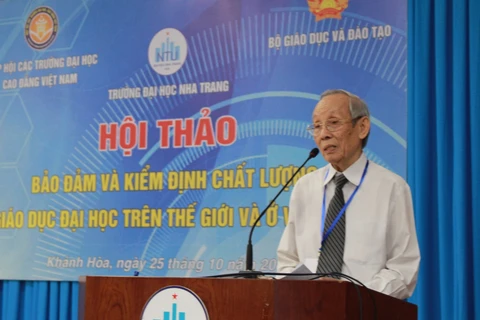
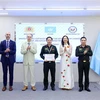
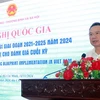
Deputy Mission Director of the US Agency for International Development (USAID) Bradley Bessire delivers an opening remark at the forum. (Photo: VNA)
 The forum was co-organised by the “Building University-Industry Learning and Development through Innovation and Technology” or BUILD-IT project, Arizona State University, and the Hanoi University of Industry.
At the forum on International Accreditation and Recognition Value and Success Showcase, experts in academia, industry, and government explored the importance, the successes, and the challenges of raising the profile of academic institutions through international recognition and accreditation.
Participants also looked at an introduction to a structured approach and key factors leading to successful ABET programme accreditation or AUN-QA programme evaluation, experienced increased capacity development for international accreditation and via a keynote address and panel sessions highlighting Vietnamese successes in obtaining AUN-QA evaluation or ABET accreditation.
Proven models and key success factors were highlighted, all within the Vietnamese context.
The event also provided guided exploration of necessary steps and preparations towards successful international recognition of programmes, based on the recently developed “playbook” or quick start guide.
A key part of international accreditation recognition is quality and seeking continuous improvement.
Nguyen Huy Phuc, Head of Office of Testing & Quality Assurance at the Industrial University of Ho Chi Minh City said: “Quality assurance is not a destination, but it is a journey to further continuous improvement.
"And the most important aspect is to build a culture of quality assurance institutionally so that all stakeholders can see that quality assurance activities are not of a single unit or individual, but of a collective, from the programmes to the faculties and departments and the institution as a whole.”
For the past seven years, the BUILD-IT project has been helping Vietnamese universities implement robust systems to attain international accreditation and recognition. The tools and techniques BUILD-IT teaches for accreditation and assessment become part of institutional processes and contribute to improving quality of teaching and learning. BUILD-IT’s goal is to enable sustainability of quality STEM education in the long-term, in part by increasing the breadth of programs seeking and achieving international accreditation and recognition.
Since the inception of BUILD-IT, 86 partner programmes have achieved international/regional accreditation and recognition.
This forum showcased some of those programmes and their institutions by bringing together a national audience focused on implementing best practices for international recognition, such as ABET accreditation or AUN-QA evaluation.
Dr. Pham Tran Vu, the Dean of the Faculty of Computer Science and Engineering at HCM City University of Technology, the first university in Vietnam to achieve ABET-accredited programmes, said: “Accreditation, after all, helps us to have better insights into quality assurance in education."
Deputy Head of International Cooperation Department at Cao Thang Technical College (the second higher education institution in Vietnam to achieve ABET accreditation), Nguyen Thi Thanh Binh, added: “Accreditation is not for certificate only, but for the real benefits to the stakeholders along the way.”
To leverage seven years’ worth of programmes, workshops, seminars, and training sessions, BUILD-IT created its Playbook Series to assist to sustain BUILD-IT’s value long after the project ends in 2023.
Topics in this playbook series include Institutional Accreditation, Project Based-Learning, Digital Immersion Learning, Program Accreditation (AUN-ABET), Industry Advisory Boards, Women in STEM, Maker Innovation Network, and Faculty Development and Active Learning.
BUILD-IT anticipates that the playbooks will become recognised resources and utilised for university and higher education planning. These tools can help build scale – reaching additional universities and engineering programmes throughout Vietnam for sustainable and nationwide change./.
VNA