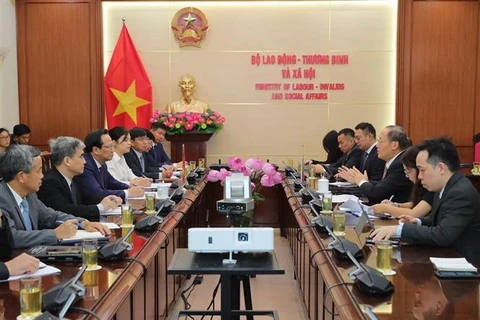
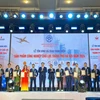
Foreign Minister Bui Thanh Son (the fourth from left) and delegates at the conference (Photo: VNA)
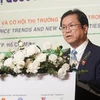
 Singapore (VNA) – Addressing a conference on Vietnam investment in Singapore on July 17, as part of his ongoing official visit to the country, Foreign Minister Bui Thanh Son stressed investment cooperation has become a highlight in bilateral relations, actively contributing to the socio-economic development of both Vietnam and Singapore in recent times.
Themed “Seizing investment opportunities in Vietnam in response to new changes”, the event was jointly hosted by the Vietnamese Embassy to Singapore and the Joint Stock Commercial Bank for Foreign Trade of Vietnam (Vietcombank). It saw the participation of over 250 representatives from the Ministry of Planning and Investment, the Ministry of Industry and trade, and the Ministry of Foreign Affairs, business associations and enterprises of the two countries.
 Participants express confidence in Vietnam's strong economic development potential. (Photo: VNA)
 There are new opportunities for Vietnam and Singapore to promote investment cooperation in various sectors in the context of rapid transformations with such trends as digital transformation, green economy, sustainable development, and the Fourth Industrial Revolution in the region and the world, he said.
The establishment of the Vietnam–Singapore Digital Economy and Green Economy Partnership during Prime Minister Pham Minh Chinh’s visit to Singapore in early 2023 serves as an essential foundation for the two sides to strengthen cooperation in important areas, promote circular economic development, clean energy, and address climate change challenges.
Representatives from Vietnamese ministries, sectors, and businesses updated on the countrys development goals for 2030 and its vision for 2045, development trends and investment opportunities in Vietnam, particularly in the fields of digital economy, industry - manufacturing, and renewable energy.
Participants expressed confidence in Vietnam's strong economic development potential and spoke highly of its efforts in promoting the development of green economy, digital economy, and circular economy. They discussed and proposed various specific measures to effectively implement the Vietnam–Singapore Digital Economy and Green Economy Partnership, strengthen cooperation, and mobilise resources for infrastructure development and high-quality investment projects, and promote green financial cooperation and energy transformation.
Singaporean delegates showed their interest in Vietnam's policies related to developing eco-industrial parks, plans to implement National Power Development Plan VIII, and incentives for green investment projects.
The conference started a series of activities within the framework of FM Son’s first official visit to Singapore. It is expected to pave the way for new and practical opportunities in investment cooperation between the two countries, contributing to further deepening the Vietnam-Singapore strategic partnership.
Singapore is now the second-largest foreign investor in Vietnam with nearly 3,300 projects worth over 73 billion USD. Building on the initiative of both governments, the first Vietnam-Singapore Industrial Park (VSIP) was established in the southern province of Binh Duong in 1996. So far, there have been 14 VSIPs operating efficiently, generating over 300,000 jobs for locals./.