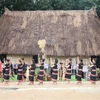
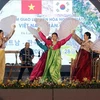
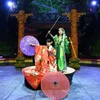
A ritual in Ky Yen festival (Photo: VNA)
 Binh Duong (VNA) - Ky Yen Festival at Tan An temple represents historic evidence for local village land reclamation, demonstrating the typical agrarian culture and people captured in the Vietnamese saying “When drinking water, remember its source”.
Tan An temple, known as Ben The temple, lies along the Saigon River in Thu Dau Mot city, the southern province of Binh Duong. It was founded in 1820 when the Vietnamese began to reclaim land and establish villages in the early 19th century.
The temple was recognised by the Ministry of Culture, Sports and Tourism as a National Architecture and Art Relic in 2014.
Every lunar November, like other temples in the south, Ky Yen festival at Tan An temple is held to remember forebears who were credited with establishing villages and extending the land, as well as to pray for national peace and fine weather.
Holding the festival is a way to show locals’ gratitude to the Gods who have protected and blessed the village, and remember forebears and martyrs who contributed to protecting the homeland. The temple not only satisfies the need for spiritual and religious practice but also serves as a cultural living space for local folks.
The festival also demonstrates community solidarity, the character of people in the south and self-reliance of the local community. Participating in the work of the temple, men or women alike, demonstrates gender equality in the new society.
During the year of the Buffalo, Tiger, Dragon, Snake, Goat, Monkey, Dog and Pig, Tan An temple holds the festival on a small scale on the 15th day of the lunar November. During the Year of the Rat, Cat, Horse and Rooster, the festival is held on a big scale from the 14th to the 16th of the lunar November.
According to tradition, the festival also includes the worship of the agricultural god, ancestors who contributed to extending the land, and martyrs who sacrificed their lives to the nation.
It features a dozen rituals, including Inviting Ancestors, Inviting the Deities, Receiving the Deities and Praying for Peace, Life Offering (sacrificing a live pig), Audience (village elders presenting themselves to the deities), Life Cycle (presenting the creation and development of the universe), Main Rite, Worship the Village Founders, and Seeing the Deities Off.
Among these rituals, the Life Cycle is the most attractive to locals and visitors alike because it is an opera presentation offered to the Gods.
A book, published during the 1802 – 1820, described Ky Yen Festival: “Each village (in the South) has a temple. Only God-favoured days should be chosen for village events.” On such a day, old and young must gather at the temple in the evening and stay there overnight. This is called the audience. On the second day, scholars in ceremonial dress beat drums and gongs and conduct the main rituals. And On the third day, the closing ceremony, called “Great Unification”, is conducted.
Worship rituals also have boi singing, traditional music to fascinate audiences, attracting thousands of visitors. Many locals living and working far away often return home to join the festival.
Throughout history, generations of the Vietnamese people in Binh Duong have created a culture imbued with national identity. This accomplishment has left a treasure of diverse and invaluable intangible cultural heritage, including Ky Yen Festival at Tan An temple which is more than 200 years old and has witnessed many changes. Rituals of the temple are still preserved and conducted regularly by locals in accordance with old customs.
On January 12, 2022, the Ky Yen festival was named in the list of national intangible cultural heritages by the Ministry of Culture, Sports and Tourism. Tangible and intangible cultural heritage values of Tan An temple reflect the local cultural identity, cultural diversity and human creativity that has been passed on through many generations./.