Large banks want foreign owner cap to be increased

Large banks have asked the Government to increase the cap for foreign stakeholders in the banks from the current stipulated 30 percent to more than 40 percent.
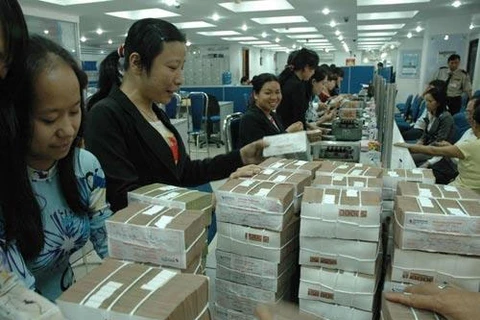
Large banks want foreign owner cap to be increased ảnh 1Vietcombank is proposing to issue new shares equivalent to 10 percent of its capital to foreign investors. — File photo

Hanoi (VNA) - Large banks have asked the Government to increase the cap for foreign stakeholders in the banks from the current stipulated 30 percent to more than 40 percent.

Vietcombank is proposing to issue new shares equivalent to 10 percent of its capital to foreign investors. Japan’s Mizuho Corporate Bank Ltd, which owns 15 percent of the bank, plans to acquire another 5 percent.

If the proposal is approved, Vietcombank’s foreign ownership will rise to around 35 percent from the current 21 percent.

Vietinbank general director Le Duc Tho said that the bank would seek permission from the Government to increase ownership for foreign investors at his bank to 40 percent or even higher. However, the State would still hold the dominant ratio of 51 percent in the banks, he said.

The rise would help Vietinbank, the country’s second largest lender by assets, to raise its foreign ownership from the current 27.75 percent to more than 40 percent.

At the shareholders meeting recently, Sai Gon Commercial Joint Stock Bank (SCB) General Director Vo Tan Hoang Van also announced that the State Bank of Vietnam allowed the SCB to find foreign strategic investors to sell 50 percent of the bank’s stakes.

An Binh Bank is also expecting to increase the caps for foreign stakeholders at the bank to 49 percent. MayBank and IFC are currently among An Binh Bank’s largest shareholders, holding 30 percent of the bank’s charter capital.

According to experts, the cap increase for foreign stakeholders in local banks is indispensable as it will help the banks improve their restricted finance and governance, and grow rapidly in the context of rising competition from the country’s integration into the world market.

Under the current regulations, cap on foreign holdings in a Vietnamese bank is set at 30 percent. However, according to experts, the rule makes investment into domestic banks less attractive as foreign investors with low stakes have no say in the decision making process in such banks.

Domestic commercial banks also said that it is hard for them to find foreign strategic partners due to the current rules on foreign ownership limits.

The Bank for Investment and Development of Vietnam (BIDV), for example, early last year planned to find foreign strategic partners, selling a 15 percent stake to a foreign strategic partner and 10 percent to a foreign financial investor. However, it failed in its search.

Another example is Military Bank. After failing to find suitable foreign strategic partners for a long time, the bank recently had to change its plans and decided to increase stakes for foreign investors from 10 percent to 20 percent through an additional share issue.

The same trend was seen with VP Bank after its strategic partner - the Singapore-based Overseas Chinese Banking Corporation Limited (OCBC) - withdrew its capital from late 2013. Finding no foreign strategic partners, VP Bank had to ask its shareholders in October 2015 to approve a plan to issue a number of shares, equal to 20 percent of the bank’s capital, to overseas investors in order to raise capital to serve the bank’s core businesses.

However, to attract foreign strategic partners, besides cap increase of foreign stake holdings, experts also recommended to domestic banks that they improve their transparency.

Deputy Director of the Central Institution for Economic Management Vo Tri Thanh said that transparency was a key factor in attracting foreign partners. Transparency must exist at all levels and banks must commit to it, both, in their reporting and operations, he said.-VNA
VNA

See more

Shrimp processing for export at Huy Nam company, An Giang province. (Photo: VNA)

Fisheries sector proactively adjusts to emerging challenges

In addition to food safety regulations, the US continues to closely monitor the origin of imported seafood through the Seafood Import Monitoring Programme (SIMP) administered by the National Oceanic and Atmospheric Administration (NOAA). Requirements linked to the Marine Mammal Protection Act (MMPA) are also a major concern for businesses.

Pham Van Cong, Chairman of the Vietnam Cashew Association, speaks in a conference reviewing the industry’s 2025 performance and deploying procurement plans for 2026 in HCM City on March 13. (Photo: VNA)

Cashew sector braces for challenges in 2026 amid global uncertainties

Vietnam’s cashew industry recorded export turnover of about 5.5 billion USD in 2025, the highest level ever. He noted that the result reflects the industry’s remarkable development, dynamism and timely adaptation to complex and unpredictable challenges both domestically and globally.

An Phát Complex Industrial Park in Hai Phong City is one of the eco-friendly industrial parks. (Photo: VNA)

Green industrial parks become new magnet for FDI

Statistics show that about 80% of FDI enterprises prioritise investing in industrial parks with green energy infrastructure, reflecting a growing shift in investment preferences amid tightening global environmental standards.

Wood panel production at the Thuan An Wood JSC in Ho Chi Minh City (Photo: VNA)

Vietnamese businesses ride wave of investment in green manufacturing

Recent developments in private investment show that as confidence in the private sector has grown and is a key driver of economic development, investors are strengthening support for enterprises not only through capital but also management expertise and market connectivity.

Officers and soldiers of Son Tra Border Guard Station, Da Nang City Border Guard Command tell local fishermen about IUU fishing. (Photo: VNA)

Fishing solidarity groups help Vietnam with IUU “yellow card” warning removal

Over the years, coastal authorities in Da Nang have intensified efforts to educate fishermen about regulations, particularly the need to avoid illegal fishing in foreign waters. Local administrations and competent forces have also strengthened vessel registration and inspection procedures, installed vessel monitoring systems and ensured transparent declarations of catches at ports.

Representatives of Central Retail Vietnam and Lotte Plaza Market sign a distribution cooperation agreement at the networking event in Ho Chi Minh City on March 13. (Photo: VNA)

Vietnamese firms step up cooperation with international distribution chains

Connecting Vietnamese businesses with international distribution networks has been a key component of government-led trade promotion programmes for many years, which are designed to help domestic companies place goods directly into global retail systems rather than exporting solely through intermediaries.

Direct Hanoi–Amsterdam flights by Vietnam Airlines to begin on June 16. (Photo: Vietnam Airlines)

Vietnam Airlines to launch direct Hanoi–Amsterdam service on June 16

Under the plan, the Hanoi–Amsterdam route will commence operations on June 16, 2026, with an expected frequency of three return flights per week using modern wide-body Airbus A350 aircraft. This will be the first direct air link between Vietnam and the Netherlands, helping to shorten travel time and enhance connectivity between Vietnam and one of Europe’s key economic, logistics and aviation transit hubs.

Farmers harvest the 2025 Winter–Spring rice crop in An Giang province. (Photo: VNA)

An Giang accelerates export shift to meet green consumption trends

To enhance competitiveness, authorities are assisting businesses in obtaining globally recognised certifications such as GlobalG.A.P., Organic and HACCP, enabling key exports including rice, seafood and clean agricultural products to strengthen their position in global markets, according to Quang Xuan Lua, Director of the An Giang Centre for Trade and Investment Promotion.

Motorcycle riders refill their vehicles at a petrol station in Hanoi (Photo: VNA)

E5 RON92 biofuel price falls in latest adjustment

Since the beginning of this year, domestic fuel prices have undergone 14 adjustments, including five decreases and nine increases for RON95 and six declines and eight hikes for E5 RON92. Meanwhile, diesel price has fallen three times and risen 11 times.