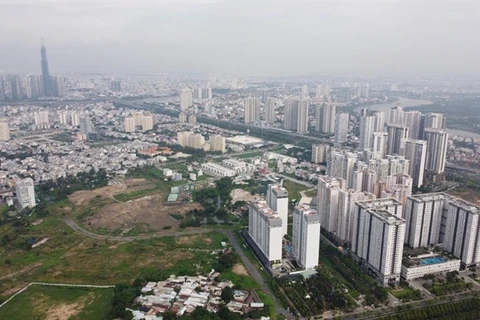
Law revised to apply market-based approach in valuing land price (Photo: VNA)
 The change is expected to significantly help the development of the real estate market and the economy.
Currently the land price framework is promulgated by the Government every five years. From this framework, local people’s committees set their own price lists for calculating tax payments or calculating a land price for compensation for project clearance.
However, as the latest revision of the law was made in 2013, the land price bracket is currently too low when compared to the price traded directly on the market between the seller and the buyer. The real market price is always much higher than the local People’s committees’ set-up prices.
According to Dr. Nguyen Dinh Tho, general director of the Institute of Strategy and Policy on Natural Resources and Environment, the 2013 Law on Land stipulates that the land price in the framework must be equal to the market price, but in fact, is much lower. The current land price framework of most localities is 30-60% lower than market price.
Professor Dang Hung Vo, former Deputy Minister of Natural Resources and Environment, said the big gap between the two types of land prices caused disputes, lawsuits, corruption and chaos in the real estate market.
The land market of Vietnam has long existed as a dual-price mechanism so the revised law is expected to remove the price gap.
To deal with shortcomings, the draft revised Law on Land removes the Government’s land price framework. It means the Government will no longer apply the minimum and maximum prices for each type of land. Instead, when issuing the land price list of each locality, the provincial People’s Committee will use methods of land pricing, land prices, and standards, and the fluctuations in actual land prices in the market to build price list.
After completing the construction of the land price list, it will be submitted to the provincial People’s councils for approval.
Benefits
The most serious consequence of the gap between the two types of land prices was corruption, Vo noted, adding it was one of the loopholes leading to the loss of State’s budget revenue. In addition, brokers used the adjustment of the land price framework to spread false information, inflate prices, and create a virtual fever. The removal of the land price framework would be a breakthrough to bring the price back to its real value, and prevent land corruption.
According to Troy Griffiths, Deputy General Director of Savills Vietnam, the Law on Land is always a sensitive and complicated issue in the legal system of any country in the world. This amendment is expected to change the land valuation from using the out-of-date price bracket to another method in accordance with market principles. The change is especially important as it will help attract investors and develop the real estate market and the economy.
Prime Minister Pham Minh Chinh and General Secretary Nguyen Phu Trong have recently raised concerns about delays in the development of public projects. In the post-COVID-19 period, infrastructure spending is needed to stimulate the recovery of the economy, but the work has remained slow, mainly due to difficulties in land compensation and allocation in the wake of the large gap between the land market price and the Government’s land price framework. Amendments on property appraisal under the draft Law on Land is very important to speed up the work.
Griffiths said under the land allocation, the compensation process was simply calculated based on the Government’s land price bracket, but the measure sometimes caused inadequate compensation and generated many additional costs, leading to delays in the project development plans.
Under the revised law, owners of acquired real estate will receive a more reasonable compensation value and closer to market price, which will help speed up the land compensation and allocation process to build new projects.
Griffiths hopes the amended Law on Land will help the real estate market become more transparent. All land that needs to be cleared or compensated will be appraised in line with market prices. The change will create more confidence for investors and people besides helping the State have more revenue as the land is fully taxed.
Sharing the same view, Professor Tho said when opening the economy, oil and gas was the financial source that brings stability to the State’s budget. In recent years, revenue from annual land use had replaced oil and gas as the main source of income. Around 15-16% of the State budget came from the collection of land use tax amounting to 12.9 billion USD.
But this number was still not significant compared to the ability that land resources could bring to the country and people. The conversion of land use purposes from agriculture to non-agriculture, or other types of land to residential land had brought great value. The land use tax difference would be reallocated to the State, people, and businesses, ensuring the harmony of interests between them. It could also create a balance between today’s and future generations, ensuring that future generations still have land to use.
According to ASL Law Firm, the change in the method of determining the land price bracket will also help deal with the real estate crisis in Vietnam as it can prevent or delay the possibility of a potential real estate bubble./.
VNA