Licensed software boosts IP rights

Bolstering intellectual property (IP) rights enforcement, including computer software, is high on the Government’s agenda, as part of its efforts to uphold international IP rights commitments it has made.
Licensed software boosts IP rights ảnh 1Gary Gan, director of the Compliance program for Asia-Pacific, BSA (Photo: ictnews.vn)

Hanoi (VNS/VNA)
- Bolstering intellectual property (IP) rights enforcement,including computer software, is high on the Government’s agenda, as part of itsefforts to uphold international IP rights commitments it has made.

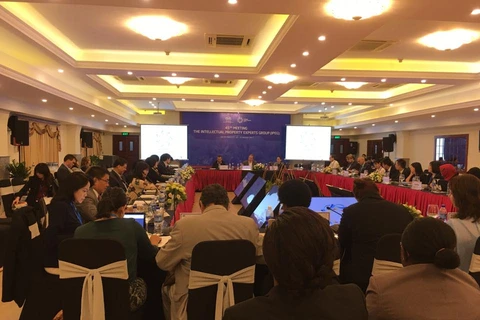
TheVietnam Intellectual Property Association (VIPA) and the Vietnam Chamber ofCommerce and Industry (VCCI), in co-operation with the Software Alliance (BSA),held a workshop titled “Opportunities for businesses to explore legally andefficiently using software” in Hanoi on August 29.

Inhis opening remarks, VIPA Chairman Mai Ha said that "As Vietnam integratesinternationally, compliance with international laws becomes moreimperative".

"Thisrequires businesses, in particular, to closely adhere to laws and observe faircompetition rules," he added.

Onhaving a workshop gathering both software corporate users and softwarecompanies, Nguyen Thi Thu Hang, VCCI Secretary General, said that actually,many businesses were unaware that most current software companies like PTC,Microsoft, Autodesk, Siemens and others have various policies in place to helpbusinesses use software efficiently.

Ascyber security attacks targeting major Vietnamese organisations and businessesare increasing, Gary Gan, director of the Compliance program for Asia-Pacific,BSA, underscored that there was strong connection between the use of illegal orunlicensed software and malware attacks or cyber attacks.

“Thefirst advice for Vietnamese businesses is to use licensed software. Thisenables you to have the latest patches from the software companies, regardlessof which ones you use whether it is Microsoft, Adobe, Autodesk, etc. This willallow you to first of all be quick in identifying a cyber attack when ithappens and able to deal with it effectively.”

Thedirector also detailed the Software Asset Management toolkit that allowscompanies or businesses to conduct an assessment of the software they have.

 “Whatthat means is traditionally, when people think of software, they think it isthe responsibility of the management or IT manager. But I would say that nowwith everyone using mobile phones, laptops and the internet, everyone hasaccess to different types of software, so everyone needs to know what they’reusing, how they’re using it, what risks they’re exposing themselves to, and whenthere’s an instance of an attack, how to identify it quickly and again, be ableto deal with it effectively,” he said.

Addressingthe workshop, Tran Van Minh, Deputy Inspector General, Ministry ofCulture-Sports-Tourism, said that inspection efforts indicated that violationof ownership rights and related rights was still going on, abusing the rightsand interests of both domestic and foreign rightful owners, and compromisinginnovation, economic-cultural-social development of the nation, and its progressof global integration.

“Thecauses of this mostly come from a lack of awareness, understanding, andparticularly a culture of adherence to ownership rights and related rights byrelevant organisations and individuals, or inability to recognise the gravityof the problem,” he added.

Minhalso said that in 10 years of the Intellectual Property Law being in effect,from 2006 to 2016, the Inspectorate of the Ministry of Culture-Sports-Tourismaudited 541 businesses, inspected 27,602 computers, and imposed administrativefines worth 8.61 billion VND.

Inspectionactivities took place at 55 businesses, with 1.38 billion VND in administrativefines levied in the first eight months of this year alone.

“Enforcementand protection of ownerships and related rights, and ownership rights forcomputer software in particular, are one of the biggest concerns that requirespecial attention from businesses. Without adequate awareness, businesses mayface adverse implications on their operations and challenges in theirintegration attempts,” Minh accentuated.

Inaddition to being able to steer clear of legal risks, probably the mostimportant benefit of using licensed software is that it can improve efficiencyand information security for businesses.

Reportsfrom the Vietnam Computer Emergency Response Team from 2016 show a total of134,375 cyber attacks, 4.2 times higher than in 2015. In the first half of 2017alone, Vietnamese websites were victims to more than 6,000 instances of cyberattacks.-VNA
VNA
See more

Deputy Prime Minister Ho Quoc Dung speaks at the meeting on June 17 (Photo: VNA)

Deputy PM urges faster completion of science, technology, digital transformation regulations

Deputy PM Ho Quoc Dung stressed the need for close coordination among the Ministry of Science and Technology, the Ministry of Justice and the Government Office to finalise and submit for issuance key decrees guiding the implementation of the Law on High Technology and the Law on Digital Transformation within this month, thus enabling them to be brought into practice as soon as possible.

Can Tho city has guaranteed that at least 1% of its total budget expenditure will be allocated to science, technology, and innovation (Photo: VNA)

New tax incentives expected to boost science, technology enterprises

The incentives are also expected to attract and retain scientists and technology experts while providing enterprises with additional resources to enhance competitiveness in strategic sectors such as artificial intelligence, semiconductors, software and biotechnology.

An engineer at the Digital Transformation Centre under the Khanh Hoa provincial Department of Science and Technology performs equipment maintenance. (Photo: VNA)

Efforts needed to safeguard data security in digital era

Vietnam’s cybersecurity landscape has witnessed a notable shift in recent years. While the number of cyberattacks recorded in 2025 showed signs of decline, the proportion of organisations suffering actual damage rose to 52.3%. Cyberattacks increasingly target critical sectors, including banking, finance, energy, telecommunications, and government agencies.

A worker from Hanoi branch of the Viettel Construction Corporation is connecting and installing 5G BTS station equipment. (Photo: VNA)

Vietnam expects digital economy to contribute 30% of GDP by 2030

The country also aims to support at least 500,000 small and medium-sized enterprises in digital transformation, develop a minimum of five digital technology companies capable of competing with counterparts in advanced economies, and establish at least five operational data exchanges.

The international conference takes place in Varna city, Bulgaria, from June 10 to 12. (Photo: VNA)

Vietnam hopes to enhance nuclear energy cooperation with Bulgaria: ambassador

Highly valuing Bulgaria's extensive experience in operating the Kozloduy nuclear power plant and training specialised personnel, Ambassador Nguyen Thi Minh Nguyet proposed boosting bilateral cooperation in specialist training, scientific research, and the sharing of management, operational, and nuclear safety expertise.

Visitors explore agricultural production equipment on display at Agri & Biotech Vietnam 2026 in Ho Chi Minh City. (Photo: VNA)

Agri-biotech exhibition series underway in Ho Chi Minh City

In addition to the exhibition activities, Agri & Biotech Vietnam 2026, lasting until June 12, is set to host a series of specialised forums and seminars. Topics of particular interest to businesses include farming exports, sustainable development of the pepper and spice industries, low-emission agriculture, carbon credits, the circular economy, biotechnology and innovative start-ups.

At Expo Tel Aviv in Israel (Photo: VNA)

Digital transformation fuels demand for cybersecurity talent

According to the National Cybersecurity Association (NCA), cyberattacks are rising in both frequency and severity. Attackers are targeting critical infrastructure, personal data, and public services with increasingly advanced methods. This isn't just a technical glitch, but a systemic vulnerability requiring a workforce that can analyse and respond in real time.

Billionaire Eric Schmidt, former Chairman and CEO of Google and former Chairman of the US National Security Commission on Artificial Intelligence (NSCAI) (Photo: NIC/VietnamPlus)

Vietnam well-positioned to become global AI hub: Eric Schmidt

Vietnam possesses significant advantages and strong potential to emerge as a global centre for artificial intelligence (AI), according to billionaire Eric Schmidt, former Chairman and CEO of Google and former Chairman of the US National Security Commission on Artificial Intelligence (NSCAI).

Vietnamese Ambassador to Austria Vu Le Thai Hoang speaks at the event. (Photo: VNA)

Vietnam shows off homegrown humanoid robots in Austria

The event paired a robotics showcase with an innovation networking session, spotlighting Vietnamese companies’ research, development and technological mastery in robotics, automation and artificial intelligence.

Vietnamese delegates at the 2026 IEEE International Conference on Robotics and Automation (ICRA 2026). (Photo: VNA)

Vietnamese tech draws attention at Austria robotics forum

Representing Vietnam were VinRobotics and VinDynamics, two tech subsidiaries of Vingroup. They showcased "Make in Vietnam" humanoid robots, demonstrating the country’s growing capacity to integrate into the global robotics value chain.

Deputy Prime Minister Ho Quoc Dung speaks at the meeting of the Government task force on strategic technology development on June 4. (Photo; VNA)

Deputy PM demands tangible results in strategic tech development

Deputy PM Ho Quoc Dung pressed ministries and agencies to rapidly convert their assigned tasks into concrete action plans with clearly defined responsibilities, and effectively launch projects that create strategic technology products capable of sharpening national competitiveness.