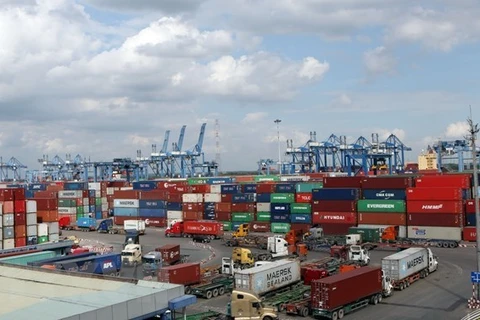
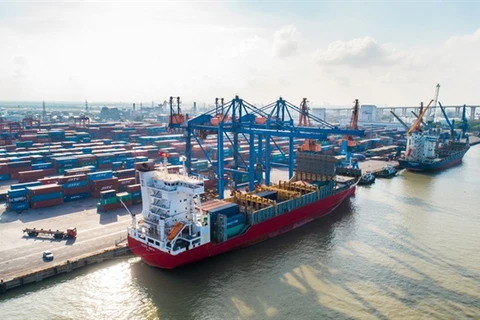
Cat Lai Port in HCM City. Small and medium-sized logistics enterprises need to embrace digital transformation to enhance their global competitiveness post-pandemic, an online conference on the logistics industry heard recently. (Photo: VNA)
 HCM City (VNS/VNA) - Vietnamese logistics firms, especially small and medium-sized ones, need to get up to speed on digital transformation to enhance their competitiveness if they want to enter global markets after the pandemic ends, experts have said.
Nguyen Ngoc Dung, Vice Chairman of the Vietnam E-commerce Association, said it is high time that SMEs realised the advantages of and the urgent need for digital transformation, pointing out that most of them have remained slow in embracing it.
“Successful digital transformation will bring many benefits to businesses such as reducing costs and enabling them to access all markets.”
A shipper in Vietnam delivers two parcels a day on average since it takes time to locate addresses and wait for recipients to collect the order, whereas a shipper in a developed market could deliver 200 a day with map data to optimise routes, he said.
“High logistics costs not only affect the competitiveness of goods, but also pose an obstacle for businesses when entering new markets.”
He was speaking at a seminar on “Logistics industry before the turning point of digital transformation” last week.
Nguyen Tuong, Deputy General Secretary of the Vietnam Logistics Business Association, said the COVID-19 pandemic has affected global investment and trade, and supply chains have been disrupted.
Enterprises, especially logistics firms, must apply hi-tech solutions to reduce costs, he added.
Tuong listed three challenges that prevent logistics companies from adopting digital transformation: financial capacity, human resources and identifying suitable technologies.
There are only a few international standard software offerings in Vietnam, making it difficult for firms to identify optimal ones, he said.
Besides, logistics companies’ managements are not confident about data and payment security when implementing digital transformation, he said.
“Both executives and staff remain hesitant about changing their habits for the digital environment. Thus, we need to change the perceptions held by logistics companies.”
According to the Vietnam Logistics Business Association, not many logistics firms adopt integrated solutions in their logistics and supply chains.
Around 40 percent of software applications remain very basic such as international forwarding management, warehouse management, transport management, electronic data exchange, and customs declaration, he added.
Tuong said the Government should prioritise development of infrastructure and logistics service centres, and offer income and other tax breaks.
Policies are needed to ease business conditions, simplify inspection procedures and mobilise resources for investment in logistics, especially regional and international logistics centres, he added.
Ngo Khac Le, a lawyer and arbitrator at the Vietnam International Arbitration Centre and an expert in logistics and transport, said SMEs can learn from the experience of large logistics enterprises that have applied digital transformation at a rather high level.
Experts said to capitalise on the EU-Vietnam Free Trade Agreement, Vietnamese firms need to meet three main criteria: product origin, quality and digital capability.
EU businesses are 10-15 years ahead of their Vietnamese counterparts in terms of digital capacity, and so the latter must strive to achieve comparable levels to be able do business with them, they said.
Thus, digital transformation is an inevitable process and Vietnam would be left behind if it does not do it, they warned.
Enterprises should start to get acquainted with e-contracts, pay digital taxes and digitise all business activities, they said.
Digital transformation refers to creating a new operating method based on digital technologies like IoT, cloud, big data, AI, and blockchain to create new production and business models.
Vietnam’s logistics costs are 6 percent higher than Thailand’s, 7 percent higher than China’s and 12 percent higher than Malaysia’s.
The high costs have hampered the competitiveness of Vietnamese goods, according to experts.
According to a recent report by the World Bank, logistics costs are equivalent to 20 percent of Vietnam’s GDP, while in other countries it is 9-14 percent.
Economists said in the context of the prolonged epidemic, the use of digital transformation for market access and penetration is even more vital.
If Vietnam wants to improve the quality of logistics services it needs to have a clear roadmap./.
Nguyen Ngoc Dung, Vice Chairman of the Vietnam E-commerce Association, said it is high time that SMEs realised the advantages of and the urgent need for digital transformation, pointing out that most of them have remained slow in embracing it.
“Successful digital transformation will bring many benefits to businesses such as reducing costs and enabling them to access all markets.”
A shipper in Vietnam delivers two parcels a day on average since it takes time to locate addresses and wait for recipients to collect the order, whereas a shipper in a developed market could deliver 200 a day with map data to optimise routes, he said.
“High logistics costs not only affect the competitiveness of goods, but also pose an obstacle for businesses when entering new markets.”
He was speaking at a seminar on “Logistics industry before the turning point of digital transformation” last week.
Nguyen Tuong, Deputy General Secretary of the Vietnam Logistics Business Association, said the COVID-19 pandemic has affected global investment and trade, and supply chains have been disrupted.
Enterprises, especially logistics firms, must apply hi-tech solutions to reduce costs, he added.
Tuong listed three challenges that prevent logistics companies from adopting digital transformation: financial capacity, human resources and identifying suitable technologies.
There are only a few international standard software offerings in Vietnam, making it difficult for firms to identify optimal ones, he said.
Besides, logistics companies’ managements are not confident about data and payment security when implementing digital transformation, he said.
“Both executives and staff remain hesitant about changing their habits for the digital environment. Thus, we need to change the perceptions held by logistics companies.”
According to the Vietnam Logistics Business Association, not many logistics firms adopt integrated solutions in their logistics and supply chains.
Around 40 percent of software applications remain very basic such as international forwarding management, warehouse management, transport management, electronic data exchange, and customs declaration, he added.
Tuong said the Government should prioritise development of infrastructure and logistics service centres, and offer income and other tax breaks.
Policies are needed to ease business conditions, simplify inspection procedures and mobilise resources for investment in logistics, especially regional and international logistics centres, he added.
Ngo Khac Le, a lawyer and arbitrator at the Vietnam International Arbitration Centre and an expert in logistics and transport, said SMEs can learn from the experience of large logistics enterprises that have applied digital transformation at a rather high level.
Experts said to capitalise on the EU-Vietnam Free Trade Agreement, Vietnamese firms need to meet three main criteria: product origin, quality and digital capability.
EU businesses are 10-15 years ahead of their Vietnamese counterparts in terms of digital capacity, and so the latter must strive to achieve comparable levels to be able do business with them, they said.
Thus, digital transformation is an inevitable process and Vietnam would be left behind if it does not do it, they warned.
Enterprises should start to get acquainted with e-contracts, pay digital taxes and digitise all business activities, they said.
Digital transformation refers to creating a new operating method based on digital technologies like IoT, cloud, big data, AI, and blockchain to create new production and business models.
Vietnam’s logistics costs are 6 percent higher than Thailand’s, 7 percent higher than China’s and 12 percent higher than Malaysia’s.
The high costs have hampered the competitiveness of Vietnamese goods, according to experts.
According to a recent report by the World Bank, logistics costs are equivalent to 20 percent of Vietnam’s GDP, while in other countries it is 9-14 percent.
Economists said in the context of the prolonged epidemic, the use of digital transformation for market access and penetration is even more vital.
If Vietnam wants to improve the quality of logistics services it needs to have a clear roadmap./.
VNA