Ministry rolls out measures to speed up public investment disbursement

The Ministry of Transport (MOT) is prioritising the rapid disbursement of public investment funds, setting its sights on ensuring the full utilisation of allocated budgets for 2024.

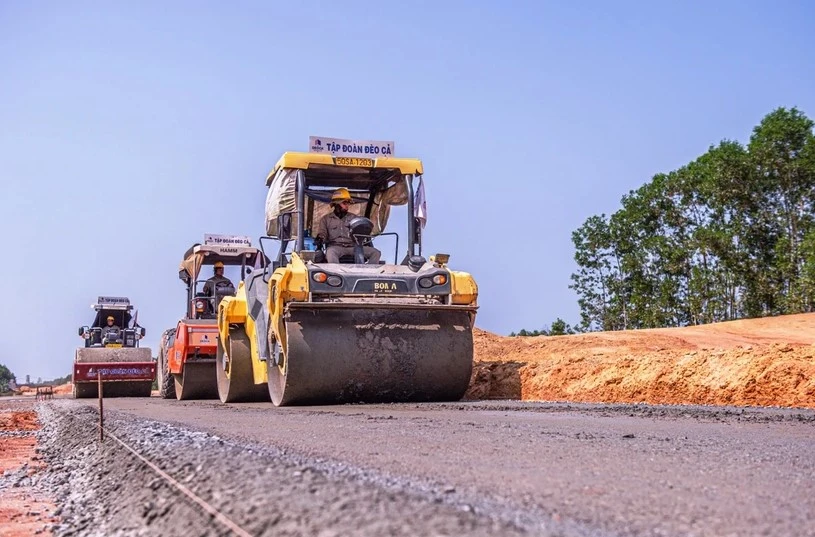
Constructing roadbed items at a North-South expressway project in the 2021-2025 period (Photo: VietnamPlus)

Hanoi (VNA) - The Ministry of Transport (MOT) is prioritising the rapid disbursement of public investment funds, setting its sights on ensuring the full utilisation of allocated budgets for 2024.

With a total investment plan of over 75.5 trillion VND (2.97 billion USD), the ministry has outlined a comprehensive strategy to speed up the progress of key transport projects, particularly roads and expressways.

A significant portion of the disbursed funds is focused on key expressway projects. One such project, the Quang Ngai-Hoai Nhon expressway, has made notable progress. After 22 months of construction, the project has completed over 45% of its work, with the pace of construction increasing daily.

To date, the project has disbursed nearly 6.2 trillion VND of its total construction budget of 13.4 trillion VND. For 2024 alone, the project was allocated 4 trillion VND, with 2.7 trillion VND, or 66%, already disbursed.

Similarly, the Ham Nghi-Vung Ang expressway project is also on a right track. With a targeted completion date of April 30, 2025, contractors are ramping up efforts by mobilising additional machinery and workers to accelerate the pace of construction.

The project now boasts an average of 15 billion VND worth of work daily, and more than 100 billion VND per week. The Thang Long Project Management Unit, overseeing the Ham Nghi-Vung Ang and Bai Vọt-Ham Nghi expressways, reported the approval of additional funding, with a 977 billion VND top-up for Ham Nghi-Vung Ang and 800 billion VND for Bai Vot-Ham Nghi. By the end of October 2024, disbursements for the unit’s projects had exceeded 3.7 trillion VND, or 56% of the allocated budget.

Meanwhile, the Van Phong-Nha Trang expressway, another priority project, is also on track to complete before the April 2025 deadline, with 76% of the contract value already realised. The project has deployed 1,300 workers and 800 pieces of machinery, ensuring that progress is maintained.

Screenshot 2024-12-02 135943.jpg
Construction of bridge girder items at Can Tho-Ca Mau expressway project (Photo: VNA)

While projects in the northern and central regions have shown rapid progress, those in the South have encountered some hurdles. The Can Tho-Ca Mau expressway, for instance, is behind schedule, having completed only 46% of its target, 11% short of its planned rate. The delay is largely due to a shortage of sand, as local sand mines do not provide enough to meet demand. The project requires 76,000 cubic metres of sand per day, yet only 50,000 cubic metres are being produced. To resolve this, the Project Management Unit has been working with local authorities in five southern provinces to secure the necessary materials, aiming to meet its deadlines of load testing by December 2024 and project completion by December 2025.

As of September 2024, the MoT had been allocated 71.3 trillion VND of its investment plan, and additional 1.24 trillion VND sourced from the Government’s increased budget revenue for 2022. By the end of October, the ministry had disbursed 47.75 trillion VND, or 63% of the total target. Most of these funds have gone to the National Expressway Project Phase 1 (2021-2025), with nearly 26.5 trillion VND.

Screenshot 2024-12-02 140024.jpg
Transport projects are being sped up by contractors to achieve high volume and disbursement value (Photo: VietnamPlus)

To ensure full disbursement by the end of the year, the ministry has made it a priority to tie the performance of project managers and contractors to the completion of disbursement goals. It is closely reviewing disbursement plans for each project, ensuring that each project’s management unit is held accountable. Additionally, they are making use of favourable weather conditions, coordinating with local authorities for land clearance and resettlement, and increase workforce to ensure that all processes are in place for prompt payment and project completion.

By adjusting funds and ensuring strict quality control, the ministry aims not only to meet financial targets but also to uphold safety standards and maintain environmental integrity during construction./.
VNA

See more

Toy production at a Hong Kong-invested factory (Photo: VNA)

Vietnam targets deeper market penetration in Hong Kong in 2026

Vietnam-Hong Kong trade hit 62.3 billion USD in the first 11 months of 2025, soaring 73.1% annually. Vietnamese exports to Hong Kong amounted to 36.8 billion USD, a 90.6% hike, ranking fourth among Hong Kong’s import sources, while imports from Hong Kong stood at 25.5 billion USD, up 52.9% and ranking third.

Vietnam’s start-up market enters restructuring phase

Vietnam’s start-up market enters restructuring phase

In 2026, venture capital inflows into Vietnam’s start-up ecosystem are expected to recover gradually, though in a more selective manner. VinVentures forecasts that capital will focus on start-ups that have survived the rigorous screening of 2024–2025, possess clear business models, strong commercialisation capacity, and the ability to generate real cash flows.

Workers process tra (pangasius) for export (Photo: VNA)

Vietnam–Singapore trade continues to thrive

For the year as a whole, Vietnam retained its position as Singapore’s 10th largest trading partner. Bilateral trade reached a record high of nearly 40 billion SGD, up 26.2% from the previous peak of 31.67 billion SGD recorded in 2024.

Eric Van Vaerenbergh, an energy expert and lecturer at the Brussels Engineering School (ECAM) (Photo: VNA)

Belgian expert optimistic about Vietnam’s economic outlook

Vietnam should move from a growth model based mainly on expanding capital and labour to one driven by productivity improvements. He said that this requires enhancing the quality of the workforce, particularly engineers, technicians, and managers in industrial sectors.

Workers at the VSIP Hai Phong industrial and urban complex, which specialises in producing electronic components for office equipment. (Photo: VNA)

Roadmap aims to improve business climate and boost competitiveness

By the end of 2026, Vietnam aims to rank among the world’s top 50 performers in the United Nations Sustainable Development Goals, advance at least three places in the International Property Rights Index, and climb at least one position in the Global Innovation Index.

Vietnam is strengthening its position in the technology value chain, becoming a major manufacturing hub for complete consumer electronics products. (Photo: VNA)

ESG standards offer opportunities to reposition Vietnam’s electronics firms

The 2025-2027 period will be a critical turning point, as exporters to the European market will be required to strictly comply with ESG standards, including net-zero emissions roadmaps, labour standards, corporate governance and transparency requirements. As a key export sector, the electronics industry is being directly and strongly affected by this shift.

A production line for camera modules and electronic components at the factory of MCNEX VINA Co. Ltd, a Republic of Korean-invested company in Phuc Son Industrial Park, Ninh Binh province. (Photo: VNA)

Science, technology, innovation as engines of economic growth

To ensure that science and technology truly act as a powerful growth engine, experts emphasised the need for the Government to put in place supportive mechanisms and policies that encourage enterprises to invest in research and development, while strengthening cooperation among the State, research institutions and the business sector.