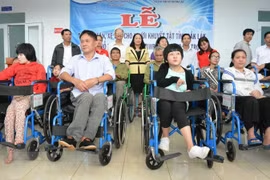
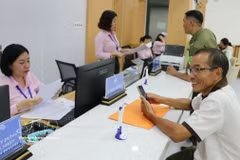
People with disabilities attend a job training class at a vocational school in the central province of Thanh Hoa. (Photo: VNA)
As Vietnam is set to conduct its second national survey on people withdisabilities, it is important to collect data on the full spectrum of peoplewith disabilities in Vietnam, so as to develop appropriate actions andpolicies.
Representatives of the United Nations Development Programme (UNDP) Vietnam, VietnamFederation on Disability and the General Statistics Office (GSO) held aconsultation workshop regarding the issue on October 6.
Speaking at the workshop, Patrick Haverman, Deputy Resident Representative ofUNDP in Vietnam, said that according to the latest UN analysis, out of the 158sustainable development indicators of Vietnam (VSDGs), only eight require dataregarding those with disabilities.
Among these eight indicators, only two (the number of beneficiaries of monthlysocial allowance in the community, and number of people living and being caredfor in social protection facilities or social housing) are collected by boththe General Statistics Office and the National Council on Disability (NCD)through statistical surveys and reporting.
Data of half of the eight indicators to assess the level of disabilityinclusion in different areas of VSDG are not collected by NCD, such as theproportion of the population satisfied with their most recent experience ofpublic services.
”It is difficult to find disability data; and when found, it is unclear whichsource should be cited due to the inconsistency of data reported by differentGovernment agencies,” he said.
“It is important to make PwDs more visible in our national database and to havemore indicators disaggregated by disabilities in VSDGs, which helps us betterunderstand PWDs’ vulnerability and needs,” he said.
“UNDP is supporting the development of a set of output indicators for theNational Survey on Persons with Disabilities in 2023 to be comprehensive andalign with international standards,” Haverman said.
Dang Van Thanh, vice president of Vietnam Federation on Disability, said therewere about 6.2 million people with disabilities in Vietnam including more than700,000 children.
He said that the number of people with disabilities in Vietnam released bydifferent agencies was different from each other.
This crucial information was a foundation to design and develop activities andpolicies, for example, social welfare, education or healthcare, he said.
“The more exact the input information is, the better the outputs are,” he said.
Deputy head of the GSO Le Trung Hieu said that Vietnam was preparing for thesecond national survey on people with disabilities next year.
The first National Survey on PwDs was done in 2016, using an internationallystandardised toolkit for measuring disability. That survey was part of theNational Statistical Survey Programme.
"Through that survey, for the first time, we had an overview of thedisability rate in the general population nationwide, types and degrees ofdisability, as well as PWDs’ living conditions and the level of PWDs’integration in a number of areas such as healthcare, social protection,education, employment, and a comparison of disability rates betweensocio-economic regions," said Hieu.
Until now, there have been many reports by State agencies, organisations andfor persons with disabilities, and disability experts still using datapublished in this survey.
After six years, the 2016 National Survey on Persons with Disabilities (VDS2016) no longer accurately reflects the current situation of PWDs in Vietnam, Hieusaid.
“The data needs to be updated and supplemented to better support the monitoringof disability-inclusive socio-economic development programmes and policies, andto better meet the law and policy-making requirements in line withinternational commitments, particularly the upcoming amendment of the Law onPersons with Disabilities, the monitoring of the implementation ofdisability-mainstreaming laws, policies, and the International Convention onthe Rights of Persons with Disabilities (CRPD),” he said.
The GSO has proposed a set of 53 indicators to be disaggregated bydisabilities, covering ten Sustainable Development Goals. The indicators can beused not only for the survey next year, but also serve the disability datadisaggregation in other national statistical surveys, contributing evidence tothe development of disability-inclusive socio-economic policies and programmes.
Nguyen Dinh Trung, a GSO official, said that in Vietnam, according to thenational population census 2009, people with disabilities made up 7.98% of thecountry’s population aged from five.
According to VDS 2016, people with disabilities made up 7.06% of the country’spopulation aged from two years old. It is estimated that now, there are aboutseven million people with disabilities in Vietnam.
“Data about people with disabilities in Vietnam still fails to meet increasingdemands of data users, especially in policy making, monitoring and assessingthe implementation of relevant laws as well as the implementations ofinternational commitments that Vietnam has made,” Trung said,
He said that GSO was developing plans to conduct the second national survey onpeople with disabilities in September and October next year, collectingresponses of 75,000 households nationwide.
In addition, questionairs would also be offered to social sponsor centres whichtake care and offer services for people with disabilities. The survey will alsocollect information from commune/ward people’s committees, ministries,agencies, schools and grassroot healthcare centres.
Vu Thi Kim Hoa, deputy director general of Child Affair Department under theMinistry of Labour, Invalid and Social Affairs, suggested that it was necessaryto collect information about children with disabilities, which would help tobetter ensure child rights and address child-related issues./.
VNA