Muong Hoa, Vietnam’s longest mountain rail route developed by Sun Group, opens on March 31 (Photo: reatimes.vn)
 Lao Cai (VNA) – Muong Hoa, Vietnam’s longest mountain rail route developed by Sun Group, was opened on March 31, connecting Sa Pa Town and the existing cable station to Fansipan Peak.
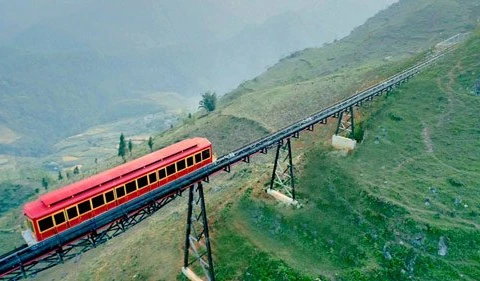
The 2km rail route starts from MGallery Hotel in Sa Pa Town and ends at the cable station to Fansipan Peak, promising a spectacular journey for tourists.
The two-carriage train can travel at a maximum speed of 10m per second and serve up to 2,000 guests per hour.
 The Muong Hoa rail route starts from MGallery Hotel in Sa Pa Town and ends at the cable station to Fansipan Peak. (Photo: VNA)
It will shorten tourists’ travel time from 20 minutes by car over risky mountainous roads to four minutes by train through valleys, viaducts and tunnels offering beautiful views of surrounding villages as well as nature.
The two carriages were designed and produced by Swiss company Garaventa. Each carriage is 20m in length and 3m wide, weighs 25 tonnes and can carry 200 passengers at once.
The carriage has classic European interiors with antique lights, ceiling fans and huge glass windows.
The 2km rail route starts from MGallery Hotel in Sa Pa Town and ends at the cable station to Fansipan Peak, promising a spectacular journey for tourists.
The two-carriage train can travel at a maximum speed of 10m per second and serve up to 2,000 guests per hour.
 The Muong Hoa rail route starts from MGallery Hotel in Sa Pa Town and ends at the cable station to Fansipan Peak. (Photo: VNA)
 It will shorten tourists’ travel time from 20 minutes by car over risky mountainous roads to four minutes by train through valleys, viaducts and tunnels offering beautiful views of surrounding villages as well as nature.
The two carriages were designed and produced by Swiss company Garaventa. Each carriage is 20m in length and 3m wide, weighs 25 tonnes and can carry 200 passengers at once.
The carriage has classic European interiors with antique lights, ceiling fans and huge glass windows.
 Inside the train on Muong Hoa rail route. (Photo: VNA)
 At the Muong Hoa Cable Station, tourists will continue to take the cable route over Hoang Lien Son range to reach Fansipan Peak, the top of Indochina, at a height of 3,143m.
The new rail route and the world’s most modern three-rope cable car system, Fansipan Sapa, measuring 6,292.5m in length - which was opened to the public on February 2, 2016 - will complete service at the Sun World Fansipan Legend tourism complex.
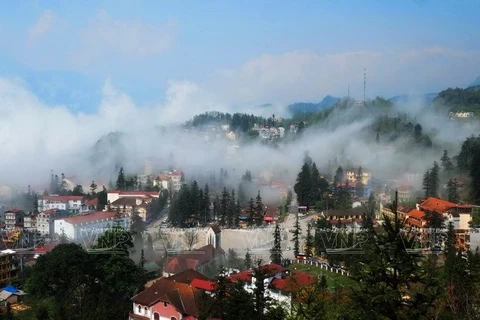
Located 350km northwest of Hanoi, Sa Pa town in the northern mountainous province of Lao Cai is 1,600m above sea level. The town is dominated by the Hoang Lien Son mountain range which features Indochina’s highest mountain of Fansipan at 3,142 m above sea level.
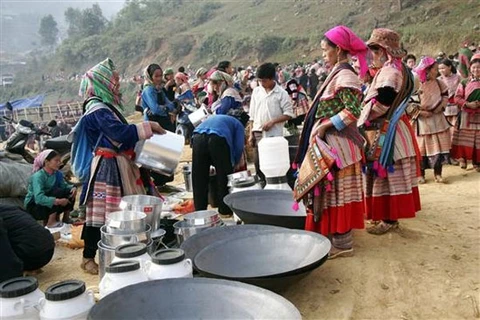
Sa Pa has many natural scenic sites such as Ham Rong Mountain, Thac Bac (Silver Waterfall), Cau May (Rattan Bridge), Bamboo Forest and Ta Phin Cave. The hill town is home to six main ethnic minority groups, including Kinh, Hmong, Dao, Tay, Day and Xa Pho with various traditional festivals and unique cultural practices, especially the Bac Ha market and Sa Pa love market.
The resort town was recognised as a national tourism site in December 2017. - VNA
VNA